
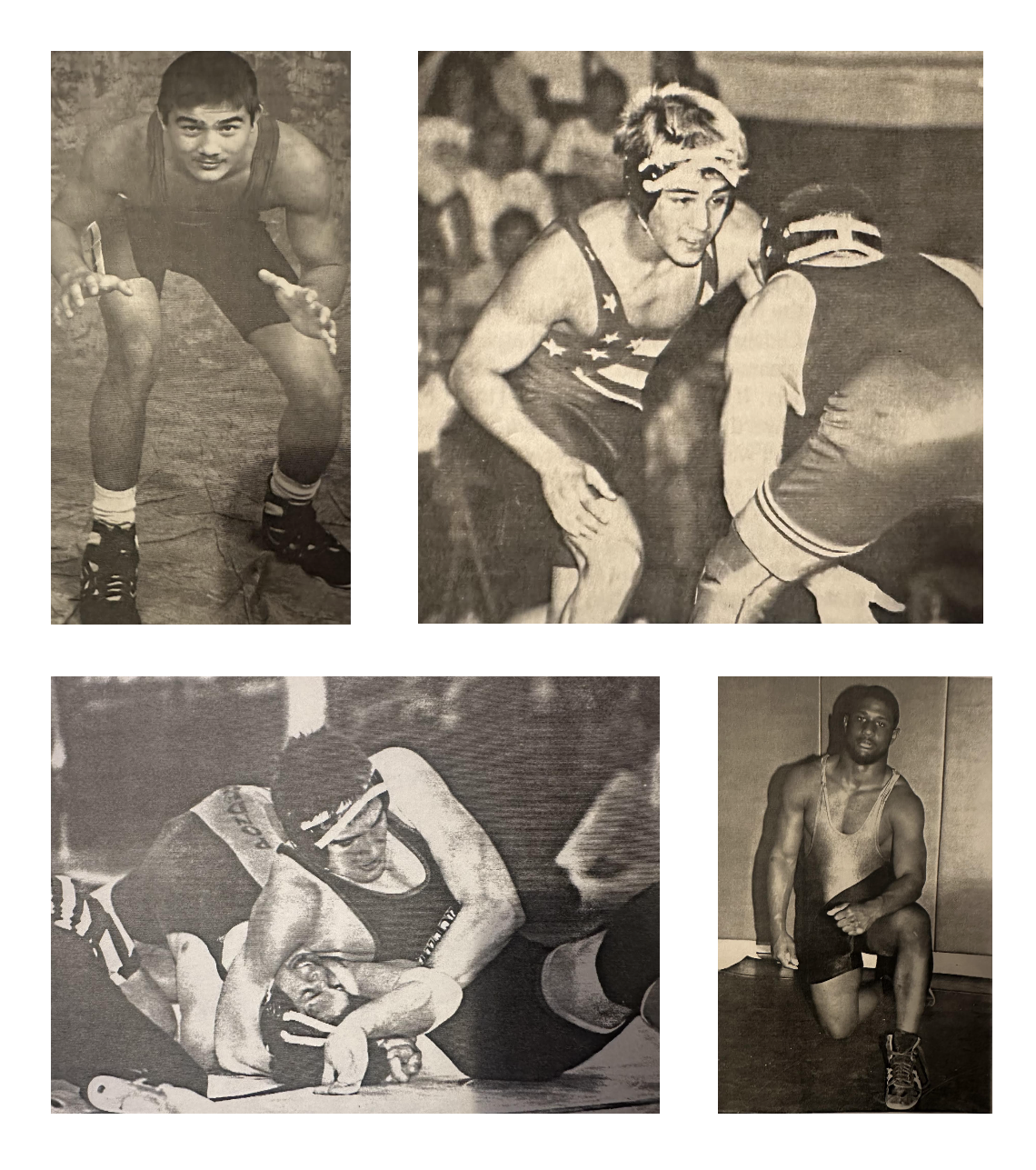

California’s 1995 high school wrestling season produced a remarkable collection of national champions, NCAA All-Americans, collegiate national champions, and three future Olympians.
The 1995 CIF State Wrestling Championships represented far more than another year of outstanding competition on the California high school wrestling calendar. Looking back 31 years, the tournament stands as a remarkable snapshot of one of the state’s most talented generations of wrestlers. Among those who competed that season were future NCAA champions, multiple collegiate All-Americans, high school national champions, and three athletes who would eventually represent the United States at the Olympic Games. From the championship teams at Independence and Calvary Chapel to individual standouts emerging from James Logan, Bakersfield, Vallejo, and throughout the state, California was producing an extraordinary level of wrestling talent.
Held at the Spanos Center on the campus of the University of the Pacific in Stockton, the 1995 championships were directed by Chuck Chandler and featured 13 weight divisions, 32-man brackets, and a true third-place consolation format. With 416 state qualifiers competing for 104 medals, the tournament brought together the best wrestlers from California’s 10 CIF sections. At the time, California had approximately 604 high school wrestling programs and 20,105 participants, according to the National Federation of State High School Associations (NFHS). Of those programs, 228 schools were represented at the state championships, illustrating the depth of competition required to earn a place among the state’s elite.
The CIF State Championships have long been considered among the most prestigious high school state tournaments in the country, and the qualification process was a significant part of what made earning a place in Stockton so meaningful. In most sections, wrestlers had to navigate three separate qualifying stages: league competition, CIF or sub-section competition, and the Masters tournament. However, the qualification structure varied across the state. Several sections, including the Los Angeles, Oakland, and San Francisco City Leagues, as well as the North Coast Section, utilized fewer qualifying tournaments, with some requiring only one or two levels of competition before advancing wrestlers to the state championships. Regardless of the qualifying format, securing a place among California’s 416 state participants was a significant accomplishment.
Qualifying for state was an accomplishment in itself, but the challenge was far from over once wrestlers arrived in Stockton. Every match represented another physical and mental test, demanding the conditioning, composure, and determination necessary to navigate a difficult bracket. The tournament was unforgiving. A state medalist from the previous season was not guaranteed another podium finish, and even returning champions could find themselves facing an entirely different outcome.

Upland’s Demetris Huff provided a particularly compelling example in 1995. Entering the tournament ranked No. 5 in the state and returning as the defending state champion at 171 pounds, Huff was among the established favorites. However, his championship defense did not go as planned. He finished 2-2 in the state bracket, losing in the second round to eventual state champion Larry Silva of Grace Davis and ultimately failing to earn another state medal. Yet Huff’s season was far from over. Rather than allowing the disappointment to define his year, he rebounded just a few weeks later with a third-place finish at the NHSCA Senior Nationals, earning national All-American honors. He subsequently continued his career at Lassen Community College, where he earned two NJCAA All-American honors. His experience illustrates both the unforgiving nature of the California state tournament and the resilience required to succeed at the highest levels of the sport.
The team race produced an especially memorable outcome. Independence High School of the Central Coast Section captured its first CIF state team championship with 112.5 points, becoming only the 15th school in California history to win a state title. Remarkably, as of 2026, only 18 schools have accomplished that distinction, placing Independence’s 1995 championship among a very exclusive group of programs. Led by two individual champions, two finalists, five medalists, and two additional wrestlers reaching the round of 12, Independence edged Southern Section powerhouse Calvary Chapel, which finished second with 106.5 points. Calvary Chapel also crowned two individual champions and produced four medalists, making the team race a close contest between two programs featuring some of the nation’s premier high school talent.

Bakersfield finished third with 98.5 points, an impressive performance built around six state medalists. James Logan placed fourth with 76 points, led by one champion, two finalists, and four medalists. Watsonville followed in fifth with 70.5 points, while Poway, Oak Grove, Hughson, Rancho Buena Vista, and Clovis West rounded out the top 10. Hughson’s eighth-place finish was particularly noteworthy, as the Sac-Joaquin Section program crowned an individual state champion while producing two additional medalists. The team results reflected the geographical diversity of California wrestling, with championship-caliber programs emerging from nearly every major wrestling region.
However, the traditionally strong Tri-River Athletic Conference (TRAC) did not enjoy its usual success on the state stage. Clovis, one of California’s premier wrestling programs, failed to produce a state medalist, although two Clovis wrestlers came within one victory of reaching the podium before falling in the blood rounds. Clovis West fared better, producing two state medalists, while Central added one. The results represented an unusual departure from the level of postseason success traditionally associated with the Clovis-area programs.

The individual championship picture was equally compelling. The Southern Section led all sections with five individual champions, accounting for 38.5% of the 13 titles. The Sac-Joaquin Section followed with four champions, while the Central Coast and North Coast Sections each produced two. Four of California’s 10 sections were represented among the state champions, an indication of the concentration of championship-level talent among the state’s leading wrestling regions. Seven of the 13 state champions entered the tournament ranked No. 1 in their respective weight classes. However, the tournament also demonstrated that rankings were not guarantees. Mark Munoz of Vallejo, ranked eighth in the state, was the lowest-ranked wrestler to capture an individual championship, providing another example of the unpredictable nature of postseason competition.

The 1995 championships also offer an interesting opportunity to examine the relationship between preseason rankings and actual state tournament performance. During this era, California’s individual rankings were compiled by Bill Grant and Al Fontes of the California Wrestler Newsletter. Unlike today’s expanded ranking systems, only the top 12 wrestlers in each weight class were recognized. For historical analysis, those rankings can be separated into three tiers: Tier 1, wrestlers ranked No. 1 through No. 8; Tier 2, those ranked No. 9 through No. 12; and Tier 3, wrestlers outside the top 12 or not ranked.
Of the 104 state medalists, 76 were ranked among the top eight entering the tournament, representing 73.1% of all medalists. Another 14 were ranked between ninth and 12th, while 14 were not ranked in the top 12. In total, 90 medalists, or 86.5%, were represented in the statewide rankings. The remaining 14 medalists, or 13.5%, came from outside that recognized group. These numbers reinforce the strength of the rankings while also demonstrating that the state tournament provided opportunities for less-heralded wrestlers to establish themselves against California’s best competition.

The road to a state medal was extraordinarily demanding. Of the 228 schools represented at the championships, only 74 produced at least one medalist. That represented 32.5% of the schools competing at state and just 12.3% of California’s 604 wrestling programs. The round of 12, often referred to as the blood round, included representatives from 44 schools, while only 22 schools advanced a wrestler into the state finals. In other words, fewer than four percent of California’s high school wrestling programs produced a state finalist that season. Those figures provide important perspective when evaluating the accomplishments of the athletes who reached the podium.

The Southern Section led the state with 33 medalists, followed by the Sac-Joaquin Section with 21 and the Central Section with 18. The Central Coast Section contributed 14, while the North Coast and San Diego Sections each produced seven medalists. The Northern Section added three, followed by Los Angeles City with one. Neither Oakland nor San Francisco produced a state medalist. These section totals account for all 104 medals awarded. The Southern Section also led in the number of schools producing medalists, with 25, followed by Sac-Joaquin with 16 and Central with 12. These numbers illustrate the considerable depth of the Southern and Central California wrestling communities while highlighting the competitive strength of the Sac-Joaquin and Central Coast regions.
What makes the 1995 season especially significant, however, is what happened after these wrestlers completed their high school careers. A substantial number of the athletes competing in Stockton would go on to distinguish themselves at the nation’s most prestigious high school and collegiate competitions. Their accomplishments extended well beyond California, establishing a legacy that included national championships, NCAA titles, collegiate All-American honors, and Olympic medals.

At the senior level, the National High School Coaches Association (NHSCA) Senior Nationals provided another opportunity for California’s graduating wrestlers to measure themselves against the nation’s best. Eight California seniors earned All-American honors at the 1995 competition, including two national champions. Independence’s Eric Guerrero captured the 125-pound national championship and was named the tournament’s Outstanding Wrestler. His performance provided further evidence of the exceptional talent emerging from Independence and the Central Coast Section. Jason Webster of Centennial also claimed a national championship at 152 pounds, while Calvary Chapel’s Ed Mosley finished third at the same weight. Other California All-Americans included Michael Kawamura of Rosemead, who placed second at 112 pounds; Ruben De Leon of Chaffey, fifth at 112; Josh Holiday of Calvary Chapel, seventh at 145; Demetris Huff of Upland, third at 171; and Bryan Yeager of Oak Grove, fifth at 275.
Huff’s third-place NHSCA finish was particularly noteworthy considering his earlier disappointment at the CIF State Championships. After entering Stockton as the defending state champion and leaving without a medal, he demonstrated the ability to regroup and compete at an elite national level. His performance at Senior Nationals reinforced that one difficult tournament does not define an athlete’s potential or the trajectory of a wrestling career. Huff would go on to earn two NJCAA All-American honors at Lassen Community College.
The accomplishments of this group were not limited to NHSCA Nationals. Six California wrestlers also earned Amateur Wrestling News All-American recognition: Ruben De Leon, Michael Kawamura, Eric Guerrero, Josh Holiday, Ed Mosley, and Jason Webster. Their inclusion on the national honor roll further demonstrated the caliber of the graduating class and the strength of California’s wrestling programs during this period.
The ASICS High School All-American selections offered another perspective on the state’s depth. Eric Guerrero earned First Team recognition at 135 pounds, while Ruben De Leon and James Logan’s Stephen Abas received Second Team honors at 103 and 112 pounds, respectively. Kawamura was also a Second Team selection at 119, while Mosley earned Third Team recognition at 160. Honorable Mention selections included Independence’s Tony Gomez, Hiram Johnson’s Adam Tirapelle, Calvary Chapel’s Josh Holiday, and Vallejo’s Mark Munoz. Wrestling USA Magazine also recognized Guerrero, Mosley, Holiday, and Kawamura as All-Americans, with Guerrero earning a place on its prestigious Dream Team.
The significance of these honors becomes even more apparent when examining the collegiate careers that followed. Several athletes who competed during the 1995 season went on to become household names within the collegiate wrestling community. Their success at the NCAA, NJCAA, and NAIA levels represents one of the strongest indicators of the talent California was producing during this era.
Eric Guerrero’s career stands prominently among the accomplishments of this generation. After leading Independence to a state team championship and capturing a national senior title, Guerrero continued his career at Oklahoma State University, where he became a three-time NCAA Division I champion and four-time NCAA All-American. His collegiate achievements placed him among the most accomplished wrestlers in Oklahoma State history and helped establish his reputation as one of the premier wrestlers of his generation. Guerrero’s success ultimately extended to the international stage, where he represented the United States on the 2004 Olympic freestyle team in Athens.
Another standout from the 1995 season was James Logan’s Stephen Abas. Recognized as an ASICS All-American while competing for one of Northern California’s most successful programs, Abas continued his career at Fresno State and developed into one of the most accomplished wrestlers in NCAA history. He captured three NCAA Division I national championships and earned four All-American honors. His collegiate success culminated at the 2004 Athens Olympic Games, where he captured the silver medal in freestyle wrestling. Abas’ accomplishments were especially meaningful for California wrestling, as he became one of the most recognizable representatives of the state’s high school and collegiate wrestling traditions.
Jamill Kelly of Atwater also followed an extraordinary path. After competing in California, Kelly continued his wrestling career at Lassen Community College, where he earned NJCAA All-American honors. His development at the junior college level, followed by his time at Oklahoma State, helped prepare him for the international stage. In 2004, Kelly represented the United States at the Athens Olympics and captured the silver medal in freestyle wrestling. His journey demonstrated the importance of California’s junior college system in developing athletes capable of competing at the highest international levels.
The collegiate success of this generation extended across multiple divisions and institutions. Ruben De Leon, who competed for Chaffey, became a two-time NCAA Division I All-American at CSU Bakersfield. His national high school recognition was an early indication of the talent that would carry over to the collegiate level. Adam Tirapelle, then a junior at Hiram Johnson during the 1995 season, continued his senior year at Buchanan in 1996 before moving on to Illinois, where he became an NCAA champion and three-time All-American. His accomplishments provided another example of the tremendous depth of talent emerging from Northern and Central California.
Mark Munoz of Vallejo, the eighth-ranked wrestler who captured a state championship in 1995, went on to become an NCAA champion and two-time All-American at Oklahoma State. His development from a state champion ranked outside the top seven to a national collegiate champion is an especially compelling example of the long-term potential that can emerge from California’s high school wrestling programs.
Other wrestlers from this era also made their mark at the collegiate level. Paul Gomez, who competed for North Monterey County, earned NJCAA All-American recognition at Lassen Community College before continuing his career at Nebraska, where he became an NCAA Division I All-American. Ryan Escobar of Ponderosa developed into an NAIA national champion and two-time All-American at Southern Oregon. Max Schurkamp of Escalon earned NCAA Division II All-American honors at San Francisco State, while Joey Martinez of Turlock became a two-time NAIA All-American at Menlo College. Ati Conner of Dos Pueblos also earned NCAA Division I All-American recognition at Nebraska, while Ed Mosley of Calvary Chapel continued his career at Harvard and became an NCAA Division I All-American.
Taken together, these accomplishments illustrate the remarkable range of opportunities and competitive pathways available to California’s elite high school wrestlers. Whether continuing at the NCAA Division I, Division II, NJCAA, or NAIA levels, the athletes from this generation demonstrated that California was producing talent capable of succeeding throughout the collegiate wrestling landscape.

Perhaps the most impressive distinction of the 1995 generation was its representation at the Olympic level. Three wrestlers associated with this era eventually represented the United States at the 2004 Summer Olympic Games in Athens, Greece. Stephen Abas of James Logan and Jamill Kelly of Atwater both captured silver medals in freestyle wrestling, while Eric Guerrero of Independence earned a place on the U.S. Olympic freestyle team. Having three athletes from this California wrestling generation reach the Olympic stage is an extraordinary achievement and speaks volumes about the quality of the state’s high school wrestling programs.

When viewed collectively, the 1995 CIF State Wrestling Championships represented much more than a tournament featuring 13 individual champions and a state team title for Independence. They reflected a generation that would leave a lasting mark on high school, collegiate, and international wrestling. The eight NHSCA Senior All-Americans, six Amateur Wrestling News All-Americans, nine ASICS All-American selections, and four Wrestling USA Magazine All-Americans highlighted the national recognition earned by California’s top high school talent. The subsequent collegiate accomplishments included multiple NCAA champions, numerous All-Americans, and success across several collegiate divisions. Three members of this broader group ultimately reached the Olympic stage, with two returning home from Athens with silver medals.
There is also something particularly noteworthy about the historical context. In 1995, California wrestling operated in a very different media environment. Statewide rankings were limited to 12 wrestlers per weight class, national exposure was considerably more difficult to obtain, and information about recruiting and collegiate opportunities was far less accessible than it is today. Yet the talent was unmistakable. Programs such as Independence, Calvary Chapel, James Logan, Bakersfield, and Vallejo were producing wrestlers who could compete with the best in the country, while schools throughout the state contributed to an exceptionally deep competitive landscape.
Now, 31 years after the 1995 season, the tournament remains an outstanding example of California’s ability to develop championship-level wrestlers. The state champions were impressive, the national high school recognition was substantial, and the collegiate accomplishments were extraordinary. But perhaps the most compelling measure of that season is the number of athletes who continued to elevate their performance long after their high school careers ended.
From the championship mats in Stockton in 1995 to NCAA championship finals and ultimately the Olympic podium in Athens in 2004, this generation of California wrestlers left a legacy that deserves recognition. It was, without question, one of the most accomplished collections of wrestling talent to emerge from the Golden State.
Photos courtesy of California wrestling archives and John Sachs, Tech-Fall.com
Follow me on X @Coach_Al_1984 | on Instagram @tier_one_idaho


Leave a Reply