
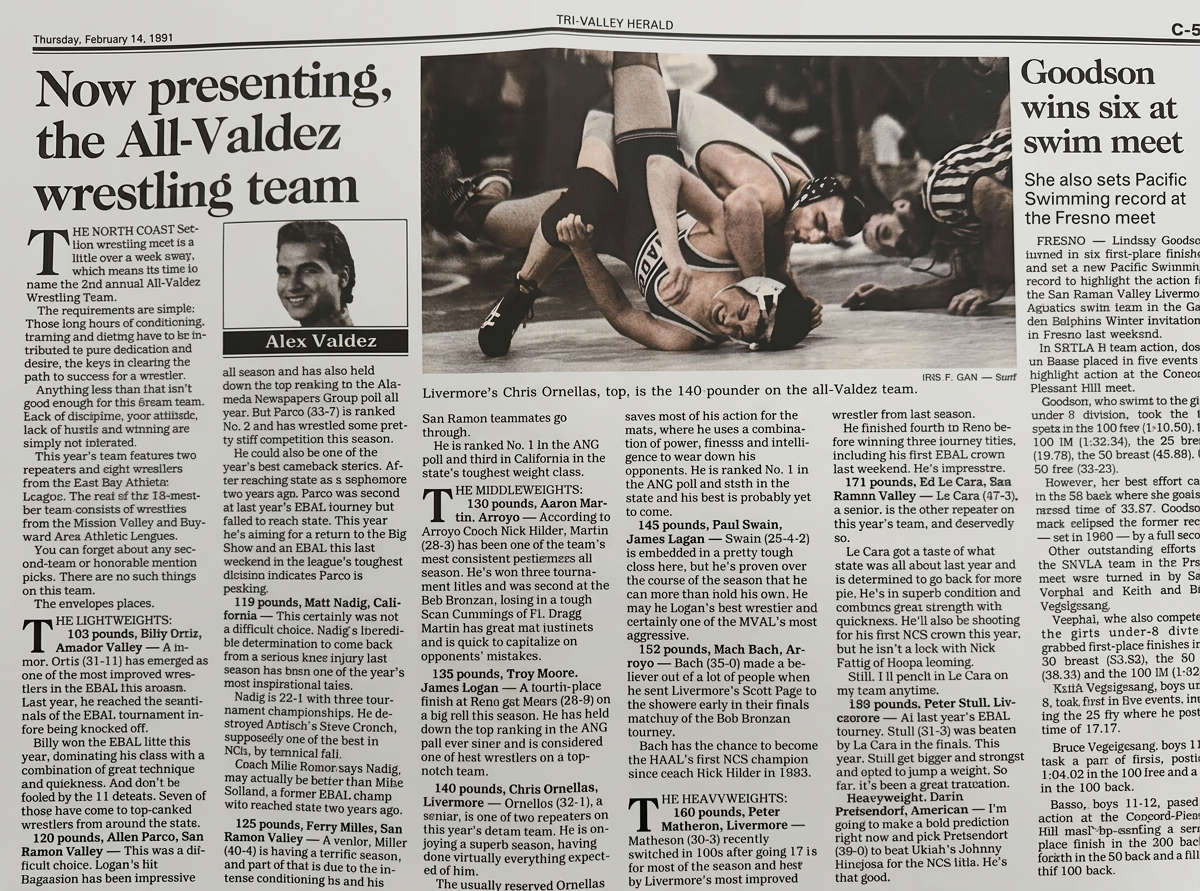

More than 40 years ago, prep sports coverage in the Tri-Valley and throughout the Bay Area operated in an entirely different world. Long before the World Wide Web, online publications, Instagram, Facebook, X, and today’s nonstop, minute-by-minute information cycle, local newspapers were the primary lifeline connecting communities to their high school athletic programs.
Information traveled differently. There were no instant updates, online rankings, social media posts, or endless streams of wrestling results from across the state and nation. For many of us, our understanding of the wrestling world was largely confined to our own communities and surrounding areas. We followed the athletes, teams, rivalries, and tournaments that received attention in our local newspapers. In many respects, we lived and followed the sport within a localized bubble, often having little awareness of the outstanding competitors, programs, and developments taking place just beyond our immediate geographical boundaries.
I can still remember the excitement of receiving my subscription to Amateur Wrestling News (AWN) in the late 1970s and early 1980s. Delivered to our home through the regular mail, each new issue was something my brother, Aaron, and I eagerly anticipated. We would literally race to the mailbox, hoping to be the first to retrieve the latest edition and start reading. At the time, AWN and a handful of other national wrestling publications represented our primary window into what was happening beyond the confines of our local media bubble. Those publications connected us to a much larger wrestling world, introducing us to nationally recognized athletes, prominent programs, major tournaments, and developments we otherwise might never have known about.
I also remember eagerly looking through the latest edition of the California Wrestlers Newsletter, founded and edited by legendary Hall of Fame coach and wrestling promoter Bill Grant. Beyond being an important source of information for California wrestling, that publication holds a special place in my personal history. Bill was the individual who gave me my start in the wrestling promotion world more than 30 years ago, opening a door that would ultimately influence much of my involvement in the sport as a writer, editor, promoter, and historian.
Looking back, what we lacked in the speed and volume of information available today was often made up for by the anticipation and appreciation we had for what we received. A new issue of AWN, the California Wrestlers Newsletter, or a feature in the local newspaper was something to look forward to. We read those publications from cover to cover, studied results, followed the careers of familiar competitors, and eagerly absorbed whatever information was available. Information was more limited, but its value was never diminished. In many respects, we appreciated what we had because we understood how difficult it could be to obtain.
That makes this era particularly significant when looking back at how prep sports, especially local wrestling, were covered, recognized, and promoted. Newspapers did far more than report scores and match results. They provided exposure, created excitement, documented rivalries, celebrated accomplishments, and helped establish the identity of local athletic programs. Within the limitations of the time, many newspapers and their sportswriters did an admirable job keeping their communities informed, engaged, and connected to their student-athletes.

WHEN WRESTLING DESERVED A FULL PAGE
One particularly memorable account comes from Don Baird, a Livermore High School wrestling alumnus from the early 1970s, who recalls just how extensive the local newspaper coverage could be during that era. Baird specifically remembers sportswriter Tim Hunt of the Livermore Herald & News, who provided remarkably detailed coverage of high school wrestling throughout the early and mid-1970s.
According to Baird, Hunt regularly devoted an entire page to wrestling statistics following every Tuesday and Friday dual meet. The coverage went well beyond match results, tracking individual performances and recognizing the athletes leading the East Bay Athletic League (EBAL) in categories such as takedowns, pins, and reversals. For local wrestlers, this level of attention provided an opportunity to follow the competition, measure their performances against their peers, and receive recognition that extended beyond the wrestling room.
Baird also remembers receiving an unexpected front-page feature in the newspaper’s sports section, although perhaps not for the reason most wrestlers would have hoped.
“I even had my picture on the front page of the sports section after almost getting pinned and losing to the great Steve Ventimiglio of Amador by an 18-1 score! Back then, there were no technical falls. The headline read, ‘Baird Almost Pinned,” Baird recalled.
His story captures both the depth of the newspaper coverage and the personality of the era. Even a lopsided loss could become a memorable newspaper feature, demonstrating how closely local sportswriters followed the athletes and rivalries within their communities. More than 50 years later, Baird still remembers the match, the opponent, the score, and the headline—a testament to the lasting impression that local newspaper coverage could make.
THE PEOPLE BEHIND THE COVERAGE
Among those who stood out was Alex Valdez, one of the area’s leading advocates and promoters of prep athletics. He understood the importance of local sports coverage and the role it played in recognizing young athletes, supporting coaches, and generating community interest. His efforts helped provide local wrestling and other prep sports with a meaningful platform during a time when newspaper exposure could make a tremendous difference.
Among Valdez’s most anticipated editorial features was his annual “All-Valdez” Wrestling Team, which highlighted the top high school wrestlers throughout the greater Bay Area. The feature provided well-deserved recognition to some of the region’s most accomplished competitors, bringing attention to athletes whose performances might otherwise have received limited exposure beyond their immediate communities. More than simply recognizing individual accomplishments, the annual selection helped establish a broader picture of the talent and competitive depth within Bay Area wrestling.
For the wrestlers selected, being named to the “All-Valdez” Wrestling Team represented an opportunity to be recognized among the region’s elite competitors and have their accomplishments preserved in print. Features like this were particularly meaningful during an era when recognition beyond one’s local newspaper was not easily accessible. It was another example of how dedicated sportswriters and newspaper advocates helped elevate prep wrestling and connect athletes across geographical boundaries.
Today, we can access results, rankings, photographs, interviews, and wrestling news from virtually anywhere with just a few clicks. Back then, a newspaper article, photograph, or tournament recap could be the primary connection between an athlete’s accomplishment and the community that celebrated it. A feature in the local paper carried considerable significance, and seeing your name or photograph in print was something athletes, families, and coaches genuinely appreciated.

It was a different era, with a different reach, but its impact should never be underestimated. Those newspapers, wrestling publications, and the people behind them helped preserve the stories, personalities, rivalries, and accomplishments that might otherwise have been forgotten.
Wrestling history wasn’t built solely on championship matches, individual accomplishments, and team titles. It was also built by the people who documented the sport, promoted its athletes, and connected communities through the written word. From the local newspaper sports pages to the pages of AWN and the California Wrestlers Newsletter, these publications helped us see beyond our own backyards and appreciate that we were part of something much bigger.
For those of us who experienced it firsthand, there was something special about waiting for the mail, opening a new wrestling publication, and discovering what was happening throughout the wrestling world. Those memories are part of our history, too, and they deserve to be remembered.
Before information was instant, access was limited, and the wrestling world seemed much larger than our own backyard, these publications brought the sport closer to home. Their legacy extends well beyond the printed page.
All newspaper, magazine, and newspaper images are from my personal archives in addition to the Tri-Valley Herald newspaper clipping provided by Don Baird.
Follow me on X @Coach_Al_1984 | on Instagram @tier_one_idaho


Leave a Reply