
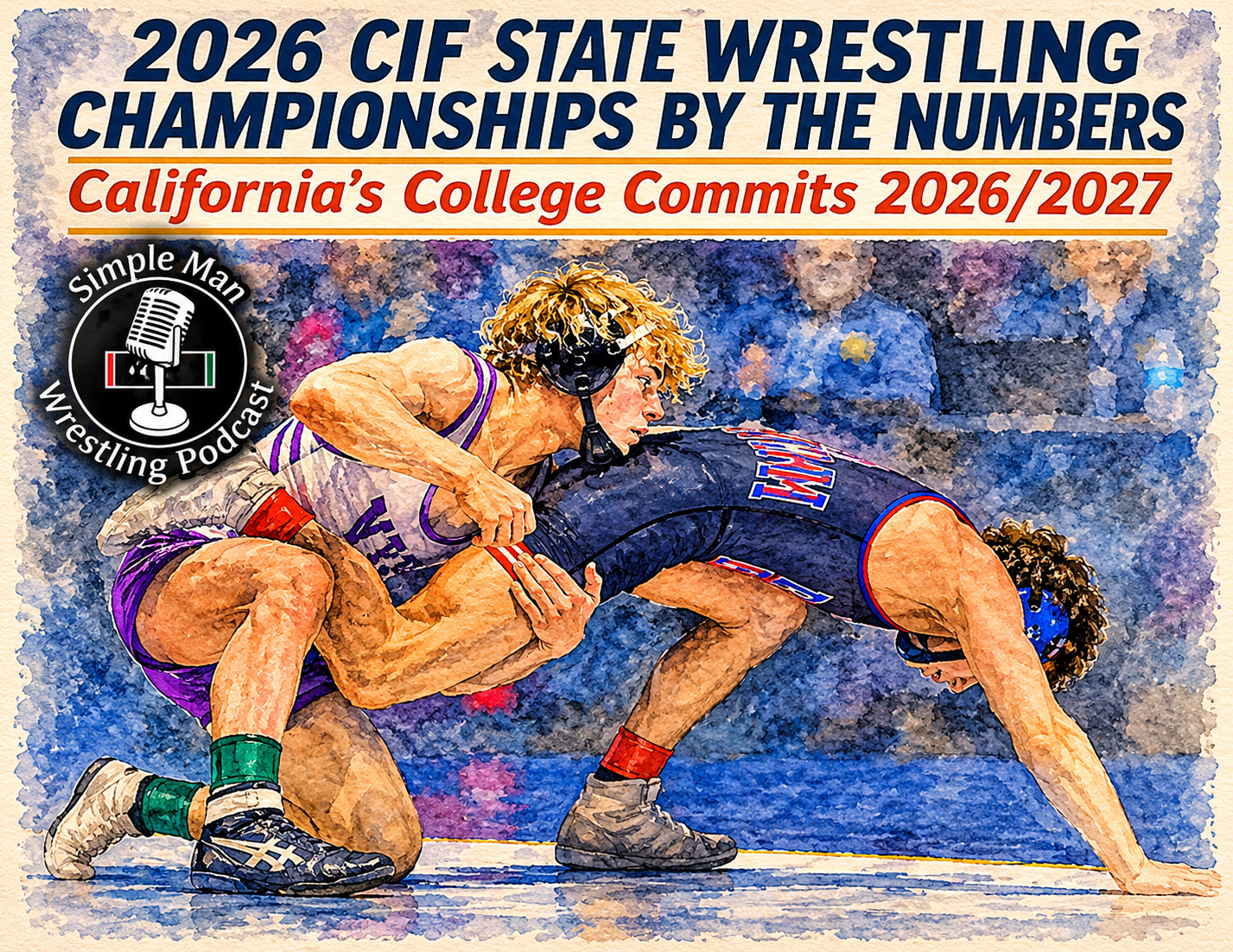

An Analytical Look at Competitive Dominance, Statewide Representation, Ranking Accuracy, and the Next Generation of California Westling
The 2026 CIF State Wrestling Championships provided another compelling statistical snapshot of the competitive landscape of California high school wrestling. Beyond the individual champions, team standings, and medal ceremonies, the numbers reveal important trends regarding the concentration of elite talent, the accuracy of preseason rankings, the competitive strength of individual CIF sections, and the programs responsible for producing California’s top collegiate-level prospects.
The championship data also illustrates the significant gap between the state’s established wrestling powers and the broader field of approximately 910 high school wrestling programs. While California continues to produce an impressive collection of nationally recognized wrestlers, the distribution of state medals demonstrates that championship-level success remains concentrated among a relatively small number of schools.
With 112 state medals awarded across 14 weight classes, 48 high schools represented among the medalists, and 56 medalists identified as underclassmen, the 2026 championships offer an opportunity to examine not only who reached the podium, but also where California wrestling is strongest and what the competitive landscape could look like heading into the 2026-27 season.
RANKINGS VALIDATED: THE STATE’S ELITE WRESTLERS DELIVER
One of the most revealing statistical measures from the 2026 championships was the relationship between preseason rankings and actual state championship results.
Of the 14 individual weight classes, 12 were won by the wrestler ranked No. 1 in California entering the state championships. That represents an 85.7% success rate, or approximately 86%, for the top-ranked wrestler.
The results reinforce the strength of California’s elite wrestling population and the ability of the state’s leading competitors to perform when the championship is on the line.
The lowest-ranked wrestler to capture an individual state championship was Bailey Holman of Poway, who won the 157-pound title representing the San Diego Section. His championship illustrates that, even in a tournament dominated by highly ranked competitors, the state tournament remains capable of producing results that challenge established expectations.
The broader medalist rankings further demonstrate the separation between California’s top tier and the remainder of the field.
According to the California state rankings compiled by wrestling expert Michael Cho, 90 of the 112 state medalists were ranked among the top eight wrestlers in their respective weight classes. That represents 80.4% of all state medalists.
The numbers become even more pronounced when expanding the analysis to the top 12. A total of 106 medalists, representing 95% of the podium finishers, entered the championships ranked among California’s top 12.
This means only six medalists came from outside the top 12.
Four were ranked between No. 13 and No. 15, while two were not ranked among the state’s top 15.
These figures provide compelling evidence that the state’s established ranking structure accurately identified the overwhelming majority of championship-level performers. They also illustrate how difficult it has become for wrestlers outside the top tier to break through and earn a state medal.
For analytical purposes, the results establish a clear competitive distinction:
- Tier 1 — Top 12: 106 medalists, approximately 95%.
- Tier 2 — Ranked No. 13-15: Four medalists.
- Tier 3 — Outside the top 15: Two medalists.
While rankings do not determine tournament outcomes, the 2026 results demonstrate that California’s state medalists were overwhelmingly drawn from its highest-ranked competitors.
Source: California state rankings compiled by Michael Cho.
TEAM COMPETITION: BUCHANAN CONTINUES TO SET THE STANDARD
Buchanan once again established itself as California’s premier high school wrestling program, capturing the state team championship with 288.5 points.
Poway finished second with 229.5 points, followed by St. John Bosco with 219.5. The three programs separated themselves from the remainder of the field, combining for 737.5 points and establishing a substantial advantage over the rest of the top 10.
Clovis finished fourth with 177.5 points, followed by Gilroy (165.5), Clovis North (163.0), Esperanza (151.0), Birmingham (119.0), Fountain Valley (99.0), and Pitman (75.0).
The top 10 team standings were:
- Buchanan (Central) — 288.5
- Poway (San Diego) — 229.5
- St. John Bosco (Southern) — 219.5
- Clovis (Central) — 177.5
- Gilroy (Central Coast) — 165.5
- Clovis North (Central) — 163.0
- Esperanza (Southern) — 151.0
- Birmingham (Los Angeles City) — 119.0
- Fountain Valley (Southern) — 99.0
- Pitman (Sac-Joaquin) — 75.0
The medal distribution among these programs is particularly revealing.
Buchanan led all schools with 12 state medalists, accounting for 10.7% of the 112 medals awarded. Poway followed with 11 medalists (9.8%), while St. John Bosco produced nine (8.0%).
Gilroy and Clovis North each contributed six medalists (5.4%), while Esperanza had seven (6.3%). Clovis and Birmingham each produced five medalists (4.5%), and Fountain Valley and Pitman each added three (2.7%).
Combined, the 10 highest-scoring teams accounted for 67 of the 112 state medals, or approximately 60% of the entire championship field.
That is an extraordinary concentration of success when considering that these 10 schools represent only approximately 1.1% of California’s 910 high school wrestling programs.
In other words, roughly one out of every 91 California programs represented in the statewide CIF school census accounted for 60% of the state’s medalists through the top 10 team finishers.
The statistics reinforce the importance of sustained program development, competitive scheduling, experienced coaching, and the ability to develop depth across multiple weight classes. Buchanan, Poway, and St. John Bosco demonstrated that championship-level team success requires more than one or two standout individuals.
It requires a lineup capable of consistently advancing through the championship and consolation brackets.
CIF SECTION BREAKDOWN: SOUTHERN AND CENTRAL LEAD THE STATE, BUT PROGRAM REPRESENTATION TELLS A BIGGER STORY
The sectional breakdown of the 2026 CIF State Wrestling Championships provides another important perspective on the distribution of California’s wrestling talent. Beyond identifying which sections produced the most state medalists, examining the number of medal-winning schools relative to each section’s total wrestling programs offers a more meaningful assessment of competitive depth and statewide representation.
The Southern Section led California with 38 state medalists (33.9% of all medals), representing 21 different high schools out of 300 total wrestling programs. The Central Section finished second with 29 medalists (25.9%), representing seven schools among its 108 programs.
San Diego placed third with 14 medalists (12.5%), representing three schools out of 80 programs, while the Sac-Joaquin Section produced 12 medalists (10.7%) from eight schools among its 142 programs.
The Central Coast Section accounted for 10 medalists (8.9%), representing five schools out of 91 programs. Los Angeles City produced five medalists (4.5%) from one school among 30 programs, followed by North Coast with three medalists (2.7%) from two schools among 104 programs. Northern produced one medalist (0.9%) from one of its 41 programs.
Oakland City and San Francisco City did not produce a state medalist among their combined 14 wrestling programs.
2026 State Medalists by CIF Section
| CIF Section | Medalists | Schools with Medalists | Total Programs | Programs Producing Medalists |
| Southern | 38 | 21 | 300 | 7.0% |
| Central | 29 | 7 | 108 | 6.5% |
| San Diego | 14 | 3 | 80 | 3.8% |
| Sac-Joaquin | 12 | 8 | 142 | 5.6% |
| Central Coast | 10 | 5 | 91 | 5.5% |
| L.A. City | 5 | 1 | 30 | 3.3% |
| North Coast | 3 | 2 | 104 | 1.9% |
| Northern | 1 | 1 | 41 | 2.4% |
| Oakland City | 0 | 0 | 6 | 0.0% |
| S.F. City | 0 | 0 | 8 | 0.0% |
| California Total | 112 | 48 | 910 | 5.3% |
Percentages represent the number of schools producing at least one state medalist divided by the total number of wrestling programs in that section. Figures are rounded to one decimal place.
Two distinctly different models of competitive concentration
The sectional results reveal two different models of championship-level success.
Southern Section: Broadest representation of medal-winning programs
The Southern Section produced the most medalists (38) and the largest number of medal-winning schools (21). Its 21 medal-winning programs represented 7.0% of its 300 wrestling programs, the highest percentage among all California sections.
Its results demonstrate that championship-caliber talent is distributed across a comparatively broad geographic area and a larger number of high school programs.
Central Section: Exceptional concentration of elite talent
The Central Section’s performance was particularly impressive. It produced 29 medalists from just seven schools, meaning those programs accounted for 25.9% of all state medals despite representing only 6.5% of the section’s 108 programs.
That translates to an average of more than four state medalists per medal-winning school. The results reflect the extraordinary strength of established programs, particularly Buchanan, Clovis, and Clovis North.
The comparison is noteworthy: Southern produced nine more medalists and three times as many medal-winning schools, but Central generated a comparable percentage of medal-winning programs relative to its overall school census.
Sac-Joaquin and Central Coast demonstrate competitive breadth
The Sac-Joaquin Section deserves particular recognition. Its 12 medalists came from eight different schools, representing 5.6% of its 142 wrestling programs.
In fact, Sac-Joaquin’s eight medal-winning schools were second only to Southern’s 21 in total school representation. Its results demonstrate that championship-level talent is not exclusively concentrated within a handful of traditional powerhouse programs.
The Central Coast Section also delivered a respectable performance, with five medal-winning schools among its 91 programs (5.5%).
Conversely, North Coast produced just three medalists from two schools among 104 programs, representing 1.9% of its school census. This was the lowest representation among sections that produced at least one state medalist.
Southern and Central dominate the statewide championship picture
Combined, the Southern and Central Sections accounted for 67 of California’s 112 state medals (59.8%). When San Diego is included, those three sections produced 81 medals, representing 72.3% of the championship podium.
CONCENTRATION OF CALIFORNIA’S 112 MEDALS
- Southern + Central: 59.8%
- Southern + Central + San Diego: 72.3%
- All other sections combined: 27.7%
State medalists in relation to California’s 910 wrestling programs
Perhaps the most revealing statistic emerges when all ten sections are examined collectively.
California had 910 high school wrestling programs represented in the supplied CIF census data. Of those, only 48 produced at least one state medalist in 2026.
That means:
- 48 schools (5.3%) produced at least one state medalist.
- 862 schools (94.7%) did not produce a state medalist.
- The 112 individual state medals were distributed among just 48 high schools.
- Southern and Central alone accounted for nearly 60% of all state medals.
This distinction is important. The 112 medals represent individual accomplishments, while the 48 schools represent the number of programs that successfully placed at least one wrestler on the state podium.
What the sectional numbers tell us about California wrestling
The 2026 sectional breakdown reinforces two important characteristics of California high school wrestling: exceptional competitive depth and a significant concentration of championship-level achievement.
The Southern Section demonstrated the broadest distribution of medal-winning programs, while the Central Section showcased the extraordinary ability of a relatively small group of schools to produce multiple state medalists. Sac-Joaquin also demonstrated meaningful competitive breadth, with eight different programs represented on the podium.
However, the statewide picture is particularly significant. Despite having 910 wrestling programs and 27,452 participants, only 48 schools produced a state medalist.
This is not necessarily an indication that the remaining programs lack quality wrestlers. Rather, it illustrates the extraordinary competitive threshold required to earn a medal in California’s single-class championship structure.
For the broader discussion about California’s championship format, these findings deserve serious consideration. If more than 94% of the state’s wrestling programs did not produce a state medalist, should CIF examine whether its current single-class format provides the best possible opportunity to showcase the depth of talent throughout California?
That question does not diminish the prestige of a CIF State medal. Instead, it challenges the wrestling community to examine whether additional championship opportunities, through multiple divisions or alternative qualifying structures, could recognize more deserving athletes while preserving the significance of the state championship.
Editorial note: The section-specific percentages above measure the proportion of programs in each section that produced at least one state medalist. They are not participation rates, individual wrestler success rates, or percentages of all schools that qualified wrestlers for the tournament.
THE NEXT GENERATION: 56 MEDALISTS RETURN FOR 2026-27
While the 2026 championships concluded the high school careers of many accomplished seniors, the grade-level distribution provides an encouraging outlook for the upcoming season.
Of the 112 state medalists, 56 were seniors, representing exactly 50% of the medal-winning field.
The remaining 56 medalists were underclassmen:
- Seniors: 56 (50.0%)
- Juniors: 27 (24.1%)
- Sophomores: 22 (19.6%)
- Freshmen: 7 (6.25%)
Based on the grade classifications supplied, 56 medalists will be eligible to return for the 2026-27 season, assuming continued enrollment and eligibility.
That returning group represents half of the 2026 podium.
The 27 juniors account for nearly one-quarter of all state medals, while the 22 sophomores represent another significant group of established championship-level competitors. Seven freshmen also reached the podium, demonstrating that several of California’s emerging talents have already established themselves among the state’s best.
The distribution is especially significant because returning medalists are not simply experienced varsity competitors. They have already demonstrated the ability to navigate the pressure, competition, and depth of the CIF State Championships.
For the state’s leading programs, retaining these wrestlers will be critical to their championship aspirations.
Returning medalists by CIF section
The supplied section breakdown identifies 56 returning state medalists, distributed as follows:
- Southern: 21
- Central: 14
- San Diego: 11
- Sac-Joaquin: 4
- Central Coast: 4
- Los Angeles City: 1
- North Coast: 1
- Northern: 0
- Oakland City: 0
- San Francisco City: 0
The Southern Section leads with 21 returning medalists, representing 37.5% of the returning group.
The Central Section follows with 14 (25%), while San Diego has 11 (19.6%).
Combined, these three sections account for 46 of the 56 returning medalists, or approximately 82.1%.
The concentration is especially notable within several established programs.
Esperanza and St. John Bosco account for a reported 57% of the Southern Section’s returning medalists. Within the Central Section, 86% of its returning wrestlers are identified as coming from the Tri-River Athletic Conference (TRAC). In San Diego, Poway represents a reported 82% of the section’s returning medalists.
These figures reinforce the continued strength of the state’s established wrestling centers and suggest that the Southern, Central, and San Diego Sections will once again have considerable representation among California’s top programs.
PROGRAM-BY-PROGRAM: WHERE THE RETURNING TALENT IS CONCENTRATED
Several of California’s leading programs have particularly strong groups of medalists and returning competitors.
Poway — San Diego Section
Poway’s championship performance was highlighted by 11 state medalists and a second-place team finish with 229.5 points.
Bailey Holman captured the 157-pound championship, while Mario Carini won the 175-pound title. Mick Moylan added a third-place finish at 215 pounds.
The Titans also demonstrated considerable depth through their returning competitors, including Julius Villamil, who placed eighth at 113 pounds, and Lewis Fofanah, a returning 285-pound state qualifier.
The supplied Poway roster also identifies Arseni Kikiniou, a two-time state medalist and U17 World medalists (twice), whose previous podium finishes were second and fifth. Although he did not compete at the 2026 state championships, he is identified as returning for 2027.
Poway’s combination of established state medalists, experienced qualifiers, and championship-level depth should make the program an important factor in the upcoming team race.
St. John Bosco — Southern Section
St. John Bosco finished third in the team standings with 219.5 points and produced nine state medalists.
The Braves captured two individual championships through Jesse Grajeda at 144 pounds and Michael Romero at 150 pounds.
Their returning talent includes Luke Loren and Nathan Reynolds, both sophomores who earned state medals, along with juniors Isai Fernandez and Mason Savidan, who each finished second in their respective weight classes.
St. John Bosco’s ability to develop underclassmen while maintaining a championship-caliber varsity lineup has helped establish the program as one of California’s leading wrestling powers.
Esperanza — Southern Section
Esperanza finished seventh in the team standings with 151 points and produced seven state medalists.
Its medalists included two state finalists: Max Murillo, who placed second at 113 pounds, and Samuel Sanchez, who placed second at 120 pounds.
The program’s returning group includes Giovanni Suarez, who reached the Round of 12, along with several other experienced underclassmen.
Esperanza’s depth is particularly noteworthy. Its roster also identifies multiple returning state qualifiers and wrestlers who advanced to the blood round, providing the program with considerable experience heading into 2027.
Buchanan — Central Section
Buchanan’s 288.5-point championship performance was supported by 12 state medalists, the most of any school.
Paul Ruiz captured the 126-pound state championship, while sophomores Thales Silva and Thiago Silva finished second and third, respectively, at 106 and 113 pounds.
Carlo Contino and Sammy Seja also earned fifth-place finishes.
Buchanan’s returning group includes several underclassmen who have already established themselves as state-level performers. The program’s ability to replenish its lineup while maintaining its competitive standard remains a significant advantage.
Clovis — Central Section
Clovis finished fourth with 177.5 points and produced five state medalists.
Michael Bernabe captured the 106-pound championship, while Anthony Garza won the 113-pound title. James Curoso finished second at 165 pounds, and Andrew Arroyo placed second at 285 pounds.
The Cougars also had several wrestlers reach the Round of 12, including Zander Schaefer, Dylan Tirapelle, and Adan Castillo.
The combination of two individual state champions and returning tournament experience provides a strong foundation for the program’s continued competitiveness.
Clovis North — Central Section
Clovis North finished sixth with 163 points and produced six state medalists.
Chris Arreola finished second at 144 pounds, while Elijah Ornellas placed fifth at 175 pounds. Tyler Sweet and Phillip Hernandez each finished sixth.
The Broncos also have returning competitors who gained valuable state tournament experience, including several wrestlers who qualified for the championship through the Central Section.
Gilroy — Central Coast Section
Gilroy finished fifth with 165.5 points and produced six state medalists.
Eli Mendoza placed fourth at 113 pounds, while Brian Haran finished fifth at 215 pounds.
Gilroy’s tournament also included several wrestlers who reached the Round of 12, including Roman Fonseca and Max Torrez.
With multiple returning competitors, the Mustangs remain an important part of the Central Coast Section’s championship picture.
Fountain Valley — Southern Section
Fountain Valley finished ninth with 99 points and produced three state medalists.
Vinnie Gutierrez placed third at 138 pounds, while Kavi Garvey finished fourth at 144 pounds.
The program also had several wrestlers gain valuable state tournament experience, including Christian Stoeber, who advanced to the Round of 12.
Fountain Valley’s results illustrate how a program can remain competitive through multiple weight classes, even without an individual state champion.
THE BLOOD ROUND: THE FINE LINE BETWEEN A STATE MEDAL AND GOING HOME
One of the most demanding stages of the CIF State Championships is the Round of 12, commonly known as the blood round.
For the wrestlers who reach this point, the difference between a state medal and finishing outside the podium often comes down to a single match.
The 2026 numbers demonstrate the competitiveness of this round.
A total of 42 schools were represented among the Round of 12 competitors. Of the wrestlers who lost in the blood round, 13 had entered the tournament ranked among California’s top eight.
Another 33 were ranked between No. 9 and No. 16.
Combined, 46 of the wrestlers identified in the ranking breakdown were ranked among the state’s top 16, illustrating the level of competition required to advance into the medal rounds.
The sectional distribution of the Round of 12 wrestlers was:
- Southern: 20
- Central: 9
- Central Coast: 12
- San Diego: 7
- North Coast: 3
- Sac-Joaquin: 4
- Los Angeles City: 1
The Southern Section led with 20 representatives, followed by the Central Coast Section with 12.
The Central Coast’s representation is particularly interesting when compared with its 10 state medalists. Its 12 Round of 12 representatives demonstrate that the section had considerable depth beyond the eventual podium finishers.
Similarly, the Southern Section’s 20 blood-round representatives reflect the depth of competition within a section that ultimately produced 38 state medals.
These results reinforce an important point: reaching the Round of 12 is itself a significant accomplishment in California, where the state tournament draws together the best competitors from across a highly competitive statewide qualification system.
A wrestler can enter the tournament among California’s top eight and still finish one match short of a medal.
That is the reality of championship-level competition.
THE 2027 OUTLOOK: RETURNING MEDALISTS AND BLOOD-ROUND EXPERIENCE
Looking ahead, the 2026 results provide a useful starting point for identifying programs that could emerge as contenders in the 2027 championships.
Beyond the 56 returning medalists, several schools have wrestlers identified as returning Round of 12 competitors.
The supplied school breakdown includes:
- Los Gatos — 2
- Brawley — 1
- Everett Alvarez — 1
- Frontier-Bakersfield — 1
- Granada — 1
- La Costa Canyon — 1
- Junipero Serra — 1
- Northview — 1
- Palm Desert — 1
- Palo Alto — 1
- Redlands East Valley — 1
- San Dimas — 1
- San Luis Obispo — 1
- Silver Creek — 1
- South Torrance — 1
- St. Francis — 1
These wrestlers represent an additional group of competitors who have experienced the intensity of the state tournament and will have an opportunity to build on that experience.
The inclusion of programs such as Granada, Los Gatos, Palo Alto, and Everett Alvarez is particularly noteworthy for sections and regions where expanding championship-level representation remains an important objective.
However, the returning Round of 12 list does not represent every returning state qualifier. It is limited to the schools identified in the supplied blood-round data.
For the 2026-27 season, the combination of returning medalists, blood-round competitors, and wrestlers who qualified for state but did not reach the Round of 12 will provide a broader foundation for evaluating the next championship race.
WHAT THE NUMBERS TELL US ABOUT CALIFORNIA WRESTLING
The 2026 CIF State Wrestling Championships revealed several important characteristics of California’s current competitive landscape.
First, the state’s elite wrestlers continue to validate their national and state-level rankings. With 12 of 14 top-ranked competitors winning their respective weight classes and approximately 95% of medalists ranked among the top 12, California’s highest-ranked wrestlers demonstrated remarkable consistency.
Second, championship success remains heavily concentrated among a relatively small number of schools. The top 10 teams accounted for approximately 60% of the state’s medals, despite representing only 1.1% of the statewide wrestling programs.
Third, the Southern and Central Sections continue to lead California in overall medal production. Their combined 67 medals represented approximately 60% of the championship podium, while the San Diego Section further strengthened the dominance of the state’s leading wrestling regions.
Fourth, the grade-level distribution provides a strong foundation for the future. Although 56 seniors will graduate, another 56 medalists are identified as eligible to return for the 2026-27 season. The opportunity to build on that experience will be particularly important for programs with multiple returning medalists.
Finally, the blood-round statistics demonstrate that California’s championship depth extends well beyond the eventual medalists. With 42 schools represented in the Round of 12, the state tournament provided a competitive platform for programs throughout California.
CONCLUSION: A CHAMPIONSHIP DEFINED BY ELITE PERFORMANCE AND COMPETITIVE DEPTH
California remains one of the nation’s premier high school wrestling states, and the 2026 CIF State Championships offered substantial statistical evidence to support that position.
The results highlighted the dominance of established championship programs, the continued strength of the state’s leading sections, and the ability of California’s top-ranked wrestlers to deliver when the stakes were highest.
Buchanan, Poway, and St. John Bosco established themselves as the leading team programs, while the Southern, Central, and San Diego Sections accounted for the overwhelming majority of the state’s medalists.
At the same time, the 56 returning medalists and the additional group of returning blood-round competitors provide an encouraging outlook for the next championship cycle.
Perhaps the most important takeaway is that the 2026 championships were not simply a measure of who won and who lost. They offered a detailed look at where California wrestling stands competitively, how its championship talent is distributed, and which programs are positioned to shape the next generation.
The challenge moving forward is to expand that championship-level success beyond the established powers, develop more programs capable of producing state medalists, and continue creating opportunities for the next generation of California wrestlers.
The 2026 numbers tell the story of a state dominated by elite programs and exceptional individual talent. The 2027 season will provide the next opportunity to see whether that competitive landscape expands—or whether the established powers continue to set the standard.
2026 CIF STATE WRESTLING CHAMPIONSHIPS BY THE NUMBERS
12 No. 1 ranked won their respective weight group [86%]
Lowest ranked wrestler to win state: 157 – Bailey Holman [Poway, SD]
TIER 1 WRESTLERS [Top 12 ranked in CA]
- 90 State Medalists ranked in the top 8 [80.4%]
- 106 State Medalists ranked in the top 12 [95%]
TIER 2 | TIER 3 WRESTLERS
- 4 State Medalists Ranked No. 13 – No. 15 in CA
- 2 State Medalists not ranked in the top 15 in CA
NOTE: CIF STATE RANKINGS COMPILED BY WRESTLING EXPERENT MICHAEL CHO.
TOP 10 TEAM SCORES
- Buchanan (CS): 288.5 [12 medalists |10.7% of total]
- Poway (SD): 229.5 [11 medalists |9.8% of total]
- St. John Bosco (S): 219.5 [9 medalists | 8% of total]
- Clovis (CS): 177.5 [5 medalists | 4.5% of total]
- Gilroy (CC): 165.5 [6 medalists | 5.4% of total]
- Clovis North (CS): 163.0 [6 medalists | 5.4% of total]
- Esperanza (S): 151.0 [7 medalists | 6.3% of total]
- Birmingham (LA): 119.0 [5 medalists | 4.5% of total]
- Fountain Valley (S): 99.0 [3 medalists | 2.7% of total]
- Pitman (SJ): 75.0 [3 medalists | 2.7% of total]
TOP 10 TEAMS PRODUCED 67 MEDALS [60% of the total] | Represents 1.1% of the state’s programs [910]
STATE MEDALISTS BY CIF SECTION
- Southern (S): 38 [21 Schools |Represents 2.4% of CIF Schools per census data]
- Central (CS): 29 [7 Schools | Represents 0.8% of CIF Schools per census data]
- San Diego (SD): 14 [3 Schools | Represents 0.3% of CIF Schools per census data]
- Sac-Joaquin (SJ): 12 [8 Schools | Represent 0.9% of CIF Schools per census data]
- Central Coast (CC): 10 [5 Schools Represents 0.5% of CIF Schools per census data]
- Los Angeles City (LA): 5 [Birmingham | Represent | 0.1% of CIF Schools per census data]
- North Coast (NC): 3 [2 Schools | Represents 0.2% of CIF Schools per census data]
- Northern (N): 1 [Anderson |0.1% of CIF Schools per census data ]
- Oakland City (O): 0
- San Francisco City (SF): 0
NOTE: 48 high schools finishing produced the 112 state medals [5.3% of the state]
STATE MEDALISTS BY GRADE
- Senior: 56 [50%]
- Junior: 27 [24.1%]
- Sophomore: 22 [19.6%]
- Freshman: 7 [6.25%]
NOTE: 56 returning state medalists eligible for the 2026-’27 season
2026 CIF STATE – ROUND OF 12 STATS [Lost in the Blood Round]
- 42 Schools represented in the round of 12
- Number of top 8 ranked wrestlers that lost in the Blood Round: 13
- Ranked No. 9 to No. 16 wrestlers: 33
- 20 from the Southern Section
- 9 from the Central Section
- 12 from the Central Coast Section
- 7 from the San Diego Section
- 3 from the North Coast Section
- 4 from the Sac-Joquin Section
- 1 from the Los Angeles City Section
NUMBRER OF RETURING STATE MEDALISTS BY CIF SECTION
- Southern (S): 21 [Esperanza and St. John Bosco represent 57% of returning medalists]
- Central (CS): 14 [86% of returning wrestlers are from the TRAC]
- San Diego (SD): 11 [Poway represents 82% of returning medalists]
- Sac-Joaquin (SJ) 4
- Central Coast (CC): 3
- Los Angeles (LA): 1
- North Coast (NC): 1
- Northern (N): 0
- Oakland City (O): 0
- San Francisco City (SF): 0
RETURNING STATE MEDALISTS/QUALIFIERS BY SCHOOL
Poway (SD): 9
- 113 – Julius Villamil (11), 8th Place
- 120 – Rene Cordero (12), 4th Place
- 132 – Jack Malinconico (12), 5th Place
- 138 – Matty Orbeta (12), 5th Place
- 144 – Diego Valdviezo (12), 5th Place
- 144 – Arseni Kikiniou (12), 3x State Medalists (2,5,5). Did not compete at 2026 CIF State, but returns in 2027
- 157 – Bailey Holman (12), State Champion
- 165 – Mason Canrite (12), 5th Place
- 175 – Mario Carini (12), State Champion
- 215 – Mick Moylan (12), 3rd Place
- 285 – Lewis Fofanah (11), SQ (SD2)
St. John Bosco (S): 6
- 106 – Luke Loren (10), 5th Place
- 120 – Nathan Reynolds (10), 7th Place
- 144 – Jesse Grajeda (12), State Champion
- 150 – Michael Romero (12), State Champion
- 157 – Sergio Gomez (12), SQ (S2)
- 175 – Isai Fernandez (11), 2nd Place
- 190 – Mason Savidan (11), 2nd Place
Esperanza (S): 6 (3 – Rd. 12)
- 106 – Giovanni Suarez (11), SQ (S1, Rd. 12)
- 113 – Max Murillo (12), 2nd Place
- 120 – Samuel Sanchez (11), 2nd Place
- 126 – Aaron Meza (11), 8th Place
- 132 – Joseph Guardado (12), 8th Place
- 138 – Marcello Calavitta (12), SQ (S4)
- 144 – James Ruiz (12), SQ (Rd. 12)
- 150 – Matthew Centeno (11), 8th Place
- 157 – Dimetry Molina (11), 6th Place
- 165 – James Holiday (12), SQ (S3)
- 175 – Jude Holiday (12), SQ (S2, Rd. 12)
Buchanan (CS): 5
- 106 – Thales Silva (10), 2nd Place
- 113 – Thiago Silva (10), 3rd Place
- 126 – Paul Ruiz (11), State Champion
- 157 – Carlo Contino (11), 5th Place
- 190 – Raiden Bishop (12), SQ (CS4)
- 215 – Andre Sandoval (10), SQ (CS4)
- 285 – Sammy Seja (11), 5th Place
Clovis (CS): 3 (3 – Rd. 12)
- 106 – Michael Bernabe (10), State Champion
- 113 – Anthony Garza (12), State Champion
- 132 – Jaden Garcia (11), SQ (CS7)
- 144 – Zander Schaefer (12), SQ (Rd. 12)
- 157 – Dylan Tirapelle (11), SQ (Rd. 12)
- 175 – Shane Struthers (12), SQ (CS8)
- 215 – Adan Castillo (12), SQ (Rd. 12)
- 285 – Andrew Arroyo (11), 2nd Place
Clovis North (CS): 4
- 106 – Tyler Sweet (11), 6th Place
- 113 – Phillip Hernandez (10), 6th Place
- 120 – Colton Meixner (10), SQ (CS4)
- 138 – Mason Blair (11), SQ (CS5)
- 144 – Chris Arreola (11), 2nd Place
- 157 – Jr. Cruz (11) SQ (CS4)
- 175 – Elijah Ornellas (11), 5th Place
Gilroy (CC): 3 (2 – Rd. 12)
- 106 – Roman Foncesca (11), SQ (Rd. 12)
- 113 – Eli Mendoza (11), 4th Place
- 120 – Gavin Pongsai (12), SQ (CC2)
- 126 – Max Torrez (10), SQ (CC3, Rd. 12)
- 157 – Wyatt Lewis (12), 2nd Place*
- 215 – Brian Haran (12), 5th Place
*Earned 2026 state medal for Del Note (NC)
Fountain Valley (S): 2 (1 – Rd. 12)
- 138 – Vinnie Gutierrez (12), 3rd Place
- 144 – Kavi Garvey (12), 4th Place
- 157 – Mason McDonnell (10), SQ (S2)
- 165 – Christian Stoeber (12), SQ (S2, Rd. 12)
- 175 – Brayden Carson (12), SQ (S3)
2026 CIF STATE – OTHER RETURNING STATE MEDALISTS
- Bella Vista (SJ): 1 (126 – Elias Castaneda, 12, 6th Place)
- Birmingham (LA): 1 (150 – Greg Torosian, 12, 6th Place)
- Chino (S): 1 (120 – Zachary Samano, 12, 6th Place)
- Cardinal Newman (NC): 1 (165 – James Curoso, 11, 2nd Place)*
- Del Oro (SJ): 1 (157 – Chase Young, 11, 8th Place)
- Folsom (SJ): 1 (138 – Orion Hill, 12, 6th Place)
- Granite Hills (SD): 1 (Cash McClurg, 10, 3rd Place)
- Imperial (SD): 1(285 – Noah Larios, 12, 6th Place)
- Lakeside (S): 1 (165 – Jesus Guzman, 11, 4th Place)
- Milikan (S): 1 (157 – Chris Anquiano, 12, 7th Place)
- Oakdale (SJ): 1 (285 – Matthew Cooley, 12, 3rd Place)
- Palma (CC): 1 (120 – Aiden Garcia, 11, 5th Place)
- Reedley (CS): 1 (106 – Aiden Talavera, 11, 4th Place)
- Servite (S): 1 (113 – Uriah Correa, 11, 5th Place)
- Stockdale (CS): 1 (106 – Nathiel Nava, 11, 8th Place)
- Sultana (S): 1 (132 – Cael Humphrey, 12, 6th Place) | (1 SQ – Rd. 12)
- Valencia (S): 1 (132 – Slater Hicks, 12, 2nd Place)
- Victor Valley (S): 1 (Daniel Mendoza, 12, 7th Place)
*Earned state medal for Clovis (CS) in 2026.
2026 CIF STATE – RETURNING RD. OF 12 BY SCHOOL [Does not include all state qualifiers]
- Brawley (SD): 1
- Everett Alvarez (CC): 1
- Frontier-Bakersfield (CS): 1
- Granada (NC): 1
- La Costa Canyon (SD): 1
- Junipero Serra (CC): 1
- Los Gatos (CC): 2
- Northview (S): 1
- Palm Desert (S): 1
- Palo Alto (CC): 1
- Redlands East Valley (S): 1
- San Dimas (S): 1
- San Luis Obispo (CS): 1
- Silver Creek (CC): 1
- South Torrence (S): 1
- St. Francis (CC): 1
CALIFORNIA WRESTLING: EXAMINING THE COLLEGE RECRUITING LANDSCAPE
An analysis of the Classes of 2026 and 2027 reveals the concentration of recruiting among state medalists, state qualifiers, California’s highest-ranked wrestlers, and the high school programs producing the greatest number of collegiate competitors.
California continues to produce some of the nation’s most accomplished high school wrestlers, competing in one of the deepest and most competitive wrestling environments in the country. With just over 27,000 participants statewide, the Golden State has an enormous pool of talent from which college programs can recruit. However, examining the number of wrestlers receiving college commitments provides an important perspective on how much of that talent is ultimately moving on to the collegiate level.
An analysis of 107 reported college commitments reveals several noteworthy trends. The list includes 78 wrestlers from the Class of 2026 and 28 from the Class of 2027, along with one additional wrestler from Poway High School, a state qualifier from the Class of 2024, who committed to continue his wrestling career at the collegiate level in 2026.
This distinction is important because the Poway graduate’s commitment is separate from the two primary graduating classes being examined. Nevertheless, his inclusion provides another example of a California state qualifier pursuing an opportunity to compete at the collegiate level beyond his original high school graduating year.
The numbers also illustrate an important relationship between the CIF State Championships and college recruiting. Most significantly, the overwhelming majority of these commitments involve wrestlers who qualified for the 2026 CIF State Wrestling Championships, with a substantial concentration among state medalists and athletes ranked among California’s top 12.
107 COLLEGE COMMITMENTS: A CLOSER LOOK
The commitment data identifies 107 wrestlers who have secured opportunities to continue their wrestling careers at the collegiate level.
| Graduating class | Commitments | Percentage |
| Class of 2026 | 78 | 72.9% |
| Class of 2027 | 28 | 26.2% |
| Class of 2024 | 1 | 0.9% |
| Total | 107 | 100% |
The Class of 2024 wrestler is Jack Estevez, a Poway High School graduate who qualified for the CIF State Championships and committed to Westcliff University (NAIA) to continue his wrestling career in 2026.
The distribution across collegiate divisions demonstrates that California’s recruiting pipeline extends throughout the collegiate wrestling landscape.
| College division | Commitments | Percentage |
| NCAA Division I | 64 | 59.8% |
| NCAA Division II | 27 | 25.2% |
| NCAA Division III | 4 | 3.7% |
| NAIA | 11 | 10.3% |
| NJCAA | 1 | 0.9% |
| Total | 107 | 100% |
NCAA Division I accounts for nearly 60% of the commitments, while Division I and Division II combined represent 91 wrestlers, or approximately 85% of the total. These figures demonstrate that California continues to supply athletes to every level of collegiate wrestling.
However, the more revealing aspect of this analysis is not simply where these wrestlers are going, but where they finished competitively during their high school careers and which programs are consistently producing collegiate-level athletes.
HIGH SCHOOL PROGRAMS LEADING CALIFORNIA’S COLLEGE RECRUITING PIPELINE
One of the more revealing aspects of the recruiting data is the distribution of commitments by high school. While California has numerous established wrestling programs, a relatively small group accounts for a significant portion of the reported collegiate commitments.
Poway High School leads all programs with 12 commitments, followed by Fountain Valley with eight and St. John Bosco with seven. Buchanan accounts for six, while Del Oro and Gilroy each have five.
These six programs alone account for 43 of the 107 commitments, representing approximately 40.2% of the entire recruiting group.
The following breakdown identifies the high schools represented in the supplied data.
| High school | Commits/signees |
| Poway | 12 |
| Fountain Valley | 8 |
| St. John Bosco | 7 |
| Buchanan | 6 |
| Gilroy | 6 |
| Del Oro | 5 |
| Birmingham | 4 |
| Pitman | 4 |
| Clovis North | 3 |
| Folsom | 3 |
| Frontier-Bakersfield | 3 |
| Oakdale | 3 |
| Valencia | 3 |
| Bakersfield | 2 |
| Del Norte | 2 |
| Granite Hills | 2 |
| Anderson | 1 |
| Aptos | 1 |
| Bella Vista | 1 |
| Bellarmine Prep | 1 |
| Camarillo | 1 |
| Central Catholic | 1 |
| Chaminade | 1 |
| Chaparral | 1 |
| Clovis | 1 |
| Corona del Mar | 1 |
| Downey | 1 |
| El Diamante | 1 |
| El Dorado | 1 |
| Escalon | 1 |
| Esperanza | 1 |
| Etiwanda | 1 |
| Firebaugh | 1 |
| Granada | 1 |
| Hesperia | 1 |
| JW North | 1 |
| John F. Kennedy | 1 |
| Kingsburg | 1 |
| La Mirada | 1 |
| Liberty-Brentwood | 1 |
| Los Gatos | 1 |
| Mayfair | 1 |
| Moreno Valley | 1 |
| Northern Michigan | 1 |
| Ponderosa | 1 |
| Redwood | 1 |
| San Clemente | 1 |
| Sheldon | 1 |
| Sultana | 1 |
| Sutter Union | 1 |
| Trabuco Hills | 1 |
| Upper Lake | 1 |
The distribution illustrates the breadth of California’s collegiate wrestling pipeline. Although Poway, Fountain Valley, St. John Bosco, and Buchanan headline the list, the commitments extend across numerous sections and communities throughout the state.
Equally important is the number of programs represented by only one or two commitments. These schools demonstrate that collegiate recruiting is not confined to the state’s traditional powerhouse programs. Individual wrestlers from a wide range of high schools are finding opportunities to continue competing.
CLASS OF 2026: BUCHANAN LEADS THE WAY
The Class of 2026 accounts for 78 commitments in the revised data. Buchanan leads all programs with six, followed by Gilroy with five.
Fountain Valley, Pitman, and St. John Bosco each contribute four commitments, while Birmingham, Clovis North, and Frontier-Bakersfield each have three.
Poway, which leads the overall school breakdown, has three commitments from the Class of 2026. Its overall total increases substantially when the eight commitments from the Class of 2027 and the additional Class of 2024 graduate are included.
| High school | Commitments |
| Buchanan | 6 |
| Gilroy | 5 |
| Fountain Valley | 4 |
| Pitman | 4 |
| St. John Bosco | 4 |
| Birmingham | 3 |
| Clovis North | 3 |
| Frontier-Bakersfield | 3 |
| Poway | 3 |
| Bakersfield | 2 |
| Del Oro | 2 |
| Folsom | 2 |
| Granite Hills | 2 |
| Oakdale | 2 |
| Valencia | 2 |
| 31 other schools | 1 each |
| Total | 78 |
Buchanan and Gilroy lead the Class of 2026 recruiting numbers, accounting for 11 commitments combined. Their representation reinforces the continued strength of two programs that have established themselves among California’s most accomplished wrestling schools.
The broader distribution is also noteworthy. Thirty-one additional schools produced one commitment apiece, demonstrating that the Class of 2026 recruiting pipeline reaches well beyond the programs at the top of the list.
CLASS OF 2027: POWAY LEADS THE NEXT RECRUITING CLASS
The Class of 2027 currently has 28 identified commitments, with Poway High School establishing a considerable lead.
Poway accounts for eight of the 28 commitments, representing 28.6% of the entire Class of 2027 recruiting group. Fountain Valley follows with four, while St. John Bosco and Del Oro each have three.
These four programs account for 18 of the 28 commitments, or approximately 64.3% of the identified Class of 2027 total.
| High school | Commitments |
| Poway | 8 |
| Fountain Valley | 4 |
| St. John Bosco | 3 |
| Del Oro | 3 |
| Birmingham | 1 |
| Clovis | 1 |
| Bella Vista | 1 |
| Valencia | 1 |
| Sultana | 1 |
| Esperanza | 1 |
| Folsom | 1 |
| Gilroy | 1 |
| Oakdale | 1 |
| Aptos | 1 |
| Total | 28 |
Poway’s eight commitments are particularly impressive. The program’s representation in the Class of 2027 is more than twice that of any other school in the supplied data.
When the two primary graduating classes are combined, Poway’s 11 commitments from the Classes of 2026 and 2027, plus Jack Estevez’s Class of 2024 commitment, give the program 12 overall.
Fountain Valley also demonstrates considerable recruiting consistency, with four commitments from each graduating class. St. John Bosco has four from the Class of 2026 and three from the Class of 2027.
These numbers offer an interesting perspective on program depth and the ability of high school programs to consistently develop athletes who attract collegiate opportunities.
The Class of 2027 numbers require an important qualification. They reflect commitments identified following the 2026 wrestling season and should not be considered a final accounting of that graduating class. Recruiting activity will continue throughout the upcoming season, and the number of commitments is expected to increase.
THE CIF STATE CHAMPIONSHIPS: A SIGNIFICANT RECRUITING MEASURE
To understand the recruiting numbers, it is important to consider the competitive structure of the CIF State Championships.
California’s state tournament features 14 weight classes, with 40 wrestlers competing in each bracket. The resulting 560 state qualifiers represent approximately 2.1% of the state’s estimated 27,000+ high school wrestling participants.
Of those 560 competitors, 112 earn state medals, representing the top eight finishers in each weight class. The remaining 448 wrestlers complete the tournament without placing.
The percentages provide important context:
- 560 state qualifiers represent approximately 2.1% of statewide participation.
- 112 state medalists represent approximately 20% of state qualifiers.
- 448 state qualifiers do not earn medals, representing 80% of the field.
- State medalists account for approximately 0.4% of California’s overall wrestling participation.
These are remarkably selective numbers. Earning a medal at the CIF State Championships is a significant accomplishment, particularly given the depth of competition throughout California’s 10 CIF Sections.
When the college commitment data is compared against this tournament structure, the relationship between state-level achievement and collegiate recruiting becomes apparent.
STATE MEDALISTS AND QUALIFIERS DOMINATE THE RECRUITING NUMBERS
Of the 107 reported college commitments, 73 are identified as state medalists from the 2026 CIF State Championships. Another 28 are state qualifiers who did not earn a medal, while six did not qualify for the state tournament.
Consequently, 101 of the 107 commitments, or approximately 94.4%, involve wrestlers who qualified for the CIF State Championships.
| State tournament accomplishment | Commits | Percentage |
| State medalists | 73 | 68.2% |
| State qualifiers, non-medalists | 28 | 26.2% |
| Non-state qualifiers | 6 | 5.6% |
| Total | 107 | 100% |
The 73 state medalists represent approximately 65.2% of the 112 available state medalist positions. While the commitment list is not necessarily a complete accounting of every graduating senior and junior, that comparison illustrates the substantial presence of state medalists in the college recruiting pool.
Equally noteworthy is the number of state qualifiers who did not medal but nevertheless attracted collegiate opportunities. Twenty-eight wrestlers fall into this category, demonstrating that a top-eight finish at the state tournament is not a prerequisite for continuing a competitive wrestling career.
The six commitments from wrestlers who did not qualify for state provide another important reminder: college recruiting extends beyond the results of one championship tournament.
Jack Estevez, the Poway wrestler from the Class of 2024, is included among the state qualifiers in this analysis. His commitment to Westcliff University in 2026 illustrates that the timeline for pursuing collegiate wrestling opportunities does not necessarily end with high school graduation.
RECRUITING IS HEAVILY CONCENTRATED AMONG CALIFORNIA’S TOP 12
Perhaps the most significant finding involves the relationship between statewide rankings and college commitments.
Using three recruiting tiers—Tier 1 (No. 1–12), Tier 2 (No. 13–20), and Tier 3 (No. 21–30 or unranked)—the distribution reveals a considerable concentration among the state’s highest-ranked wrestlers.
| Recruiting classification | Commitments | Percentage |
| Tier 1: No. 1–12 | 78 | 72.9% |
| Tier 2: No. 13–20 | 6 | 5.6% |
| Tier 3: No. 21–30/unranked | 23 | 21.5% |
| Total | 107 | 100% |
Nearly three-quarters of all reported commitments come from California’s top 12 wrestlers.
Tier 1 includes 62 NCAA Division I commitments, 10 Division II commitments, and six NAIA commitments. The concentration is particularly pronounced at the Division I level, where the state’s highest-ranked wrestlers account for the overwhelming majority of reported opportunities.
Tier 2, consisting of wrestlers ranked No. 13 through No. 20, accounts for only six commitments. Tier 3, however, contributes another 23, including athletes who did not qualify for the CIF State Championships.
These findings demonstrate that recruiting is not exclusively reserved for the state’s highest-ranked wrestlers. Nevertheless, the numbers suggest that the recruiting process becomes considerably more competitive once athletes move beyond the top 12.
A LARGER QUESTION FOR CALIFORNIA WRESTLING
California’s high school wrestling participation numbers are among the largest in the nation. With just over 27,000 participants, the state has an extraordinary competitive base. Yet, the 107 identified commitments represent approximately 0.4% of that overall participation population.
That comparison must be interpreted carefully. The 27,000 figure includes all high school grade levels, while the commitment list includes selected graduating classes. Furthermore, college commitments are not the same as actual college roster participation, and not every wrestler intends to continue competing after graduation.
Nevertheless, the data provides a useful starting point for examining California’s collegiate wrestling pipeline.
The fact that 101 of the 107 commitments involve state qualifiers reinforces the significance of the CIF State Championships as a recruiting showcase. The fact that 73 are state medalists further demonstrates how heavily college opportunities are concentrated among athletes who have achieved success at the state’s highest level of competition.
At the same time, the 34 commitments from state qualifiers who did not medal or wrestlers who did not qualify for state illustrate that opportunities exist beyond the championship podium.
The high school breakdown adds another important dimension. Poway, Fountain Valley, St. John Bosco, Buchanan, Del Oro, and Gilroy collectively account for approximately 40% of the identified commitments. Meanwhile, dozens of other programs, including Granada, have wrestlers moving on to the collegiate level.
The Class of 2026 demonstrates the strength of established California programs, with Buchanan leading the graduating class. The Class of 2027 offers an early indication of continued recruiting success, particularly at Poway, which has already produced eight commitments from that group.
This distinction deserves attention. California has a tremendous amount of wrestling talent, but the question is whether enough of that talent is being identified, developed, and provided opportunities to compete at the next level.
The objective should not simply be to increase the number of Division I commitments. It should be to strengthen the entire collegiate wrestling pipeline, including Division II, Division III, NAIA, and junior college programs.
More collegiate programs create more roster opportunities. More roster opportunities create additional pathways for high school athletes. And a stronger collegiate presence can ultimately contribute to the long-term growth of wrestling throughout California.
THE BOTTOM LINE
The numbers tell a compelling story.
California’s college recruiting landscape is heavily influenced by performance at the CIF State Championships, with nearly 95% of the identified commitments coming from state qualifiers. State medalists account for more than two-thirds of the total, and the state’s top 12 ranked wrestlers account for nearly 73%.
The high school breakdown reveals that Poway leads all programs with 12 commitments, followed by Fountain Valley with eight, St. John Bosco with seven, and Buchanan with six. The combined numbers also demonstrate that recruiting strength extends across multiple programs and graduating classes.
The Class of 2026 has produced 78 identified commitments, led by Buchanan, while the Class of 2027 currently has 28, with Poway accounting for eight. The additional commitment from Jack Estevez, a Poway graduate from the Class of 2024, also demonstrates that collegiate opportunities can materialize beyond the traditional high school graduation timeline.
But perhaps the most important takeaway is that collegiate opportunities are not limited to state champions, medalists, or even state qualifiers.
California has the participation base, competitive depth, and wrestling tradition to produce collegiate athletes at every level. The challenge is ensuring that more of those opportunities reach beyond the state’s most highly ranked competitors.
The question is not whether California produces college-caliber wrestlers. The numbers clearly demonstrate that it does. The more important question is whether California is maximizing the collegiate opportunities available to the thousands of athletes who participate in the sport each year.
CLASS OF 2026 – NCAA DIVISION I COLLEGE COMMITS/SIGNEES (State Medalists)
- Rocklin Zinkin (Buchanan, 12, CS), Oklahoma State, Ranked #1
- Henry Aslikyan (Birmingham, 12, LA), Michigan, Ranked #2
- Cameron Jackson (John F. Kennedy, 12, NC), Stanford, Ranked #12
- Emilio Escobar (Granite Hills, 12, SD), CSU Bakersfield, Ranked #9
- Hunter Jauregui (Fountain Valley, 12, S), American University, Ranked #5
- Siraj Sidhu (Clovis North, 12, CS), Sanford, Ranked #2
- Thunder Lewis (Del Nort, 12, NC), Iowa State, Ranked #3
- Aaron Silva (Corona Del Mar, 12, S), Cal Poly, SLO, Ranked #6
- Sean Wilcox (St. John Bosco, 12, S), North Carolina State, Ranked #3
- Ashton Besmer (Buchanan, 12, CS), Army West Point, Ranked #1
- Arno Vardanyan (Birmingham, 12, CS), Cal Poly, SLO, Ranked #4
- Nathan Carillo (St. John Bosco, 12, S), Oregon State, Ranked #3
- Moses Mendoza (Gilroy, 12, CC), Michigan, Ranked #1
- CJ Huerta (Buchanan, 12, CS), Rutgers, Ranked #2
- Zaydrein Hernandez (St. John Bosco, 12, S), Cal Poly, SLO, Ranked #7
- Joseph Toscano (Buchanan, 12, CS), Cornell, Ranked #3
- Edward Sheeran (Pitman, 12, SJ), Virginia Military Institute, Ranked #8
- Ivan Arias (Buchanan, 12, CS), Maryland, Ranked #2
- Alias Raby (Anderson, 12, N), Mercyhurst, Ranked #3
- Joshua Requena (Camarillo, 12, S), Cal Poly, SLO, Ranked #5
- Chris Creason (El Diamonte, 12, CS), Oregon State, Ranked #1
- Slava Shahbazyan (Birmingham, 12, LA), Stanford, Ranked #1
- Kaleo Garcia (Gilroy, 12, CC), West Virginia, Ranked #2
- Blake Woodward (Buchanan, 12, CS), Oregon State, Ranked #8
- Tigran Greyan (Valencia, 12, S), Cal Poly, SLO, Ranked #5
- Mason Ontiveros (Pitman, 12, SJ), Oklahoma, Ranked #2
- Travis Grace (Gilroy, 12, CC), Oregon State, Ranked #4
- Jonathan Roch (Clovis North, 12, CS), Virginia Tech., Ranked #1
- Dom Dotson (Poway, 12, SD), University of Virginia, Ranked #4
- Carter Vannest (Pitman, 12, SJ), Oklahoma, Ranked #3
- Noah Daniels (Sheldon, 12, SJ), Cal Poly, SLO, Ranked #6
- David Calkins, Jr. (Liberty-Brentwood, 12, NC), Univ. of Iowa, Ranked #2
- Wes Burford (Oakdale, 12, SJ), Air Force Academy, Ranked #1
- Kai Ford (Ponderosa, 12, SJ), Colorado Mesa, Ranked #6
- Coby Merrill (JW North, 12, S), Iowa State, Ranked #1
- Antonio Rodriguez (Los Gatos, CC, 12), Arizona State [Did not compete in 2026]
CLASS OF 2026 – NCAA DIVISION II COLLEGE COMMITS/SIGNEES [State Medalists]
- Kingston Cruzat (Folsom, 12, SJ), San Francisco State, Ranked #4
- Troy Montera (La Miranda, 12, S), Vanguard University, NR
- Christian Perez (Del Oro, 12, SJ), Menlo College, Ranked #14
- Issac Torres (Fountain Valley, 12, S), San Francisco State, Ranked #7
- Silas Varner (Bakersfield, 12, CS), Colorado Mesa, Ranked #8
- Tommy Holguin (Bellarmine Prep, 12, CC), San Francisco State, Ranked #4
- Treyton Sheets (Frontier-Bak., 12, CS), Vanguard University, Ranked #13
- Kelan Stever (San Clemente, 12, S), Vanguard University, Ranked #12
- Jackson Naven (Frontier-Bak., 12, CS), Vanguard University, Ranked #7
- Kayden Cartee (Mayfair, 12, S), Vanguard University, Ranked #3
CLASS OF 2026 – NAIA COLLEGE COMMITS/SIGNEES [State Medalists]
- Bryce Pasvogel (Clovis North, 12, CS), Northwestern College, Ranked #9
- Ames-Michael Hoevker (Granite Hills, 12, SD), Westcliff, Ranked #4
- Emilliano Hernandez (Hesperia, 12, S), Doane, Ranked #9
- Kaden Cryer (Moreno Valley, 12, S), Central Methodist, Ranked #11
- Jaxon Smith (Chaparral, 12, S), Hope International, Ranked #10
CLASS OF 2026 – NJCAA COLLEGE COMMITS/SIGNEES [State Medalists]
- Dominic Bozanic (Gilroy, 12, CC), North Idaho College (NIC), NR
CLASS OF 2026 – NCAA DIVISION I COLLEGE COMMITS/SIGNEES [State Qualifiers]
- Victor Alexander Gutierrez (Central Cath., 12, SJ), Cal Baptist (SQ, SJ1), Ranked #6
- Carlos Melgoza III (Kingsburg, 12, CS), Cal Baptist (SQ, CS2), Ranked #11
- Michael Kase (Chaminade, 12, S), Cal Poly, SLO (SQ, S2), Ranked #15
- Kaden Curry (St. John Bosco, 12, S), Virginia Military Institute (SQ, S3), Ranked #12
CLASS OF 2026 – NCAA DIVISION II COLLEGE COMMITS/SIGNEES [State Qualifiers]
- Cameron Rush (Del Oro, 12, SJ), Menlo College, (SQ, SJ3), NR
- Jose Limones (Gilroy, 12, CC), Menlo College, (SQ, CC3), NR
- Aiden Dancer (Upper Lake, 12, NC), Cal Poly, Humboldt, (SQ, NC1), Ranked #15
- Jack Baker (Northern Michigan, 12, NC), Northern Michigan (SQ, NC1), NR
- Kai Yi-Berg (Folsom, 12, SJ), San Francisco State, (SQ, SJ3), NR
- Michael Perez (Firebaugh, 12, CS), Southwest Minnesota State (SQ, CS6), NR
- Jonathan Jasso (Redwood, 12, CS), Menlo College (SQ ’25, S8), NR
- Alejandro Navarro (Valencia, 12, S), Vanguard University (SQ ’25, S5), NR
- Richard Creer (Sutter Union, 12, SJ), Western Colorado (SQ ’25, SJ4), NR
CLASS OF 2026 – NCAA DIVISION III COLLEGE COMMITS/SIGNEES [State Qualifiers]
- Chris Qureshi (Fountain Valley, S), Johns Hopkins (SQ, S3), Ranked #13
- Liam Qureshi (Fountain Valley, S), Johns Hopkins (SQ, S5), NR
CLASS OF 2026 – NAIA DIVISION COLLEGE COMMITS/SIGNEES [State Qualifiers]
- Jackson Golding (Bakersfield, 12, CS), Corban University (SQ, CS7), NR
- Oliver Benninghof (Trabuco Hills, 12, S), Grand View University (SQ, S4) NR
- Jayden Plata (Downey, 12, S), Grand View University (SQ, S4), Ranked #13
- Griff Lawson (El Dorado, 12, S), Hope International (SQ, S3) #16 Rank
- Cody Soares (Oakdale, 12, SJ), Simpson University (SQ, SJ3), NR
CLASS OF 2026 – NCAA DIVISION II COLLEGE COMMITS/SIGNEES [Non-State Qualifiers]
- Mika Ontiveros (Pitman, 12, SJ), Menlo College, NR
- Sam Aragon (Poway, 12, SD), Menlo College, NR
- Tas Storer (Poway, 12, SD), Minnesota State, NR
- Azuan Gonzalez-Rice (Etiwanda, 12, S), Vanguard University, NR
CLASS OF 2026 – NCAA DIVISION III COLLEGE COMMITS/SIGNEES [Non-State Qualifiers]
- Luca Cerasi (Escalon, 12, SJ), Lynchburg University, NR
- Tobias Lombera (Frontier-Bakersfield, 12, CS), Wartburg College, NR
CLASS OF 2024 – NAIA DIVISION COLLEGE COMMITS/SIGNEES [State Qualifier]
- Jack Estevez (Poway, 12, SD), Westcliff University, Ranked #10
CLASS OF 2027 – NCAA DIVISION I COLLEGE COMMITS/SIGNEES (State Medalists)
- Anthony Garza (Clovis, 11 CS), University of Illinois, Ranked #1
- Rene Cordero (Poway, 11, SD), Columbia, Ranked #6
- Elias Castaneda (Bella Vista, 11, SJ), Menlo, Ranked #11
- Slater Hicks (Valencia, 11, S), University of Oklahoma, Ranked #2
- Jack Malinconico (Poway, 11, SD), Naval Academy, Ranked #6
- Cael Humphrey (Sultana, 11, S), SIU Edwardsville, Ranked #5
- Joseph Guardado (Esperanza, 11, S), Cal Poly, SLO, Ranked #12
- Vinnie Gutierrez (Fountain Valley, 11, S), Iowa State, Ranked #3
- Matty Orbeta (Poway, 11, SD), Air Force Academy, Ranked #4
- Orion Hill (Folsom, 11, SJ), Air Force Academy, Ranked #9
- Jesse Grajeda (St. John Bosco, 11, S), Ohio State, Ranked #1
- Kavi Garvey (Fountain Valley, 11, S), North Carolina, Ranked #6
- Diego Valdviezo (Poway, 11, SD), Cal Poly, SLO, Ranked #5
- Michael Romero (St. John Bosco, 11, S), Oklahoma State, Ranked #1
- Greg Torosian (Birmingham, 11, LA), Harvard, Ranked #6
- Bailey Holman (Poway, 11, SD), Air Force Academy, Ranked #5
- Wyatt Lewis (Gilroy, 11, CC), Iowa State, Ranked #3
- Mario Carini (Poway, 11, SD), Virginia Tech., Ranked #1
- Mick Moylan (Poway, 11, SD), University of North Carolina, Ranked #3
- Matthew Cooley (Oakdale, 11, SJ), Cal Poly, SLO, Ranked #4
- Arseni Kikiniou (Poway, SD), Cornell University
CLASS OF 2027 – NCAA DIVISION I COMMITS/SIGNEES (State Qualifiers)
- Zack Samano (Fountain Valley, 11, S), Cal Poly, SLO (SQ, S2), Ranked #8
- Cruz Contreras (Aptos, 11, CC), Cal Poly, SLO (SQ, CC4), NR
- Sergio Gomez (St. John Bosco, S), Cal Poly, SLO (SQ, S2), Ranked #10
CLASS OF 2027 – NCAA DIVISION II COLLEGE COMMITS/SIGNEES (State Qualifier)
- Nate Mitchell (Del Oro, SJ), Menlo (SQ, SJ3), Ranked #14
- Declan Leonard (Del Oro, SJ), Menlo (SQ, SJ5), NR
- Cooper Sheesley (Del Oro, SJ), Menlo (SQ, SJ1), NR
- Brayden Carson (Fountain Valley, S), Slippery Rock (SQ, S3), Ranked #10
Photo image courtesy of John Sachs, Tech-Fall.com
Follow me on X @Coach_Al_1984 | on Instagram @tier_one_idaho
Leave a Reply