
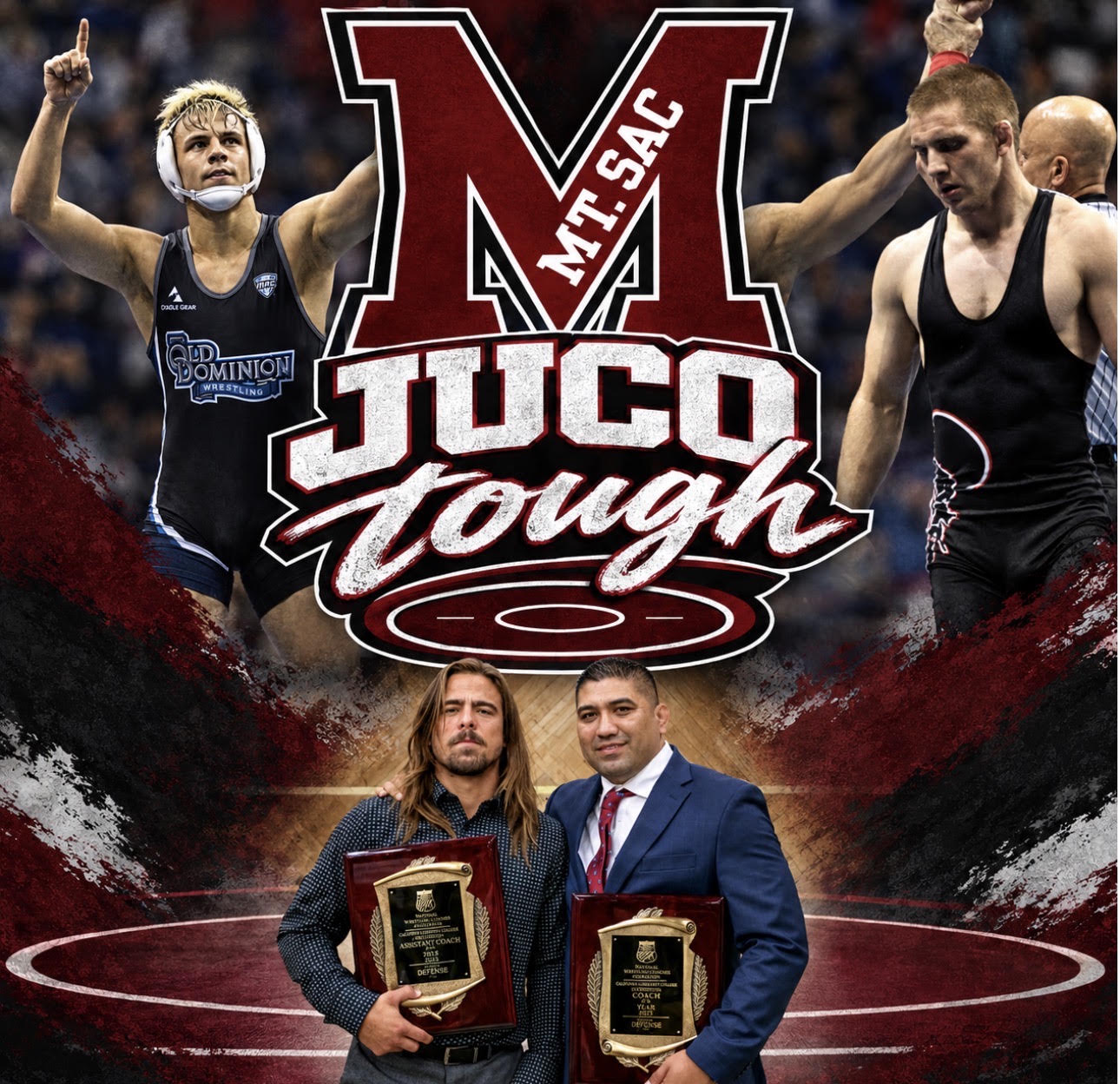

From a California Underdog to NCAA All-American, Division I Coach and JUCO Coach
By Aaron La Farge | JUCO Tough
Some wrestling careers begin with national rankings, powerhouse high schools, and expectations that a wrestler will eventually compete at the highest levels of the sport.
Chris Mecate’s story was different.
His path was built through competition, setbacks, opportunity, and a willingness to prove himself every time he stepped on the mat.
Long before Mecate became a two-time NCAA Division I All-American, four-time NCAA qualifier, Division I coach, junior college coach, and professional MMA fighter, he was a California youth wrestler beginning to make a name for himself.
Mecate was a California Triple Crown winner as a youth wrestler, but his development took another turn when he moved from La Habra, California to Redlands, California area during junior high years.
That move eventually led him to Redlands East Valley High School, where Mecate began building a career that would make him the most accomplished wrestler in school history.
Redlands East Valley was not traditionally viewed as one of California’s elite wrestling powers. It was not a program that carried the same national reputation as some of the state’s established wrestling dynasties.
Mecate didn’t seem concerned.
He built his own reputation.
As a freshman, he reached the California state podium, finishing sixth. As a sophomore, he defeated California state runner-up and NHSCA Senior National Champion Estevan Cabanas of Canyon Springs before a season-ending injury brought his season to an early conclusion.
The setback did not stop his progression.
Instead, it became another chapter in a career that repeatedly demonstrated Mecate’s ability to respond to adversity.
Before the State Championship Came the Super 32
One of the most interesting parts of Mecate’s high school career is that he became a Super 32 champion before he became a California state champion.
For a wrestler who was not coming from one of the state’s traditional powerhouse programs, winning Super 32 was a significant statement.
Super 32 has long attracted some of the best high school wrestlers in the United States. State champions, nationally ranked wrestlers, future NCAA All-Americans regularly enter the tournament and still do.
Mecate did not just compete.
He won it.
Along the way, he defeated accomplished wrestlers from around the country, including athletes who would eventually compete successfully at the NCAA and college level.
That victory helped establish something that would become a theme throughout Mecate’s career: he was capable of competing with wrestlers who were receiving far more attention than he was.
He would later add another major tournament accomplishment by winning the Doc Buchanan Invitational.
Then came the California state championship.
In 2011, Mecate captured the California state title at 135 pounds, defeating Shane Yacuta of Porterville in a 7-2 decision.
The state championship validated what Mecate had already been showing for years.
He belonged.
One of California’s Toughest Brackets
To understand just how difficult Mecate’s high school career was, look no further than the 2010 California state tournament during his junior year.
Mecate finished fifth at 125 pounds in a bracket loaded with future NCAA champions.
Among those wrestlers was Isaiah “IMAR” Martinez of Lemoore, who would go on to become a two-time NCAA Division I champion.
Mecate defeated Martinez on the front side of the bracket.
Martinez eventually finished third.
Another wrestler in the bracket was Jesse Delgado of Gilroy, who would also become a two-time NCAA Division I champion. Delgado finished fourth.
Mecate finished fifth.
Years later, those results provide a preview of the level of competition Mecate was facing while still in high school.
He wasn’t simply wrestling against accomplished California high school wrestlers.
He was wrestling against future NCAA champions.
And he was beating them.

The Jump to Division I
After high school, Mecate took the next step in his development at Old Dominion University in Norfolk, Virginia.
The transition from high school wrestling to college wrestling and NCAA Division I wrestling can expose weaknesses quickly.
His college career ultimately produced four NCAA Division I Championship appearances and two NCAA All-American finishes, placing sixth and fifth.
But the road to those accomplishments was not without difficult moments.
One of those moments came during his sophomore season.
Mecate entered the NCAA Championships as a seeded wrestler but lost to an unseeded opponent who eventually went on to become an All-American.
For many wrestlers, that kind of loss can become a defining disappointment.
For Mecate, it became a lesson.
The NCAA tournament taught him that rankings, seeds and expectations disappear once the whistle blows.
Every opponent has to be respected.
Every match has to be prepared for.
Every opportunity has to be earned.
Those lessons would eventually influence the coach he became.
What Old Dominion Taught Him
Mecate speaks highly about the impact his coaches at Old Dominion had on his development.
The lessons went beyond wrestling technique.
They included extreme ownership, self-reliance, preparation, work ethic, and accountability.
Nobody was going to do the work for you.
Those principles stayed with Mecate after his wrestling career.
They would become part of his coaching philosophy.
After completing his career at Old Dominion, Mecate returned to Norfolk, VA as an assistant coach.
During his two seasons with the Monarchs, he helped guide 157-pounder Larry Early to NCAA Division I All-American honors and coached seven additional athletes to NCAA Division I Championship appearances.
Mecate was no longer simply learning how to become a better wrestler.
He was learning how to develop wrestlers.
That distinction would become increasingly important.
Bringing Division I Experience Back to California
Mecate eventually returned to California and joined the wrestling staff at Mt. San Antonio College.
That move would connect the next chapter of his career with one of the most important themes in junior college wrestling: development.
Mecate joined the Mt. SAC program in 2019 and became part of a coaching staff that helped establish the Mounties as one of the premier junior college wrestling programs in California and the country.
The results have been significant.
Mt. SAC captured 3C2A team championships in 2021, 2023, and 2024, while finishing as runner-up in 2022.
Mecate’s Division I wrestling and coaching background gave Mt. SAC athletes access to someone who had experienced the highest levels of collegiate wrestling from multiple perspectives.
He knew what college wrestling demanded because he had lived it.
He knew what the NCAA national tournament felt like because he had competed there four times.
He knew what it took to become an All-American because he had done it twice.
And now he could pass those lessons on.
In 2023, Mecate was recognized by the National Wrestling Coaches Association as the Junior College Men’s Assistant Coach of the Year.
The JUCO Pipeline
Perhaps one of the most important parts of Mecate’s coaching career has been his role in helping wrestlers use junior college wrestling as a bridge to four-year programs.
Mt. SAC has helped numerous wrestlers earn 3C2A championships and All-American honors before continuing their careers at NCAA four-year institutions.
Athletes from the program have moved on to schools including the University of Wyoming, Long Island University, Morgan State, Glenville State, Grand View University, and New York University, among others.
Two examples stand out.
Zachary Parker continued his career at Glenville State and earned NCAA Division II All-American honors.
Mo Talebi went on to New York University and became an NCAA Division III national champion.
For Mecate, those athletes represent more than names on a list.
They represent the purpose of junior college wrestling.
JUCO can provide an athlete with another opportunity to develop, gain confidence, improve academically and athletically, and build a résumé that can open doors at the four-year level.
For athletes who may not have received the scholarship opportunity they wanted immediately after high school, junior college can provide another route toward the same destination.
Mecate’s own career gives him credibility when discussing that pathway.
He understands what it means to take the next step.
Building Wrestlers Beyond the Mat
Mecate’s coaching philosophy extends beyond takedowns, escapes, turns, and finishes.
He understands the demands placed on college athletes because he has experienced them himself.
Time management becomes critical.
Academic responsibilities have to be handled.
Training has to remain consistent.
Recovery matters.
Mental preparation matters.
And athletes have to learn how to take ownership of their development.
Those lessons are particularly important for junior college wrestlers who are trying to position themselves for opportunities at four-year universities.
Mecate brings the perspective of someone who has competed at the college level, coached at the Division I level, coached junior college wrestlers, and worked with athletes at the club level.
That combination gives him a great understanding of the wrestling pipeline.
The Next Chapter: MMA
Even after reaching the highest levels of collegiate wrestling and establishing himself as a coach, Mecate wasn’t finished competing.
He transitioned into professional mixed martial arts.
Mecate has compiled a 12–3 professional record and has defeated fighters with UFC experience or currently in the UFC now those include Jose Delgado, Jay Perrin, Javier Reyes, and Manuel Exposito, who competed on the UFC’s Contender Series.
Mecate now competes in Legacy Fighting Alliance (LFA), one of the prominent organizations in the United States that feeds right into the UFC.
While pursuing his own MMA goals, he continues to coach wrestling at Credo Elite Wrestling Club in Anaheim, California, located at Servite High School.
It is another example of the unusual path Mecate has taken.
Wrestler.
All-American.
Coach.
JUCO coach.
MMA fighter.
And still a teacher of wrestling.
The Message Behind the Career
There is a larger lesson in Chris Mecate’s career.
Not every great wrestler begins at a nationally recognized powerhouse.
Not every athlete receives immediate national recognition.
Not every setback means the journey is over.
Sometimes the path requires another opportunity.
Sometimes it requires a different program.
Sometimes it requires a junior college.
Sometimes it requires losing a match that teaches you more than a victory ever could.
Mecate’s career demonstrates the value of continuing to develop.
From Redlands East Valley to Old Dominion.
From NCAA competitor to Division I coach.
From Division I coaching to Mt. SAC a junior college.
From junior college coaching to helping athletes reach four-year programs.
And now from wrestling to professional MMA while continuing to develop the next generation of wrestlers.
His career has never followed a straight line.
But every chapter has contributed to the next one.
A Voice for the JUCO Path
That is why Mecate’s perspective is particularly valuable to the Simple Man–JUCO Tough section.
He has experienced wrestling from almost every level.
He knows what it means to be the wrestler trying to prove himself.
He knows what it means to compete at the NCAA Division I Championships.
He knows what it means to coach at the Division I level.
And he knows what it means to develop wrestlers at the junior college level.
His message to athletes considering JUCO is straightforward: View it as another opportunity to build your future.
For some wrestlers, that opportunity can change the trajectory of an entire career.
Chris Mecate is living proof of what can happen when an athlete continues to develop, embraces setbacks, takes ownership of the process. Simple Man Wrestling would like to thank Chris Mecate for taking the time to complete this interview and for sharing the story behind a career that continues to evolve.
From California’s high school mats to Madison Square Garden in New York City, from NCAA All-American to coach, and now from the wrestling room to the MMA cage, Chris Mecate’s journey.

Chris Mecate — Q&A
1. You had a great wrestling career, including being a two-time NCAA Division I All-American at Old Dominion University, a California State Champion, and a Super 32 Champion. Looking back, what experiences had the biggest impact on your development as a wrestler?
I am blessed to have had the career I had, and it wasn’t without its ups and downs, like any journey. I would say there were a few impactful moments from each chapter of my career, starting in elementary school and continuing all the way through college.
Competitively, I had some great wins that I wasn’t supposed to have, and those were really defining moments in my career. On that same note, I had some tough losses that really lit a fire under me and took me to another level in my training.
One moment that really impacted my career was my sophomore year at the NCAA Championships. I was seeded fifth and expected to place high at the tournament, but I received a very harsh lesson in never looking too far into the future and remembering that the present is all I can control.
I was too worked up and looking ahead in the bracket, and I lost to two guys whom I had beaten earlier in the year. I remember watching the podium ceremony and seeing multiple guys whom I had beaten standing on the podium while I was sitting in the stands. It was a moment of competitive heartbreak.
That experience forced me to do some serious internal work. In my next two NCAA tournaments, I was seeded lower than I had been during my first two tournaments, yet I performed better and earned All-American honors both years because of the lessons I took with me from that sophomore season.
My mantra before each match was, “Cool, calm and collected.” I would say that to myself before walking out, and it helped me get into a flow state and wrestle better than I ever had.
2. Winning the Super 32 Championship is one of the biggest accomplishments in high school wrestling. What did winning that tournament mean to you at the time, and how did that experience prepare you for the next level?
At the time I won Super 32, I was going into my junior year and hadn’t won a state title yet. I remember that in my bracket, almost every guy I wrestled was a state champion from his home state.
I was really flying under the radar.
Beating all of the guys I did on the way to the finals and then sealing the deal in the finals, in front of all those college coaches, really boosted my confidence. On paper, I didn’t have some of the accolades that my peers had at that time, but I was able to go out there and beat multiple state champions and multiple future NCAA All-Americans.
That one tournament really boosted my national stock. I was suddenly on the national radar, and that’s when a lot of college coaches began reaching out and recruiting me.
Competing in and winning that tournament also helped prepare me for the next level because it did a really good job of replicating a Tier 1 college tournament. You’re going to have battles with elite competitors from Match 1 until the last match, and you have to be able to get yourself into an elite competitive mental state for every single match.
That isn’t necessarily the case for most high school tournaments. In college, the elite guys are the ones who know how to get themselves ready for every single match, and Super 32 was really good preparation for that.
3. You went on to become a two-time NCAA Division I All-American at Old Dominion. What was the biggest adjustment you had to make when you transitioned from high school wrestling to college wrestling?
There were many technical adjustments I had to make from high school to college, but one of the main ones I really had to work on was staying in the hand fight for a lot longer to set up my attacks. The other was finishing once I got to an attack.
I felt like I was a good hand fighter and pretty physical for a high school wrestler, but once you hit the next level, it becomes such an essential skill set to wrestle from a much closer distance. You have to use your hands and feet in a more dynamic and physical way to get to your attacks.
In high school, I would say it requires half the effort to get to attacks.
The second part was realizing that once you get to an attack, the battle has really just begun. Fighting for scores and being determined once you’re on a leg or have a front headlock is another crucial skill I really had to hone in my wrestling.
In college, guys will fight to the bitter end not to get taken down, so you have to raise your technical prowess and intensity in both the hand fight and your finishing sequences.
4. What did you learn from your time at Old Dominion, both on and off the mat, that has stayed with you and influenced you as a coach?
I honestly can’t put into words all of the lessons I learned during my time wrestling at ODU. There are so many distinct moments—from specific matches to practices to conversations with coaches—that I reference during my daily life. Those experiences have helped me navigate both my coaching career and my fight career.
One of the big lessons and themes that I received during my time there was extreme ownership, which was preached and expected of us.
The coaching staff at ODU really helped form me into a man and taught me how to take matters into my own hands and create my own destiny because you can’t expect anyone else to do the work for you.
The culture built a sense of self-reliance in me and an expectation to win. That really meant putting in the necessary work required to give yourself the highest chance possible to be successful.
I’m extremely grateful for all of those lessons from the coaches and the matches I had. I still carry them with me to this day.
5. After competing at a high level, what motivated you to get into coaching and eventually become part of the Mt. San Antonio College wrestling program?
I always had a knack for teaching and coaching, so once I graduated, they asked me to stick around and coach and mentor some of the younger guys on the team. I did that and really enjoyed my time doing it.
After coaching there for a couple of years, I decided to move back to California and pursue my MMA career. When I moved back, Coach Rivera from Mt. SAC reached out to me to see if I’d be interested in coaching while I was training.
I said yes and immediately got to work.
6. Mt. SAC has established itself as one of the top junior college wrestling programs in California and the country. What makes the program and wrestling culture at Mt. SAC special?
I spent five seasons coaching at Mt. SAC, and during that time we won the 3C2A Championships three times and had one second-place finish.
Working with Coach Rivera, Coach Dominguez, Coach Watanabe, and Coach Seanez at Mt. SAC was an awesome experience. Those guys were true professionals.
It really made me feel good to help coach some of those athletes, watch the success they achieved, and see some of them go on to wrestle at four-year universities across the country.
One thing about Mt. SAC is that the expectation for excellence across all sports is very prevalent. They’ve had state and national success in many of their programs, so when I got there, the message was clear: Winning is part of the school culture, and it’s your job to continue to uphold that standard.
I tried my best to make sure I did my part in guiding these guys and helping them reach their potential. The administration gave us so much support in our pursuit of 3C2A Championships.
7. As a coach working with junior college wrestlers, what are some of the biggest challenges these athletes face when they are trying to develop and reach the next level?
One thing that really stuck out to me was that the majority of junior college athletes are trying to balance multiple things while also competing with no promises of going to the next level and continuing their athletic careers.
A lot of the guys had to work jobs during the season and maintain high academic standards while also trying to reach their goals on the mat.
As an athlete, that is no easy task because you have to find that balance between academics and athletics, which is standard for all college athletes. But because there aren’t scholarship opportunities in the same way as at the NCAA level, you often have to find ways to provide for yourself, which athletes at the NCAA level typically don’t have to do.
What I noticed during my time at Mt. SAC was that the guys who had to do that developed incredible focus and time-management skills. Those skills carried with them when they went on to the next level of their wrestling careers.
8. You have experienced wrestling at the high school, NCAA Division I, and junior college levels. How has competing and coaching at those different levels shaped your philosophy about developing wrestlers?
Because I’ve competed and coached at all different levels, you see that no two people are the same, and you have to adapt your coaching to the specific athlete.
You cannot take anything for granted. It’s your job to be able to adapt to the specific athlete, meet them where they are, and help nurture and build them from there.
Everyone has different backgrounds, family dynamics, and experience levels, so there’s no “one-size-fits-all” model that you can use.
9. What did you look for when recruiting a wrestler to Mt. SAC beyond their wrestling ability? What characteristics tell you that an athlete has the potential to succeed in your program?
Some of the main characteristics we looked for during the recruiting process when I was at Mt. SAC were an athlete’s work ethic, how coachable they were, and how they approached their academics.
It didn’t matter what an athlete’s high school credentials were or whether they had an extensive wrestling background. If they showed those traits and bought into the training and lifestyle we expected them to live, they left the program better than when they arrived.
Many athletes have come back and told me how much their time wrestling at Mt. SAC has helped them in their careers and adult lives.
That’s a reward for me as a coach that’s hard to quantify.
10. Mt. SAC has helped numerous wrestlers continue their careers at four-year universities. What advice would you give to current and future junior college wrestlers who want to use their two years at a JUCO as a stepping stone to NCAA wrestling?
I would tell the guys on the team who had aspirations to go on and continue wrestling that their time with us was very short, so use it accordingly.
Whatever their reason was for choosing Mt. SAC, they needed to put as much as possible into those two years so they could get the biggest payout once they left.
Whether it was to boost their academic profile and raise their GPA or simply improve their wrestling prowess, we were a pit stop that would tune them up and help them get ready to go out and continue to race.
There were so many cases of athletes who really went all in and took advantage of everything Mt. SAC had to offer, both athletically and academically, and they went on to outperform even their own expectations.
They used us as a proper pit stop to fix anything they needed to fix before they continued on to finish their race.
So every athlete I talk to now who isn’t sure about what to do after high school and maybe doesn’t have the offers they would like, I recommend JUCO as a great way to improve their profile for four-year coaches and continue to pursue their dreams.
Photo Courtesy: John Sachs / Tech Fall, Old Dominion University athletics & wrestling, Legacy Fighting Alliance (LFA)
Leave a Reply