
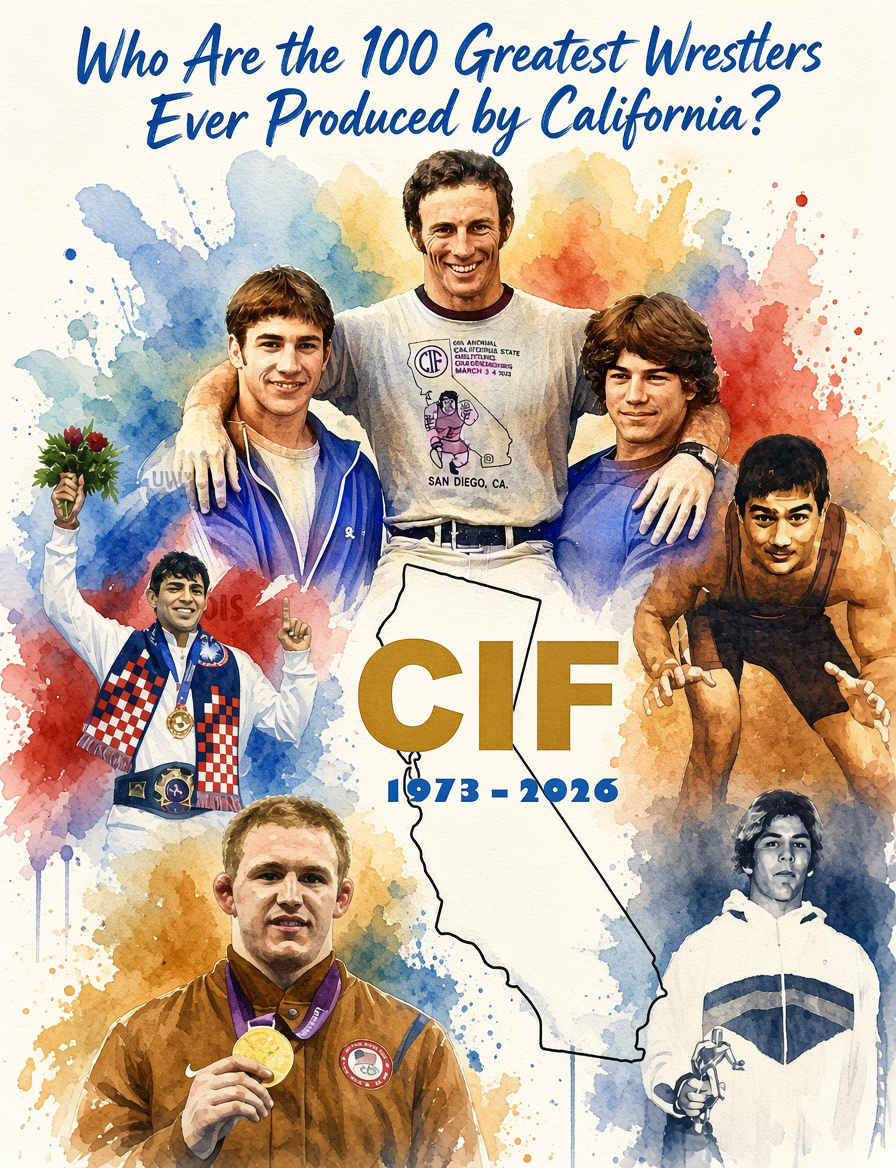

That seemingly simple question sparked what would become one of the most ambitious wrestling projects I’ve undertaken.
Over the past year, I developed a series of articles examining California’s greatest wrestlers, beginning with the inaugural CIF State Wrestling Championships in 1973 and continuing decade by decade through 2026. The series highlighted athletes who made their mark not only on California’s high school wrestling landscape, but also at the collegiate level and, ultimately, on the international stage at the Olympic Games and World Championships.
Then, not long after the series began, fellow wrestling colleague Bryan Battisto posed a question that stopped me in my tracks:
“Who do you think are the Top 100 wrestlers to come out of California over the past 50-plus years?”
At first glance, the question seemed relatively simple to answer.
Where better to begin than with the legendary Schultz brothers, Dave and Mark?
Both brothers captured CIF State championships in California before continuing their careers at the University of Oklahoma, where each became an NCAA champion and All-American. But their accomplishments didn’t stop there. They went on to reach the absolute pinnacle of the sport, representing the United States at the 1984 Olympic Games and capturing Olympic gold. Both also added World-level gold medals to their remarkable résumés.
Two brothers. Two CIF State champions. Two NCAA champions. Two Olympic champions. Two World champions.
If identifying California’s greatest wrestlers were really that simple, perhaps compiling a Top 100 would be easy.
It isn’t.
Make no mistake—this is no simple task. Identifying California’s all-time wrestling elite will require extensive research, careful consideration, and a deep dive into more than five decades of remarkable careers.
California has produced an extraordinary collection of wrestlers who have captured state titles, dominated at the collegiate level, won NCAA championships, earned All-American honors, represented their countries on the international stage, and brought home Olympic and World Championship medals.
The deeper I went, the more apparent it became that answering the question would require more than simply compiling a list of names and accomplishments.
I needed a consistent way to measure wrestlers from different generations, different eras, different weight classes, and different levels of achievement.
That led to the development of a four-tier system.

Establishing the Tiers
The first phase of this challenge was determining how best to measure and organize California’s extraordinary depth of talent.
With such a long list of accomplished wrestlers, I determined that the most effective way to streamline the process was to place California’s elite wrestlers into four distinct tiers.
These tiers provide a framework for evaluating athletes based on the level at which they distinguished themselves and the heights they ultimately reached in the sport.
TIER 1 — Olympic & World Medalists
Wrestlers who distinguished themselves through exceptional high school and collegiate careers and ultimately reached the highest levels of the sport by earning medals at the Olympic Games and/or World Championships.
TIER 2 — Olympic & World Team Members
Wrestlers who distinguished themselves through exceptional high school and collegiate careers while also earning the distinction of representing their country on an Olympic or World Championship team.
TIER 3 — Collegiate All-Americans
Wrestlers who distinguished themselves through exceptional high school and collegiate careers, including those who earned NCAA All-American honors.
TIER 4 — High School Standouts
Wrestlers who distinguished themselves through exceptional high school careers, establishing themselves among California’s premier prep wrestlers.
This tiered approach does not, by itself, determine who belongs in the Top 100.
Rather, it establishes a starting point and a common measuring stick for evaluating an incredibly accomplished group of athletes.
It is also important to emphasize that the tiers are not intended to function as a rigid ranking system.
Placement within a particular tier identifies the level at which a wrestler’s strongest documented accomplishments occurred. It does not automatically determine that one wrestler is greater than another simply because he appears in a higher tier.
A Tier 4 wrestler is not automatically excluded from consideration for the Top 100, nor is every Tier 1 wrestler automatically guaranteed a particular numerical position.
The final Top 100 will be determined holistically, with consideration given to:
- Level and quality of competition
- Championships won
- High school accomplishments
- Collegiate accomplishments
- NCAA championships and All-American honors
- National-level success
- Olympic and World Championship achievement
- Longevity
- Consistency
- Career peak
- Overall significance within California wrestling history
There is simply no rigid mathematical formula that can adequately capture all of those factors across more than five decades.
Ranking vs. Clustering
There is also a possibility that the final Top 100 will not be presented as a traditional ranking from No. 1 through No. 100.
Given the extraordinary depth of California wrestling and the difficulty of comparing wrestlers from different generations, eras, weight classes, competitive opportunities, and circumstances, the final selections may instead be presented in clusters or groups of wrestlers whose overall careers are comparable in significance.
In other words, rather than attempting to determine that one wrestler is definitively No. 37 and another is No. 38, the final Top 100 could be organized into clusters of elite wrestlers, using the same general tier concept established in this article.
This approach recognizes an important reality of an all-time ranking:
The difference between two extraordinarily accomplished wrestlers may be far smaller than a numerical ranking suggests.
A wrestler ranked No. 25 is not necessarily meaningfully greater than the wrestler ranked No. 35 simply because of a ten-position difference on a list.
In many cases, careers may be separated by circumstances, competitive eras, opportunities, weight classes, longevity, or the particular path each wrestler followed.
Therefore, the ultimate goal may not be to force California’s wrestling history into a perfectly ordered 1 through 100.
Instead, the goal is to identify the 100 wrestlers whose collective accomplishments, impact, and significance place them among the greatest wrestlers California has produced, and then organize those wrestlers into meaningful clusters that better reflect the closeness of their careers.
Perhaps the final list will include an elite cluster, followed by additional clusters representing wrestlers whose accomplishments place them within a similar range of overall greatness.
Perhaps the final product will combine clusters with numerical rankings.
That decision will come later.
For now, the objective is to identify the strongest candidates.
And therein lies the real challenge.
Because once the names begin filling the tiers, the question becomes even more difficult:
How do you separate the great from the truly exceptional?
A CIF State champion is an extraordinary accomplishment.
An NCAA All-American represents an even higher level of achievement.
An NCAA champion stands above them.
And then there are those who went even further—representing their country on the world’s biggest stages and winning Olympic and World Championship medals.
But how should those accomplishments be weighed against one another?
How do you compare a dominant wrestler from the 1970s with one from the 1990s, 2000s, 2010s, or 2020s?
How much weight should be given to high school dominance? Collegiate success? International achievement? Longevity? Championships? The quality of competition?
Those questions—and many others—became central to the process.
California Wrestling’s Elite: A Snapshot of Greatness from 1973 Through 2026
California has long occupied a unique place in the history of American wrestling.
Since 1973, the state has produced an extraordinary number of wrestlers who have excelled at the high school, national, collegiate, and international levels.
From CIF State champions to NCAA champions, and from U.S. national champions to Olympic and World medalists, California’s wrestling legacy is both extensive and remarkably deep.
The challenge, however, is determining how to evaluate such a large and accomplished group of wrestlers.
When the list of candidates includes Olympic champions, World champions, NCAA champions, multiple-time All-Americans, national champions, and generations of dominant high school wrestlers, simply identifying the state’s greatest wrestlers becomes a daunting task.
It is also important to emphasize that this is only a snapshot of California’s wrestling history.
The list is not all-inclusive.
There are undoubtedly many accomplished wrestlers who are not represented here. The purpose is to provide a sampling of the extraordinary talent California has produced from 1973 through 2026—not to suggest that this list represents every wrestler deserving of consideration.
The inclusion of wrestlers from the most recent generation also adds another dimension to the project.
Some of the newest athletes have already accomplished enough to warrant serious consideration, while others are still writing their stories at the collegiate level.
That makes the 2020s particularly fascinating.
Some careers are complete.
Others are just beginning.
TIER 1 — All-Time Greats
Tier 1 represents the very highest level of achievement.
These wrestlers distinguished themselves at the high school and collegiate levels and ultimately reached the pinnacle of the sport through Olympic and/or World Championship success.
Dave Schultz and Mark Schultz provide perhaps the clearest examples.
Both emerged from Palo Alto High School and went on to become NCAA champions and Olympic champions at the 1984 Los Angeles Games. Dave Schultz was also a World champion and six-time World medalist, while Mark Schultz captured two World championships.
Stephen Abas established one of the greatest careers in California wrestling history. A three-time CIF State champion and four-time NCAA All-American, Abas won three NCAA Division I championships at Fresno State before earning an Olympic silver medal in 2004.
Jake Varner combined California high school excellence with collegiate and international success, winning two NCAA championships at Iowa State before capturing Olympic gold in 2012.
Zahid Valencia represents the more recent generation of California excellence. A three-time CIF State champion, two-time NCAA champion, three-time NCAA All-American, and UWW World champion, Valencia continued a tradition established by previous generations of California standouts.
Jamill Kelly reached the Olympic podium with a silver medal at the 2004 Games, while Robby Smith became a World bronze medalist and 2016 Olympian.
Collectively, these wrestlers demonstrate what places an athlete in the highest tier: exceptional success at multiple levels of the sport, culminating in Olympic and/or World-level achievement.
TIER 2 — High School, Collegiate, Olympic and World-Level Competitors
Tier 2 includes wrestlers who achieved exceptional success at the high school and collegiate levels and went on to represent the United States or another nation on the Olympic or World stage.
John Azevedo was a two-time CIF State champion, three-time NCAA Division II champion, NCAA Division I champion, and two-time Division I All-American before making the 1980 Olympic team.
Joe Gonzales combined a Junior National championship with an NCAA Division I championship and two NCAA Division II championships before becoming a 1984 Olympian.
Tim Vanni was a two-time Olympian and placed fourth at the 1988 Seoul Olympics.
Mark Fuller became a five-time U.S. Senior National champion and four-time Olympic team member in Greco-Roman wrestling.
Dan Henderson was a two-time CIF State medalist, two-time Junior National champion, and member of two Olympic teams in 1992 and 1996.
Eric Guerrero compiled an extraordinary résumé that included three CIF State championships, a Junior National championship, three NCAA Division I championships, and four NCAA All-American honors before becoming a 2004 Olympian.
Stephen Neal was a two-time NCAA champion and four-time All-American before winning a World championship.
Boris Navachkov, meanwhile, combined two CIF State championships with multiple national age-group accomplishments, three NCAA All-American honors, and an Olympic appearance for Bulgaria.
Perhaps one of the most unique athletes in this tier is Aaron Pico.
Pico wrestled only one season of high school wrestling, yet during that period he won a CIF State championship, Cadet World championship, two Junior World medals, multiple Fargo championships, and numerous national honors.
But Pico’s résumé becomes even more remarkable when the level of competition he defeated while still a high school athlete is taken into consideration.
In 2014, at just 17 years old and while still a high school athlete, Pico defeated Zain Retherford in the finals of the FILA Junior National freestyle championships. Retherford was a true freshman at Penn State at the time and had already finished fifth at the NCAA Division I Championships that season.
Pico defeated him 7-0.
Pico continued to defeat Retherford at the Junior level, including another victory in the 2015 UWW Junior National finals.
Then, in 2016, at just 19 years old, Pico faced another established collegiate star, Jordan Oliver, at the U.S. Olympic Team Trials.
Oliver was a two-time NCAA champion at Oklahoma State and entered the tournament as the No. 2 seed.
Pico rallied from a 6-2 deficit to defeat Oliver 11-9, advancing through one of the most talent-filled brackets in the tournament.
Those victories provide important context when evaluating Pico’s place in California wrestling history.
His accomplishments cannot be measured solely by the number of high school seasons he wrestled or by the absence of a traditional collegiate career.
While still a teenager, Pico was defeating wrestlers who had already established themselves as some of the nation’s best collegiate competitors.
That distinction is significant.
Pico wasn’t simply a highly recruited high school prospect competing successfully against his peers.
He was competing against—and defeating—NCAA All-Americans and NCAA champions while still in his teenage years.
His career demonstrates that international achievement can sometimes occur without a traditional four-year high school or collegiate career.
In Pico’s case, his résumé includes something even more unusual:
the ability to defeat elite collegiate wrestlers while he was still competing as a high school athlete.
Together, these athletes demonstrate California’s ability to produce competitors capable of reaching the highest levels of national and international wrestling.
TIER 3 — Exceptional High School and Collegiate Accomplishments
Tier 3 represents wrestlers with exceptional high school credentials who also achieved significant collegiate success, including NCAA championships and All-American honors.
This is where the depth of California wrestling becomes particularly evident.
Steve Barrett of Miraleste High School was one of California’s early elite wrestlers, winning a CIF State championship at 138 pounds in 1973, the inaugural year of the CIF State Wrestling Championships. Barrett was also recognized as a Wrestling USA Magazine All-American before continuing his career at Oklahoma State University, where he became an NCAA Division I champion and three-time All-American.
Marty Kistler was a four-time CIF State finalist and two-time NCAA champion.
David Lee of Bella Vista High School made California wrestling history in 1984 by becoming the first wrestler to win three CIF State championships. Lee also captured a Junior National championship in freestyle and earned two national All-American honors in freestyle and Greco-Roman wrestling. He continued his career at Stanford and Wisconsin, ultimately becoming an NCAA Division I champion and three-time All-American.
Darryl Vasquez of Bakersfield High School established himself as one of California’s most accomplished high school wrestlers, making history in 2002 by becoming the first wrestler to win four CIF State championships.
Vasquez was also an NHSCA Senior High School All-American, an Amateur Wrestling News All-American, a Wrestling USA Magazine Dream Team All-American, and earned three ASICS All-American honors, including two second-team and one third-team selections. He continued his career at Cal Poly San Luis Obispo, where he became a two-time NCAA Division I All-American.
Laurence Jackson was a three-time CIF State champion and three-time Junior National champion before becoming a two-time NCAA Division I All-American.
Adam Tirapelle combined two CIF State championships with an NHSCA Senior National championship, multiple national age-group honors, and an NCAA championship at Illinois.
Mark Munoz was a two-time CIF State champion and NHSCA Senior National champion before becoming an NCAA champion at Oklahoma State.
Chris Pendleton won a CIF State championship and two NCAA championships at Oklahoma State.
Nathan Morgan was a three-time CIF State champion, four-time state medalist, and three-time NCAA All-American.
Jesse Delgado combined a CIF State championship with an NHSCA Senior National championship and two NCAA championships at Illinois.
Nahshon Garrett was a two-time CIF State champion and NCAA champion, earning four NCAA All-American honors.
Morgan McIntosh was a three-time CIF State champion and three-time NCAA All-American at Penn State.
Joey Davis may have one of the most statistically remarkable collegiate careers in the group. After an exceptional California high school career, Davis became a four-time undefeated NCAA Division II champion, finishing his collegiate career with an extraordinary 133-0 record.
Isaiah Martinez was a three-time CIF State champion, two-time NCAA champion, and four-time NCAA All-American at Illinois.
Nick Nevills was a three-time CIF State champion and four-time state medalist before becoming a two-time NCAA All-American at Penn State.
Jason Welch, Evan Wick, Kyle Parco, Chris Mecate, Anthony Valencia, and numerous others further illustrate the remarkable number of California wrestlers who went on to become NCAA All-Americans.
And the newest generation is already adding its name to this remarkable tradition.
Gerry Abas (Oakland Tech, OS), 1990, earning two CIF State medals, a Junior National title, Abas went on to earn a rare four NCAA Division I All-American honors for Fresno State University.
Richard Figueroa (Selma, CS), 2020, was a three-time CIF State champion who continued his career at Arizona State University, where he became an NCAA Division I champion.
Aden Valencia (Sobrato, CC), 2022, added another remarkable chapter to the Valencia family wrestling legacy. After earning a CIF State medal, Valencia continued his career at Stanford University, where he became an NCAA Division I champion.
Cody Merrill (Gilroy, CC), 2024, represents another member of California’s emerging collegiate generation. Merrill captured two CIF State championships before continuing his career at Oklahoma State University, where he became an NCAA Division I All-American at 285 pounds.
The accomplishments of these recent wrestlers demonstrate that California’s pipeline of elite talent did not end with the generations of the 1970s, 1980s, 1990s, or 2000s.
It continues today.
The sheer depth of this tier is significant. These are not simply wrestlers who enjoyed successful high school careers. Many became state champions, national champions, NCAA champions, and multiple-time collegiate All-Americans.
And the most recent generation is already proving capable of carrying that tradition forward.
TIER 4 — Exceptional High School and National-Level Accomplishments
Tier 4 recognizes wrestlers whose accomplishments were particularly distinguished at the high school and national age-group levels, even though they did not go on to achieve the same level of collegiate or international distinction represented in the higher tiers.
Placement in Tier 4 should not be interpreted as a ranking below the wrestlers in Tiers 1–3.
It simply identifies athletes whose strongest documented accomplishments occurred at the high school and national levels.
This category should not be mistaken for a collection of ordinary state champions.
Many of these wrestlers were multiple-time CIF State champions, state finalists, NHSCA national champions, Junior National champions, Fargo All-Americans, and nationally recognized high school All-Americans.
Glenn Cooper was a two-time CIF State champion and two-time Junior National champion.
Jimmy Aguirre won three CIF State championships and an NHSCA Senior National championship.
Tony Okada was a two-time CIF State champion, three-time state medalist, and Cadet National champion.
Scott Chapman won three CIF State championships and an NHSCA Senior National championship.
Carlos Blanco won two CIF State championships, an NHSCA Senior National championship, and national age-group honors.
Jacob Palomino was a three-time CIF State champion and four-time state medalist.
Ryan Halsey won a CIF State championship while also earning Cadet and Junior National championships and multiple national All-American honors.
Luis Bland won three CIF State championships and four state medals.
David Klingsheim won two CIF State championships and a Junior National championship.
Nikko Villarreal was a three-time CIF State champion and four-time state medalist.
Anthony Mantanona won a CIF State championship and multiple national age-group championships.
Seth Nevills accomplished the rare feat of winning four CIF State championships.
Alex Cisneros was a three-time CIF State champion and four-time state medalist.
The newest generation of California high school wrestling is also beginning to make its presence felt.
Jesse Vasquez (SJB/Santiago/Excelsior, S), 2020, established himself as one of California’s premier prep wrestlers, capturing four CIF State championships.
Rocklin Zinkin (Buchanan, CS), 2026, has already established himself among California’s elite high school wrestlers. Zinkin captured two CIF State championships and three state medals, compiling a remarkable state-tournament résumé of 2-1-1-1.
Moses Mendoza (Gilroy, CC), 2026, has also emerged as one of California’s newest elite prep wrestlers. Mendoza has captured two CIF State championships and three state medals, with a state-tournament résumé of 3-1-1.
These recent accomplishments are particularly important because the careers of the 2026 wrestlers are still developing.
Unlike retired athletes whose résumés can be evaluated in their entirety, today’s young stars have chapters yet to be written.
Some may ultimately become NCAA All-Americans.
Some may become NCAA champions.
Some may represent the United States internationally.
And perhaps one or more could eventually challenge for a place among California’s all-time greats.
For now, however, their inclusion demonstrates something important:
California’s tradition of producing elite high school wrestlers remains alive and well.
Again, these names represent only a portion of the wrestlers who could reasonably be considered for this category.
The Depth of California Wrestling
Taken collectively, these four tiers provide only a glimpse into the extraordinary depth of California wrestling from 1973 through 2026.
The names listed here represent only a fraction of the outstanding wrestlers who have competed under the California banner.
Countless additional state champions, state finalists, national champions, collegiate All-Americans, and international competitors could be added.
That depth may ultimately be the most compelling characteristic of California’s wrestling legacy.
The significance is not simply that California has produced Olympic champions, World champions, NCAA champions, and collegiate All-Americans.
It is that California has produced them in remarkable numbers and across multiple generations.
From the early 1970s through the 2020s, elite wrestlers have emerged from virtually every region of the state.
The list includes competitors from the Central Section, Southern Section, North Coast Section, Central Coast Section, San Joaquin Section, Sac-Joaquin Section, Oakland Section, San Diego Section, and other regions throughout California.
Even more impressive is the range of accomplishments represented.
California has produced wrestlers who dominated high school wrestling, excelled at the national age-group level, became NCAA champions and multiple-time All-Americans, and ultimately represented the United States or other nations on the world’s biggest stages.
And now, as the sport moves deeper into the 2020s, a new generation is already adding to that legacy.
Consequently, these four tiers should be viewed not as a definitive ranking, but as a representative cross-section of a much larger California wrestling tradition.
The challenge now becomes considerably more difficult:
Which of these wrestlers—and the many others not represented here—belong among the 100 greatest California wrestlers of the modern era?
And that final list may not necessarily be a rigid No. 1 through No. 100.
Instead, the eventual Top 100 may be organized into clusters of wrestlers whose careers are comparable in overall significance, allowing the list to recognize the extraordinary accomplishments of each athlete without creating artificial distinctions between wrestlers whose careers may be separated by only the smallest of margins.
The final structure will ultimately depend on the research, discussion, and debate that follows.
The Debate Begins
With this as our starting point, the debate is now open:
Which wrestlers deserve to be placed among the Top 100 wrestlers in California’s rich wrestling history from 1973 through 2026?
That question is not easily answered.
California has produced an extraordinary number of state champions, national champions, NCAA champions and All-Americans, as well as Olympic and World-level competitors.
Determining which 100 wrestlers rise above the rest will require more than simply counting championships.
High school dominance, collegiate success, national-level accomplishments, international achievement, quality of competition, longevity, consistency, career peak, and the overall significance a wrestler had within California wrestling history must all be considered.
There will be no simple mathematical formula that can adequately capture the careers of wrestlers separated by decades, eras, weight classes, competitive opportunities, and different paths through the sport.
The final ranking will therefore not be determined by a rigid point system.
Instead, each wrestler will be evaluated holistically, weighing the totality of his career and the circumstances surrounding his accomplishments.
And the final product may not even be a conventional ranking from No. 1 to No. 100.
There is a strong possibility that the 100 selections will instead be presented in clusters or tiers, grouping wrestlers whose overall accomplishments place them within a similar range of greatness.
Such an approach would allow the final list to recognize the remarkable depth of California wrestling without pretending that a numerical ranking can precisely distinguish between every great career.
The purpose is not to manufacture artificial separation.
The purpose is to identify the 100 wrestlers who have the strongest overall cases for being considered among California’s greatest, and then present those selections in a way that respects the complexity of comparing careers across more than five decades.
The final Top 100 list will be featured in a future article, following a period of significant debate, discussion, and evaluation within our wrestling circles, including conversations on wrestling podcasts and with coaches, wrestlers, historians, and others who have followed California wrestling over the past five decades.
There will undoubtedly be disagreements—and that is exactly what should make this process worthwhile.
I look forward to the debate.
However, if you believe a particular wrestler belongs among California’s Top 100, make the case.
Don’t simply provide a name.
Provide clear reasoning for your selection.
Explain what separates that wrestler from the many other accomplished athletes competing for one of those 100 spots.
Championships matter, but so do the circumstances in which they were achieved, the level of competition faced, national and international accomplishments, collegiate success, consistency, longevity, career peak, and the overall significance of the wrestler’s career.
After all, narrowing more than five decades of California wrestling excellence down to 100 names is going to require difficult choices.
There will be deserving wrestlers left off the list.
There will be spirited disagreements over those who make it.
And there will undoubtedly be arguments over who belongs at the very top.
That is part of the process.
Perhaps the final result will be a traditional No. 1 through No. 100 ranking.
Perhaps it will be a collection of elite clusters, grouping wrestlers whose careers are simply too close to separate meaningfully by numerical position.
Or perhaps it will ultimately be some combination of both.
Regardless of the final format, the objective remains the same:
to recognize and celebrate the extraordinary wrestlers who have helped make California one of the most significant wrestling states in American history.
From the pioneers of the 1970s to the legends of the 1980s and 1990s, from the NCAA champions of the 2000s and 2010s to the emerging stars of the 2020s, California’s wrestling story continues to be written.
The names may change.
The generations may change.
The competitive landscape may change.
But one thing remains constant:
California continues to produce exceptional wrestlers.
So, let the debate begin.
Who belongs among the Top 100 California wrestlers from 1973 through 2026?
More importantly—why?
NOTE: The research behind the California 100 is extensive—my master list of potential candidates and their accomplishments now exceeds 125 pages. The next challenge is narrowing that remarkable depth of talent into four tiers. I may release the full list in the near future, giving everyone access to the data and an opportunity to join the debate over who belongs among California’s all-time greats.
Photo images courtesy of John Sachs (Tech-Fall.com), Tony Rotundo (Wrestlers are Warriors), and California Wrestling archives.
Follow me on X @Coach_Al_1984 | on Instagram @tier_one_idaho | on Facebook @TIER1 WRESTLING


Leave a Reply