
A Century of Champions, Wrestling Dynasties, and Global Transformation

The Enduring Legacy of Olympic Greco-Roman Wrestling
Greco-Roman wrestling remains one of the foundational traditions of the modern Olympic Games and the oldest continuously contested wrestling discipline in Olympic history. Since its introduction at the inaugural 1896 Athens Olympic Games, the sport has evolved from a primarily European competition into a truly global championship featuring elite athletes from every region of the world.
Defined by upper-body technique, explosive throwing ability, balance, strength, and tactical precision, Greco-Roman wrestling has produced some of the greatest champions and most dominant national programs in Olympic history. Unlike freestyle wrestling, which allows attacks below the waist, Greco-Roman prohibits leg attacks, placing greater emphasis on upper-body control, clinching, defensive positioning, and strategic execution.
Throughout more than 125 years of Olympic competition, the sport has reflected broader changes in global athletics. Scandinavian nations established the technical foundation during the early Olympic era, Eastern European countries developed powerful wrestling systems, and the Soviet Union created one of the most successful Olympic sports programs ever assembled. Following the Soviet collapse, its wrestling traditions spread across newly independent nations, while countries such as Cuba, Iran, Japan, South Korea, China, and Turkey emerged as major international powers.
The history of Olympic Greco-Roman wrestling is ultimately a story of champions, national pride, and global transformation—from Germany’s Carl Schuhmann, the first Olympic wrestling champion in 1896, to Cuba’s Mijaín López, the first wrestler in Olympic history to win five consecutive individual gold medals.
The Evolution of the Olympic Greco-Roman Tournament
The Olympic Greco-Roman wrestling tournament has undergone significant transformation as the Games expanded and adapted to international competition.
At the first modern Olympics in Athens in 1896, only one wrestling division was contested—the open weight category. Germany’s Carl Schuhmann captured the championship and became the first Olympic wrestling gold medalist.
As participation increased, additional weight classes were introduced to provide opportunities for athletes of different sizes. The tournament expanded to four divisions at the 1908 London Olympics, five divisions in 1912 and 1920, six divisions in 1924 and 1928, seven divisions in 1932 and 1936, and eight divisions from 1948 through 1968.
The largest Olympic Greco-Roman tournament occurred from 1972 through 1996, when ten weight classes were contested. Beginning with the 2004 Athens Olympics, the competition returned to seven weight categories, a format that continued through the 2024 Paris Olympic Games.
Throughout its history, unique circumstances have shaped the Olympic record. At the 1912 Stockholm Olympics, one of the sport’s most unusual championship bouts occurred in the 82.5-kilogram division when Sweden’s Anders Ahlgren and Finland’s Ivar Böhling battled through an extended match that ended without a winner [The gold medal rules at the time were strictly unyielding: to win the ultimate title, a wrestler had to achieve a definitive victory by pinning his opponent]. After just over 9 hours of wrestling, the judges called the match to a draw. Both wrestlers were awarded silver medals, and no gold medal was presented.
Political events also influenced Olympic competition. The 1980 Moscow Olympics were impacted by a boycott led by the United States and several allied nations, while the 1984 Los Angeles Olympics faced a Soviet-led boycott involving many Eastern Bloc countries. These events altered the competitive landscape by preventing several elite wrestling nations from participating.

The Greatest Olympic Greco-Roman Wrestling Nations
The Olympic medal table reveals that while more than 40 nations have earned Greco-Roman wrestling medals, only a select group have achieved sustained success across multiple generations. The greatest programs combined deep wrestling traditions, elite coaching, athlete development systems, and national commitment to Olympic excellence.
The Soviet Union: The Greatest Olympic Greco-Roman Power
The Soviet Union stands alone as the most dominant Olympic Greco-Roman wrestling nation in history, capturing:
- 34 Olympic gold medals
- 16 Olympic silver medals
- 10 Olympic bronze medals
- 60 total Olympic medals
between 1952 and 1988.
However, the Soviet wrestling legacy began before the transcontinental nation entered Olympic competition. Athletes from the Russian Empire earned three Olympic silver medals at the 1908 and 1912 Games, while future Soviet republics such as Estonia and Latvia had already developed successful wrestling traditions.
The Soviet Union officially entered Olympic wrestling at the 1952 Helsinki Games, immediately establishing itself as a global power. Boris Masovich captured the nation’s first Olympic wrestling gold medal at 52 kilograms, beginning a dynasty that would dominate international Greco-Roman wrestling for more than three decades.
The foundation of Soviet success was built upon a comprehensive national system. Young athletes were identified early, developed through specialized sports schools, and trained under elite coaches using scientific preparation, advanced conditioning methods, and intense domestic competition.
Soviet wrestlers became known for exceptional physical preparation, technical innovation, tactical discipline, and consistency under pressure. Their success transformed international wrestling and forced rival nations to modernize their own training systems.
The collapse of the Soviet Union in 1991 ended the nation’s political existence, but its wrestling influence continued. The system’s knowledge, coaching traditions, and competitive culture were inherited by the independent republics that emerged afterward.
SOVIET UNION: Russia, Ukraine, Belarus, Estonia, Latvia, Lithuania, Moldova, Georgia, Armenia, Azerbaijan, Kazakhstan, Kyrgyzstan, Tajikistan, Turkmenistan, and Uzbekistan.
Europe: The Historical Foundation of Olympic Greco-Roman Wrestling
Before the rise of the Soviet Union, Europe established the technical and cultural foundation of Olympic Greco-Roman wrestling. Nations across the continent created the coaching philosophies, competitive traditions, and wrestling identities that continue to shape the sport today.
Scandinavia: The Birthplace of Olympic Greco-Roman Excellence
Sweden and Finland dominated the early decades of Olympic Greco-Roman wrestling, producing generations of technically skilled champions and establishing many of the sport’s early standards.
Sweden: The First Great Olympic Power
Sweden ranks among the greatest Greco-Roman wrestling nations in Olympic history, earning:
- 21 Olympic gold medals
- 17 silver medals
- 20 bronze medals
- 58 total Olympic medals
from 1908 through 2012.
Swedish wrestlers were especially dominant during the early Olympic era, with champions such as Carl Westergrenand Rudolf Svensson becoming international icons. Their technical excellence helped establish Sweden as one of the sport’s first great powers.
Finland: Strength and Technical Mastery
Finland produced an equally impressive legacy, earning:
- 18 Olympic gold medals
- 21 silver medals
- 19 bronze medals
- 58 total Olympic medals
from 1908 through 2004.
Finnish wrestlers became known for physical strength, toughness, and technical discipline. Together, Sweden and Finland formed the foundation of Olympic Greco-Roman wrestling during the first half of the twentieth century.
Hungary: A Tradition of Technical Excellence
Hungary developed one of the most respected Greco-Roman programs in Olympic history, built upon generations of technical mastery and upper-body wrestling expertise.
Hungarian wrestlers earned:
- 17 Olympic gold medals
- 13 silver medals
- 11 bronze medals
- 41 total Olympic medals
Hungary’s success demonstrated that Olympic Greco-Roman excellence extended beyond Scandinavia and reflected the strength of Europe’s broader wrestling culture.
European Powers Beyond Scandinavia
Several other European nations contributed significantly to Olympic Greco-Roman history.
Italy captured:
- 6 Olympic gold medals
- 4 silver medals
- 9 bronze medals
- 19 total medals
Romania produced:
- 6 Olympic gold medals
- 8 silver medals
- 13 bronze medals
- 27 total medals
Bulgaria emerged as one of Eastern Europe’s strongest programs, earning:
- 10 Olympic gold medals
- 14 silver medals
- 9 bronze medals
- 33 total medals
These nations demonstrated that Greco-Roman wrestling success was not limited to one region or political system. Instead, Europe created a deep wrestling culture where coaching traditions, technical development, and national investment produced generations of Olympic champions.
Germany: A Wrestling Tradition Shaped by Political Change
Germany’s Olympic Greco-Roman history reflects both athletic achievement and the political transformation of Europe.
Germany captured its first Olympic wrestling medal at the 1896 Athens Games, when Carl Schuhmann won the open weight championship. His victory established Germany as one of the earliest contributors to Olympic wrestling history.
Following World War II, Germany’s Olympic identity became complicated by political division. In 1949, Germany separated into:
- West Germany — established May 23, 1949
- East Germany — established October 7, 1949
For four decades, athletes competed under separate national banners, with both nations developing successful wrestling programs.
At the 1968 Mexico City Olympics, East and West Germany competed as separate teams, each producing Olympic competitors and medalists. Following reunification on October 3, 1990, German wrestlers returned to Olympic competition under one national banner at the 1992 Barcelona Olympics.
Across all national designations—including Germany, East Germany, West Germany, and unified Germany—the nation remains one of the longest-standing contributors to Olympic Greco-Roman wrestling history.
The Soviet Union: The Greatest Olympic Greco-Roman Dynasty
No nation has shaped Olympic Greco-Roman wrestling more profoundly than the Soviet Union. Its arrival at the 1952 Helsinki Olympic Games represented a turning point in the sport, introducing a systematic approach to athlete development that transformed international competition.
Entering the Olympic arena for the first time, Soviet wrestlers immediately demonstrated the effectiveness of their national sports system. Boris Masovich captured the Soviet Union’s first Olympic wrestling gold medal at 52 kilograms, beginning an unprecedented era of dominance.
Over the next ten Olympic Games, from 1952 through 1988, the Soviet Union accumulated:
- 34 Olympic gold medals
- 16 Olympic silver medals
- 10 Olympic bronze medals
- 60 total Olympic medals
No other nation has matched this level of sustained Olympic success in Greco-Roman wrestling.
The foundation of Soviet dominance was built around a complete athlete-development model. Young wrestlers were identified at an early age, developed through specialized sports schools, and guided by elite coaches who utilized scientific training methods, advanced conditioning, and technical innovation.
Soviet wrestlers became recognized for their exceptional physical preparation, tactical intelligence, and ability to perform under the greatest international pressure. Their success extended beyond individual championships—it represented a national sporting philosophy in which Olympic achievement became a symbol of national strength.
The Soviet system produced champions across nearly every weight category and influenced wrestling worldwide. Rival nations were forced to modernize their own training programs in response to the Soviet model.
Although the Soviet Union dissolved in 1991, its wrestling legacy continued through the nations that inherited its coaching traditions, technical knowledge, and competitive culture.
The Post-Soviet Era: A Wrestling Legacy Without Borders
The collapse of the Soviet Union created one of the most significant transitions in Olympic wrestling history. Rather than ending a dynasty, it expanded its influence across a new generation of independent wrestling nations.
At the 1992 Barcelona Olympics, the former Soviet republics competed together as the Unified Team (EUN). Despite political change, the team maintained the strength of the Soviet system and captured:
- 3 Olympic gold medals
- 2 silver medals
- 3 bronze medals
Beginning with the 1996 Atlanta Olympics, former Soviet republics competed independently, yet their collective success demonstrated the lasting impact of Soviet wrestling development.
Russia became the primary successor power, continuing much of the Soviet tradition. From 1996 through 2016, Russian Greco-Roman wrestlers earned:
- 12 Olympic gold medals
- 6 silver medals
- 7 bronze medals
- 25 total Olympic medals
However, the influence of the Soviet system extended far beyond Russia. Former republics developed into respected international programs:
- Armenia produced Olympic medalists, including two gold medal champions.
- Ukraine became a consistent contender on the world stage.
- Georgia developed one of the most respected Greco-Roman traditions internationally.
- Azerbaijan, Kazakhstan, Belarus, Kyrgyzstan, Uzbekistan, Lithuania, and Moldova all produced Olympic medalists.
The post-Soviet era demonstrated a unique phenomenon in Olympic sports: a political system disappeared, but its athletic foundation continued through the nations that inherited its expertise.
The Balkan Region: Wrestling Through National Transformation
Few regions demonstrate the relationship between political change and wrestling tradition better than the Balkans.
The former nation of Yugoslavia, established in 1918 and reorganized after World War II as a socialist federation, developed a respected Greco-Roman wrestling tradition. Yugoslav wrestlers earned:
- 3 Olympic gold medals
- 4 silver medals
- 4 bronze medals
- 11 total Olympic medals
before the nation dissolved during the 1990s.
The breakup of Yugoslavia created several independent nations:
- Slovenia
- Croatia
- Bosnia and Herzegovina
- North Macedonia
- Serbia
- Montenegro
Kosovo later declared independence in 2008.
The wrestling traditions established under Yugoslavia continued through these successor nations, with Serbia eventually achieving Olympic success as an independent country.
A similar transformation occurred with Czechoslovakia, which developed a respected wrestling tradition after its creation following World War I. In 1993, the nation peacefully divided into the Czech Republic and Slovakia, with both countries continuing their wrestling identities.
These examples reflect a recurring theme in Olympic wrestling history: nations may change borders and political structures, but wrestling traditions often survive.
Asia’s Emergence as a Global Greco-Roman Wrestling Power
For much of Olympic history, Greco-Roman wrestling was dominated by European nations, particularly Scandinavia, Eastern Europe, and the Soviet Union. During the second half of the twentieth century, however, Asia emerged as a major force through national investment, expanded coaching systems, and a strong cultural connection to combat sports.
Japan: Technical Excellence and Olympic Tradition
Japan became one of Asia’s earliest Greco-Roman wrestling powers. Drawing from its broader martial arts culture and emphasis on technical precision, Japan developed wrestlers capable of challenging the strongest programs in the world.
Japanese Greco-Roman wrestlers have earned:
- 6 Olympic gold medals
- 8 silver medals
- 4 bronze medals
- 18 total Olympic medals
Japan’s success has been built on discipline, technical efficiency, and tactical intelligence. From the 1960s through the modern era, Japanese wrestlers consistently remained competitive against global powers.
South Korea: A Modern Asian Power
South Korea emerged as one of Asia’s strongest Greco-Roman programs during the 1980s and 1990s. Significant investment in Olympic sports and a national commitment to elite competition helped Korean wrestlers challenge traditional European powers.
South Korea has earned:
- 7 Olympic gold medals
- 2 silver medals
- 7 bronze medals
- 16 total Olympic medals
The nation’s rise represented the continued globalization of Greco-Roman wrestling beyond its traditional European foundation.
China: Growth Through Modern Investment
China has steadily developed its Greco-Roman wrestling program through increased investment, improved training structures, and international competition.
Chinese wrestlers have earned:
- 2 Olympic silver medals
- 7 Olympic bronze medals
- 9 total Olympic medals
Although historically stronger in other combat sports, China’s emergence reflects the continued expansion of Greco-Roman wrestling as a worldwide Olympic discipline.
Central Asia: The Continued Influence of the Soviet Model
Central Asian nations—including Kazakhstan, Kyrgyzstan, and Uzbekistan—benefited significantly from the wrestling infrastructure established during the Soviet era.
These countries inherited decades of coaching expertise, technical knowledge, and competitive traditions. Their continued success demonstrates how deeply the Soviet wrestling model shaped international Greco-Roman competition long after the Soviet Union ceased to exist.
Iran: The Modern Middle Eastern Wrestling Power
Among the nations that have emerged as major forces in modern Greco-Roman wrestling, Iran represents one of the sport’s greatest success stories.
Wrestling holds a unique place within Iranian culture, symbolizing strength, honor, and national identity. Although Iran historically achieved greater international recognition in freestyle wrestling, its Greco-Roman program developed into a world-class contender.
Iran has earned:
- 6 Olympic gold medals
- 2 silver medals
- 6 bronze medals
- 14 total Olympic Greco-Roman medals
Iran’s greatest period of success has occurred in the twenty-first century, particularly beginning with the 2012 Olympic Games. Iranian wrestlers have consistently challenged European, Russian, Cuban, and Central Asian powers.
Iran’s rise reflects one of the most important developments in Olympic wrestling—the expansion of elite competition beyond traditional European centers into nations where wrestling has become a central part of national identity.
Cuba: The Western Hemisphere’s Greatest Greco-Roman Dynasty
While Europe and Asia historically produced the majority of Olympic Greco-Roman champions, Cuba has established itself as the undisputed powerhouse of the Americas.
Since winning its first Olympic Greco-Roman gold medal at the 1992 Barcelona Olympics, Cuba has built one of the most successful modern programs in the sport.
Cuban wrestlers have earned:
- 10 Olympic gold medals
- 5 silver medals
- 4 bronze medals
- 19 total Olympic medals
Cuba’s success has been built upon elite athlete development, technical creativity, and a national commitment to wrestling excellence. The country has consistently produced world-class competitors, particularly in the upper weight divisions.
The defining figure of Cuban and Olympic Greco-Roman wrestling history is Mijaín López.
López achieved an unprecedented feat by winning five consecutive Olympic gold medals:
- Beijing 2008
- London 2012
- Rio 2016
- Tokyo 2020
- Paris 2024
His achievement established him as the most decorated Olympic Greco-Roman wrestler in history and one of the greatest Olympic athletes of all time.
The Americas: Growth Beyond Cuba
Although Cuba has dominated Greco-Roman wrestling in the Western Hemisphere, other nations have produced significant Olympic moments.
The United States has experienced a unique relationship with Olympic Greco-Roman wrestling. Unlike freestyle wrestling, where the U.S. has historically been among the world’s leading powers, Greco-Roman has presented a much greater international challenge.
American wrestlers have competed against dominant programs from Europe, the former Soviet Union, Russia, Cuba, Turkey, Iran, and the former Eastern Bloc.
From 1896 through the 2024 Paris Olympics, the United States has earned:
- 3 Olympic gold medals
- 6 silver medals
- 4 bronze medals
- 13 total Olympic medals
Despite the challenge, American wrestlers have produced historic victories and legendary performances that elevated the nation’s standing in international Greco-Roman competition.
Mexico and Chile: Historic Moments in the Americas
Mexico holds a unique place in Olympic Greco-Roman history.
At the 1984 Los Angeles Olympics, Daniel Aceves became the first and only Mexican wrestler to win an Olympic medal, capturing silver in the 48-kilogram division.
Chile has emerged as a more recent contributor, earning consecutive Olympic silver medals in 2020 and 2024, demonstrating the continued growth of Greco-Roman wrestling throughout the Americas.
Africa and the Continued Expansion of Greco-Roman Wrestling
Africa has historically produced fewer Olympic Greco-Roman medalists than Europe and Asia, but several nations have developed meaningful wrestling traditions.
Egypt: Africa’s Historic Wrestling Leader
Egypt remains Africa’s most successful Greco-Roman wrestling nation.
Egyptian wrestlers have earned:
- 2 Olympic gold medals
- 3 silver medals
- 3 bronze medals
- 8 total Olympic medals
Egypt’s Olympic wrestling tradition dates back nearly a century, beginning with the 1928 Olympic Games and continuing into the modern era.
Turkey: A Global Greco-Roman Power
Located at the crossroads of Europe and Asia, Turkey represents one of the greatest Greco-Roman wrestling nations in Olympic history.
Turkish wrestlers have earned:
- 11 Olympic gold medals
- 6 silver medals
- 6 bronze medals
- 23 total Olympic medals
Turkey’s success reflects a deep cultural connection to wrestling and a tradition that has produced champions across multiple generations.
Among Turkey’s greatest champions are Hamza Yerlikaya and Rıza Kayaalp, whose careers helped establish Turkey as a modern Greco-Roman powerhouse.
The Pinnacle of American Greco-Roman Wrestling: The Top Five Olympic Legends
Unlike freestyle wrestling, where the United States has historically been one of the world’s dominant powers, Greco-Roman wrestling has represented a much greater international challenge for American athletes. Competing against powerhouse programs from Europe, the former Soviet Union, Russia, Cuba, Turkey, Iran, and the former Eastern Bloc, American Greco-Roman wrestlers have often had to overcome deeper international traditions and more established systems.
Despite those challenges, a select group of athletes elevated American Greco-Roman wrestling to unprecedented heights. Rulon Gardner, Matt Ghaffari, Dennis Hall, Dennis Koslowski, and Jeff Blatnick represent the absolute pinnacle of American achievement in the discipline.
Their careers include Olympic medals, World Championship success, national dominance, and historic victories that permanently changed the perception of American Greco-Roman wrestling on the world stage.

Rulon Gardner: The Greatest Upset in Olympic Wrestling History
At the top of American Greco-Roman wrestling stands Rulon Gardner, whose victory at the 2000 Sydney Olympic Games remains one of the greatest upsets in Olympic history.
Competing in the super heavyweight division, Gardner defeated Russia’s Aleksandr Karelin, widely considered the most dominant wrestler ever, ending Karelin’s legendary 13-year undefeated international streak and preventing him from winning a fourth consecutive Olympic gold medal.
Karelin had not lost an international match since 1987 and had not surrendered a point in six years, making Gardner’s 1–0 victory one of the most improbable achievements ever witnessed on an Olympic mat.
Gardner’s success extended beyond Sydney. He earned a bronze medal at the 2004 Athens Olympics, became the 2001 World Champion, received the prestigious James E. Sullivan Award in 2000, and was later inducted as a Distinguished Member of the National Wrestling Hall of Fame.
Gardner’s legacy represents perseverance, resilience, and the belief that even the greatest champions can be defeated.
Matt Ghaffari: America’s Standard of International Consistency
Matt Ghaffari remains one of the most accomplished American Greco-Roman wrestlers in history and the standard for international consistency at heavyweight.
Ghaffari captured Olympic silver at the 1996 Atlanta Games, where he pushed Aleksandr Karelin to the limit in one of the most memorable heavyweight finals in Olympic wrestling history. After battling the legendary Russian through regulation, Ghaffari ultimately fell 1–0 in overtime.
Beyond the Olympics, Ghaffari established himself among the world’s elite, earning:
- 1991 World Championship silver medal
- 1995 World Championship bronze medal
- 1998 World Championship silver medal
- Four World Cup titles
- Seven Pan American championship gold medals
His four combined Olympic and World Championship medals remain the most earned by an American Greco-Roman wrestler, reflecting his longevity and sustained excellence against the world’s best.
Dennis Hall: The Face of American Greco-Roman Success in the 1990s
Dennis Hall became the cornerstone of American Greco-Roman wrestling’s resurgence during the 1990s and one of the greatest lighter-weight wrestlers in U.S. history.
Known for relentless pace, technical precision, and unmatched competitive toughness, Hall achieved:
- 1996 Olympic silver medal
- 1995 World Championship gold medal
- 1994 World Championship bronze medal
A three-time Olympian (1992, 1996, 2004) and 10-time U.S. National Champion, Hall remains the only American Greco-Roman wrestler to win three consecutive World or Olympic medals.
His consistency during one of the most competitive eras in international wrestling made him the face of American Greco-Roman excellence throughout the 1990s.
Dennis Koslowski: Building the Foundation for American Success
Dennis Koslowski helped prove that American wrestlers could consistently compete against the world’s strongest Greco-Roman programs during the late 1980s and early 1990s.
Koslowski earned bronze at the 1988 Seoul Olympics, becoming the first American Greco-Roman wrestler to win an Olympic medal at a non-boycotted Games.
Four years later, he elevated his legacy by capturing silver at the 1992 Barcelona Olympics, becoming the first American wrestler to win two Olympic medals in Greco-Roman wrestling.
A 1987 World Championship silver medalist and seven-time U.S. National Champion, Koslowski established a foundation for future generations of American international success.
Jeff Blatnick: Courage, Triumph, and Inspiration
Completing this elite group is Jeff Blatnick, whose Olympic championship at the 1984 Los Angeles Games helped redefine what was possible for American Greco-Roman wrestling.
Alongside teammate Steve Fraser, Blatnick became one of the first two Americans to win Olympic gold medals in Greco-Roman wrestling.
His achievement carried extraordinary significance because he returned to competition after successfully battling Hodgkin’s lymphoma. His Olympic championship became one of wrestling’s most inspirational stories.
A two-time Olympian and three-time U.S. National Champion, Blatnick’s courage and determination helped establish the foundation for future generations of American champions.
The Legacy of American Greco-Roman Greatness
Together, Gardner, Ghaffari, Hall, Koslowski, and Blatnick represent the highest standard of American Greco-Roman wrestling excellence.
Their combined accomplishments include:
- Three Olympic gold medals
- Multiple Olympic silver and bronze medals
- World Championship medals
- Numerous national championships
More importantly, they created defining moments against the world’s strongest wrestling systems and proved that American Greco-Roman wrestlers could compete among the international elite.
The Greatest Olympic Greco-Roman Wrestlers in History (1896–2024): A Legacy Defined by Immortality and Dominance
Throughout 128 years of Olympic Greco-Roman wrestling, only a select few athletes have transcended their era to become true legends.
Olympic achievement remains the ultimate measure of greatness, while World Championship success demonstrates sustained international dominance. By that standard, two athletes stand above all others:
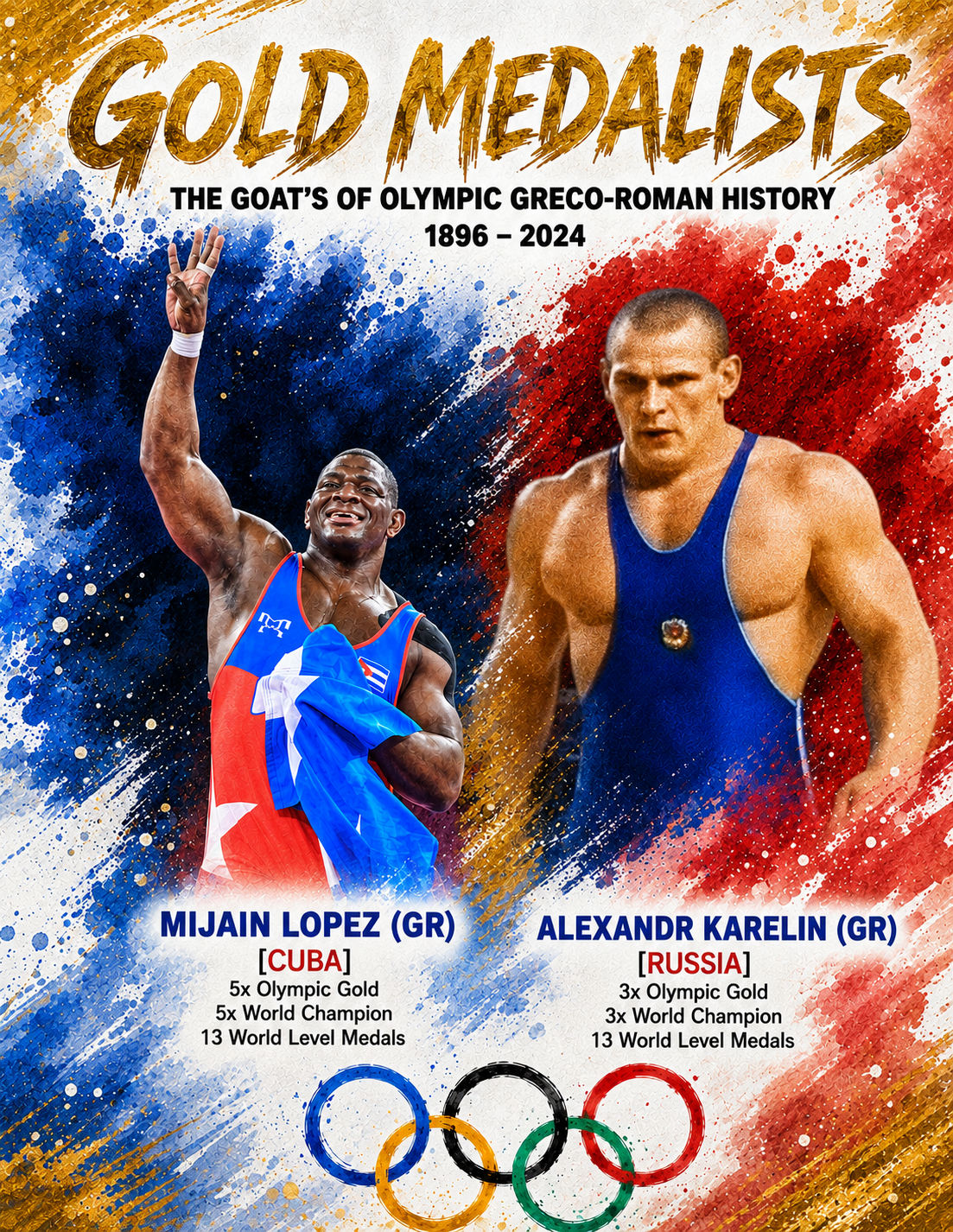
Mijaín López of Cuba and Aleksandr Karelin of the Soviet Union and Russia.
Mijaín López: The Greatest Olympic Champion in Greco-Roman History
Mijaín López achieved the most remarkable accomplishment in Olympic wrestling history at the 2024 Paris Olympic Games, becoming the first wrestler ever to win five consecutive individual Olympic gold medals.
His Olympic titles came at:
- Beijing 2008
- London 2012
- Rio 2016
- Tokyo 2020
- Paris 2024
Throughout his career, López captured:
- Five Olympic gold medals
- Five World Championship titles
- 13 combined Olympic and World medals
His longevity, consistency, and dominance at heavyweight established him as the greatest Olympic Greco-Roman champion in history.
Aleksandr Karelin: The Most Dominant Wrestler Ever
Standing alongside López is Aleksandr Karelin, widely regarded as the most dominant wrestler the sport has ever produced.
Representing the Soviet Union and Russia, Karelin won:
- Three Olympic gold medals
- One Olympic silver medal
- Nine World Championship titles
His international career featured an extraordinary undefeated streak from 1987 through 2000, including a six-year period in which he did not surrender a single point.
Known for his legendary strength, technical precision, conditioning, and intimidation factor, Karelin became the standard by which dominance in wrestling is measured.
Champions Behind the Dynasties
Beyond López and Karelin, generations of champions shaped Olympic Greco-Roman wrestling and represented the traditions of their nations.
Hamid Sourian (Iran)
A six-time World Champion and Olympic gold medalist, Sourian became one of Iran’s greatest Greco-Roman wrestlers and a symbol of the nation’s rise as a wrestling power.
Valery Rezantsev (Soviet Union)
A two-time Olympic champion and five-time World Champion, Rezantsev represented the technical excellence of the Soviet system.
Hamza Yerlikaya (Turkey)
A two-time Olympic champion and three-time World Champion, Yerlikaya became one of Turkey’s most celebrated wrestling figures.
Rıza Kayaalp (Turkey)
A five-time World Champion and one of the greatest modern heavyweights, Kayaalp continued Turkey’s tradition of international excellence.
Armen Nazaryan (Armenia/Bulgaria)
A two-time Olympic champion, Nazaryan became one of the sport’s most durable and respected competitors.
Carl Westergren (Sweden)
A three-time Olympic champion who won titles across three different weight classes, Westergren helped establish Sweden as an early Olympic powerhouse.
Rudolf Svensson (Sweden)
A four-time Olympic medalist, Svensson represented Sweden’s golden era of Greco-Roman wrestling.
Vincenzo Maenza (Italy)
A two-time Olympic champion, Maenza remains one of Italy’s greatest wrestling legends.
The Enduring Legacy of Olympic Greco-Roman Wrestling
The history of Olympic Greco-Roman wrestling extends far beyond medals and championships. It reflects cultural identity, political transformation, national pride, and the pursuit of excellence across generations.
From Scandinavian pioneers who established the sport’s early traditions, to the unmatched Soviet dynasty, to the emergence of Cuba, Iran, Turkey, Japan, and other global powers, Greco-Roman wrestling has continually evolved while maintaining its essential character.
The sport has survived world wars, political divisions, national reunifications, Olympic boycotts, and dramatic changes in the global landscape. Yet its foundation remains unchanged:
Two athletes. One mat. A test of strength, technique, discipline, and courage.
From Carl Schuhmann’s historic victory in Athens in 1896 to Mijaín López’s record-setting fifth Olympic championship in Paris 2024, Greco-Roman wrestling represents more than a competition—it represents the history of nations, cultures, and champions who shaped the Olympic Games.
After more than a century of Olympic competition, one conclusion remains undeniable:
Greco-Roman wrestling is not simply one of the oldest Olympic sports—it is one of the greatest reflections of the global wrestling tradition itself.
GOLD MEDALS BY COUNTRY [First medal – Last medal]
- Soviet Union: 34 [1952 – 1988]
- Sweden: 21 [1908 – 2000]
- Finland: 18 [1908 – 1984]
- Hungary: 17 [1908 – 2020]
- Russia [Post Soviet Era]: 12 [1996 – 2016]
- Turkey: 11 [1936 – 2000]
- Bulgaria: 10 [1960 – 2024]
- Cuba: 10 [1992 – 2024]
- South Korea: 7 [1984 – 2012]
- Iran: 6 [2012 – 2024]
- Italy: 6 [1908 – 2008]
- Japan: 6 [1964 – 2024]
- Romania: 6 [1960 – 1984]
- Germany: 4 [1896 – 1992]
- Poland: 4 [1976 – 1996]
- Estonia [Pre-Soviet Era]: 3 [1924 – 1936]
- Unified Team [Post Soviet Era]: 3 [1992]
- United States: 3 [1984 – 2000]
- Yugoslavia: 3 [1964 – 1984]
- Armenia [Post Soviet Era]: 2 [1996 – 2016]
- East Germany: 2 [1968]
- Egypt: 2 [1928 – 2004]
- France: 2 [1924 – 2008]
- Norway: 2 [1988 – 1992]
- Ukraine [Post Soviet Era]: 2 [1996 – 2020]
- Azerbaijan [Post Soviet Era]: 1 [2004]
- Czechoslovakia: 1 [1972]
- Georgia [Post Soviet Era]: 1 [2008]
- Greece: 1 [1980]
- Kazakhstan [Post Soviet Era]: 1 [1996]
- Russian Olympic Committee or ROC [Post Soviet Era]: 1 [2020]
- Serbia [Post Yugoslavia]: 1 [2016]
- Uzbekistan [Post Soviet Era]: 1 [2004]
- West Germany: 1 [1984]
SILVER MEDALS BY COUNTRY [First medal – Last medal]
- Finland: 21 [1908 – 2004]
- Sweden: 17 [1908 – 2004]
- Soviet Union: 16 [1952 – 1988]
- Bulgaria: 14 [1956 – 1988]
- Hungary: 13 [1924 – 2020]
- Germany: 10 [1912 – 2008]
- Japan: 8 [1968 – 2020]
- Poland: 8 [1980 – 1996]
- Romania: 8 [1960 – 1984]
- Czechoslovakia: 6 [1928 – 1976]
- Russian Empire / Russia: 6 [1908 – 2012]
- Turkey: 6 [1948 – 2016]
- United States: 6 [1984 – 2000]
- Cuba: 5 [1996 – 2016]
- Armenia [Post Soviet Era]: 4 [2012 – 2024]
- Italy: 4 [1932 – 1992]
- Ukraine [Post Soviet Era]: 4 [2000 – 2024]
- United Germany: 4 [1956 – 1960]
- Yugoslavia: 4 [1960 – 1976]
- Denmark: 3 [1920 – 2016]
- Egypt: 3 [1948 – 2012]
- Greece: 3 [1896 – 1984]
- West Germany: 3 [1972 – 1988]
- Kazakhstan [Post Soviet Era]: 3 [2004 – 2024]
- Azerbaijan [Post Soviet Era]: 2 [2008 – 2012]
- Belarus [Post Soviet Era]: 2 [1996]
- Chile: 2 [2020 – 2024]
- China: 2 [2008 – 2024]
- France: 2 [1968 – 1996]
- Georgia [Post Soviet Era]: 2 [2004 – 2012]
- Iran: 2 [1972 – 2024]
- Kyrgyzstan [Post Soviet Era]: 2 [2008 – 2020]
- Lithuania [Post Soviet Era]: 2 [2008 – 2012]
- South Korea: 2 [1988 – 2000]
- Unified Team [Post Soviet Era]: 2 [1992]
- East Germany: 1 [1972]
- Latvia [Pre Soviet Era]: 1 [1936]
- Lebanon: 1 [1952]
- Mexico: 1 [1984]
- Norway: 1 [1948]
BRONZE MEDALS BY COUNTRY [First medal – Last medal]
- Sweden: 20 [1912 – 2012]
- Finland: 19 [1908 – 2000]
- Romania: 13 [1956 – 1992]
- Hungary: 11 [1912 – 2012]
- Soviet Union: 10 [1952 – 1988]
- Bulgaria: 9 [1960 – 2008]
- Italy: 9 [1928 – 1972]
- Poland: 8 [1972 – 2020]
- China: 7 [1992 – 2024]
- Russia: 7 [1996 – 2016]
- South Korea: 7 [1984 – 2016]
- Denmark: 7 [1908 – 2024]
- France: 6 [1932 – 2012]
- Germany: 6 [1928 – 2020]
- Iran: 6 [1960 – 2024]
- Turkey: 6 [1948 – 2016]
- Armenia [Post Soviet Era]: 5 [2008 – 2024]
- Azerbaijan [Post Soviet Era]: 5 [2012 – 2024]
- Belarus [Post Soviet Era]: 5 [1996 – 2016]
- Georgia [Post Soviet Era]: 5 [2000 – 2016]
- Greece: 5 [1896 – 2004]
- Cuba: 4 [1992 – 2024]
- Czechoslovakia: 4 [1952 – 1968]
- Estonia [Pre Soviet Era]: 4 [1924 – 1936]
- Japan: 4 [1976 – 2020]
- Kyrgyzstan[Post Soviet Era] : 4 [2008 – 2024]
- United States: 4 [1984 – 2008]
- Yugoslavia: 4 [1964 – 1984]
- Egypt: 3 [1948 – 2020]
- Ukraine[Post Soviet Era] : 3 [1996 – 2008]
- Unified Team [Post Soviet Era]: 3 [1992]
- United Germany: 3 [1964]
- Kazakhstan [Post Soviet Era]: 2 [2004 – 2012]
- Lebanon: 2 [1952 – 1980]
- North Korea: 2 [2000 – 2024]
- Norway: 2 [1920 – 2016]
- Austria: 1 [1932]
- Croatia: 1 [2020]
- Czech Republic: 1 [2008]
- East Germany: 1 [1976]
- Lithuania: 1 [2012]
- Moldova [Post Soviet Era]: 1 [1996]
- Russian Olympic Committee or ROC: 1 [2020]
- Switzerland: 1 [1984]
- Uzbekistan [Post Soviet Era]: 1 [2016]
Photo of Mijain Lopez courtesy of National Wrestling Hall of Fame photographer Tony Rotundo, Wrestlers Are Warriors.
Follow me on X @Coach_Al_1984 | on Instagram @tier_one_idaho | on Facebook @TIER1 WRESTLING
Leave a Reply