
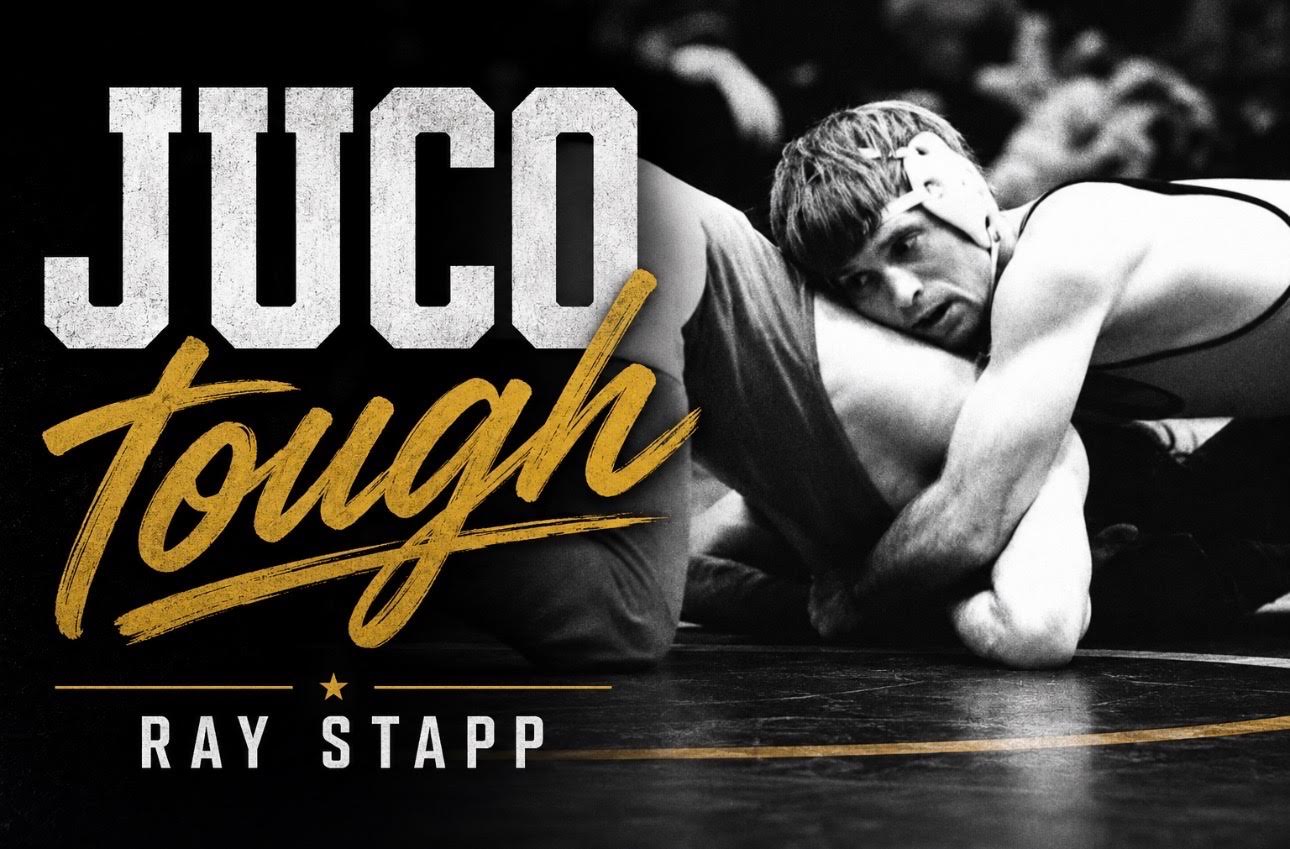
Ray Stapp: A Junior College Champion Who left an Oklahoma Wrestling Legacy

Stories like Ray Stapp’s are sometimes overlooked, but his impact on wrestling history reaches from the junior college level to the national stage at Oklahoma State University. His journey represents the importance of junior college wrestling as a pathway for athletes who may have been overlooked early in their careers but go on to achieve great things as an athlete and coach.
Growing up in Oklahoma City, Stapp became the first state champion in the history of U.S. Grant High School, capturing the Oklahoma state title at 112 pounds. His success caught the attention of legendary Oklahoma State wrestling coach Myron Roderick, and the two developed a strong relationship. However, because college wrestling’s lightest weight class at the time was 115 pounds, Roderick didn’t recruit Stapp.
Instead, Stapp began his collegiate career at Trinidad State Junior College in Colorado, where he quickly proved he belonged among the nation’s best. In 1967, Stapp captured the NJCAA championship at 115 pounds, earning First-Team All-American honors.
Following his championship victory, Stapp received a memorable phone call from Myron Roderick. After Stapp finished his final junior college match, Roderick reportedly told him, “Welcome to OSU.” The call marked the beginning of the next chapter in one of Oklahoma wrestling’s great careers.

Photo Reference: South Oklahoma City YMCA- December 1971. Ray Stapp teaches wrestling techniques to Randy Chapman and David Allstatt, who were both blind. Archival photograph courtesy of the Ray Stapp Collection / Oklahoma wrestling historical archives.
From Trinidad State to Oklahoma State All-American
After winning the NJCAA title, Stapp transferred to Oklahoma State University, where he competed for the Cowboys from 1969–1971. He immediately became one of the most successful wrestlers in the program’s storied history.
During his Cowboy career, Stapp compiled an impressive 57-8 record, won three consecutive Big Eight Conference championships, and became a three-time All-American. He earned All-American honors at 115 pounds and twice at 118 pounds, including an NCAA runner-up finish in 1970.
As a senior, Stapp finished fourth at the NCAA Championships, helping Oklahoma State capture its 27th overall NCAA team national championship.
His success was a continuation of the winning tradition that has defined Oklahoma State wrestling for generations.
A Coaching Career Built on Myron Roderick’s Influence
After his competitive career ended, Stapp dedicated himself to developing the next generation of wrestlers. He credited much of his coaching philosophy to the lessons he learned under Myron Roderick.
For more than 30 years, Stapp built a remarkable coaching legacy throughout Oklahoma. He coached at Southeast High School and Putnam City West High School before eventually making his home at Western Heights High School in Oklahoma City, where he spent the majority of his career.
At Western Heights, Stapp created the junior high wrestling program before expanding it into a successful high school program. His teams consistently finished among the top programs in their classification, producing:
- Eight individual state champions
- 38 state place-winners
- Multiple top-three team finishes
His achievements were recognized throughout the state. Stapp was named the Oklahoma Coach of the Year in 1979, received the 1995 Governor’s Accomplishment Award, and was selected as the All-State Team Coach in 1999.
Beyond coaching, Stapp contributed to wrestling and education through his involvement with organizations including the Oklahoma Coaches Association, National Wrestling Coaches Association, National High School Athletic Coaches Association, Oklahoma Education Association, and National Education Association.
In 2001, Stapp was honored with the Lifetime Service to Wrestling Award by the Oklahoma Chapter of the National Wrestling Hall of Fame. In 2024, he received the prestigious Gallagher Award, presented annually to an Oklahoma State alumnus who exemplifies the spirit, leadership, and tradition of champions established by the Cowboy wrestling program.
Trinidad State Junior College: The Beginning of a Champion’s Journey
Trinidad State played a major role in developing Stapp into a champion and All-American. The program has a proud NJCAA wrestling history, producing NJCAA champions, All-Americans, and coaches who left lasting impacts on the sport.
Trinidad State NJCAA Champions
115/118/126 Pounds
- 1962 – Runner-up – Velasquez
- 1967 – Champion – Ray Stapp
- 1968 – Champion – Tom Clary
145/147/157 Pounds
- 1962 – Runner-up – Micky Seery
- 1968 – Champion – Terry Anders
157/152/158/165 Pounds
- 1962 – Champion – Alvin Sampson
167/174 Pounds
- 1968 – Champion – Jesse Rawls
191/190/197 Pounds
- 1967 – Champion – Mike Sparaco
Trinidad State Junior College All-Americans
- 1969 – Don Evans – Honorable Mention – 123 lbs
- 1969 – Bob Shelby – Honorable Mention – 177 lbs
- 1968 – Tom Clardy – First Team – 115 lbs
- 1968 – Terry Anders – First Team – 145 lbs
- 1968 – Jesse Rawls – First Team – 167 lbs
- 1968 – Steve Arnold – Honorable Mention – 123 lbs
- 1967 – Ray Stapp – First Team – 115 lbs
- 1967 – Mike Sparaco – First Team – 191 lbs
Trinidad State also produced NJCAA Wrestling Coaches Hall of Fame member Jesse Rawls Sr., who was inducted in 1993.
The 1967 NJCAA Championship Class: A Group That Shaped College Wrestling History
The 1967 NJCAA Championships featured several future college wrestling legends.
Alongside Ray Stapp’s championship season at Trinidad State, Darrell Keller won an NJCAA championship for Columbia Basin College before transferring to Oklahoma State. Keller became a two-time All-American and NCAA national champion for the Cowboys, defeating University of Washington standout Larry Owings 16-12 in the 1971 NCAA finals.
Other notable wrestlers from that era included:
- Katsumi Suzuki – Finished third at the NJCAA Championships for Garden City College before becoming a runner-up at the Big Eight Championships for Oklahoma State.
- Rich Mihal – NJCAA champion before finishing second at the NCAA Championships for the University of Iowa.
- Mickey Carroll – NJCAA champion for Arizona Western after placing third the previous year. He later transferred to Northern Arizona University, where he won an NAIA national championship in 1969 and placed third in 1970. Carroll was also a 1972 Olympic alternate for the New York Athletic Club later inducted to the 1992 NAU Athletic Hall of Fame.
The 1967 NJCAA tournament was a showcase of future champions and elite collegiate wrestlers.
The Growth of Oklahoma Junior College Wrestling
Ray Stapp’s story also highlights the importance of junior college wrestling and the opportunities these programs provide.
Trinidad State helped launch Stapp’s career, and today junior college wrestling continues to grow across the country. Oklahoma has experienced a significant resurgence in recent years.
- Northeastern Oklahoma A&M College (NEO) reinstated wrestling for the 2013–14 season after a 22-year hiatus and won an NJCAA championship in its first season back.
- Northern Oklahoma College (NOC Tonkawa) returned to wrestling after approximately 30 years away.
- Carl Albert State College added wrestling, continuing the growth of Oklahoma junior college opportunities.
- Murray State College established it’s self recently in the NJCAA.
- Rose State College has brought wrestling back, with its first competitive season scheduled for 2026–27.
The return and expansion of these programs show how Oklahoma continues to build on its rich wrestling tradition.
Ray Stapp’s journey from U.S. Grant High School, to Trinidad State Junior College, to Oklahoma State University, and finally into decades of coaching represents what junior college wrestling has always been about: creating opportunities, developing into a champion and All-American, all while leaving a lasting legacy.
Leave a Reply