
Preserving Wrestling’s Past While Building Its Future

Since joining the staff at Simple Man Wrestling, my mission has remained consistent: to preserve the rich history of wrestling, highlight today’s athletes and emerging trends, and contribute to the continued growth and advancement of the sport at every level.
That commitment extends far beyond the publication of articles. On an almost daily basis, Simple Man Wrestling staff writers Pablo DiMaria, myself, and Aaron LaFarge, along with founder Bryan Battisto and the entire SMW team, engage in meaningful conversations about the stories that deserve attention, the issues shaping the future of wrestling, ways to strengthen our coverage, and innovative strategies to expand our audience.
Collectively, we are committed to building a trusted platform that serves the wrestling community throughout the United States while also connecting with fans around the world.
Much of today’s wrestling dialogue—whether through social media, major wrestling publications, podcasts, or broader conversations within the sport—centers around NCAA Division I wrestling and its significant influence on the collegiate landscape. Division I deserves recognition as the highest-profile level of collegiate wrestling; however, the continued growth and sustainability of the sport depend on recognizing and celebrating every pathway that provides opportunities for athletes.
Among those often overlooked pathways is junior college wrestling.
Having competed in California’s 3C2A during the 1980s, I have a deep appreciation for the vital role community college wrestling has played in the development of student-athletes. The 3C2A/JUCO pathway has historically provided wrestlers with opportunities to continue competing, pursue higher education, develop academically and athletically, and position themselves for future success at four-year institutions.
Despite its impact, this level of collegiate wrestling has often received far less attention than it deserves. The history, accomplishments, and future potential of junior college and community college wrestling represent one of the most important stories within the broader wrestling ecosystem.
That same appreciation is shared by fellow Simple Man Wrestling writer and wrestling promoter Aaron LaFarge, whose competitive accomplishments include earning 3C2A All-American honors at Palomar College and becoming a two-time NAIA All-American at Montana State-Northern and Oklahoma City University.
Together, we believe in celebrating every level of collegiate wrestling and recognizing the opportunities these programs provide for student-athletes determined to continue their wrestling journey beyond high school.
Whether an athlete competes at NCAA Division I, Division II, Division III, NAIA, NJCAA, 3C2A, or club wrestling levels, every program contributes to the development, preservation, and future growth of this great sport.
The Reality of the Collegiate Wrestling Pipeline
The transition from high school wrestling to collegiate competition represents one of the most challenging steps in an athlete’s career.
National participation data illustrates just how limited those opportunities truly are. Based on annual participation census figures and collegiate roster data collected from organizations including the National Federation of State High School Associations (NFHS), NCAA, NAIA, NJCAA, California’s 3C2A (formerly CCCAA), and the National Collegiate Wrestling Association (NCWA), only a small percentage of high school wrestlers ultimately compete at the collegiate level.
These pipeline statistics highlight both the limited number of available roster positions and the extraordinary commitment required to advance within the sport.
It is important to recognize that these percentages represent estimated opportunity trends rather than exact probabilities. Participation reporting methods, roster sizes, eligibility rules, and institutional structures vary among governing organizations. However, the overall message remains clear: earning a place on a collegiate wrestling roster is an accomplishment achieved by a relatively small percentage of high school athletes.
NCAA Division III: The Largest Collegiate Opportunity Base
NCAA Division III represents the largest percentage of collegiate wrestling opportunities, with an estimated 1.3% to 3.1% of high school wrestlers continuing to compete at this level.
Although Division III institutions do not provide athletic scholarships, they sponsor the greatest number of NCAA wrestling programs and remain one of the most accessible pathways for student-athletes seeking to continue their competitive careers while pursuing higher education.
Division III wrestling has played an essential role in preserving opportunities for athletes who value both academic achievement and athletic competition.
NCAA Division I: The Highest Visibility and Greatest Selectivity
NCAA Division I wrestling remains the most visible and prestigious level within the sport, attracting national attention, elite recruits, and the highest level of competition.
However, it also represents one of the most selective pathways.
Approximately 1.0% to 1.2% of high school wrestlers advance to Division I programs, where roster positions are typically earned by nationally ranked competitors, multi-time state champions, and athletes competing at the highest levels of youth, high school, and national competition.
Division I serves as the pinnacle of collegiate wrestling, but it represents only one portion of the broader wrestling landscape.
NCAA Division II, NAIA, NJCAA, and 3C2A: Essential Pathways
NCAA Division II provides opportunities for approximately 0.8% of high school wrestlers, offering a competitive collegiate environment with programs committed to developing student-athletes both athletically and academically.
The NJCAA also accounts for approximately 0.8% of the collegiate wrestling pipeline and continues to serve as one of the most important developmental avenues within the sport.
For many athletes, junior college wrestling provides a critical bridge—allowing them to continue competing, mature physically and academically, improve technically, and prepare for opportunities at four-year institutions.
The NAIA provides opportunities for approximately 0.6% of high school wrestlers through institutions that offer athletic scholarship opportunities while maintaining a competitive collegiate environment.
California’s 3C2A contributes another 0.4% of the collegiate wrestling pipeline, representing a unique community college model centered on affordability, accessibility, regional competition, and educational opportunity.
Why Every Pathway Matters
When combined, these figures demonstrate that fewer than one out of every fifteen high school wrestlers will compete at any collegiate level.
That reality reinforces the importance of recognizing every division and every program that provides wrestlers with an opportunity to continue their careers.
The wrestling community is not built solely by elite programs, national champions, and nationally ranked athletes. It is built by thousands of coaches, institutions, and student-athletes who dedicate themselves to preserving and advancing the sport at every level.
Every collegiate program represents more than a roster.
It represents opportunity.
It represents a chance for an athlete to continue pursuing a dream that began years earlier in youth wrestling rooms, high school gyms, and local communities.
That mission is exactly why junior college wrestling remain essential components of the collegiate wrestling landscape.

The Current Landscape of Junior College Wrestling [3C2A / NJCAA]
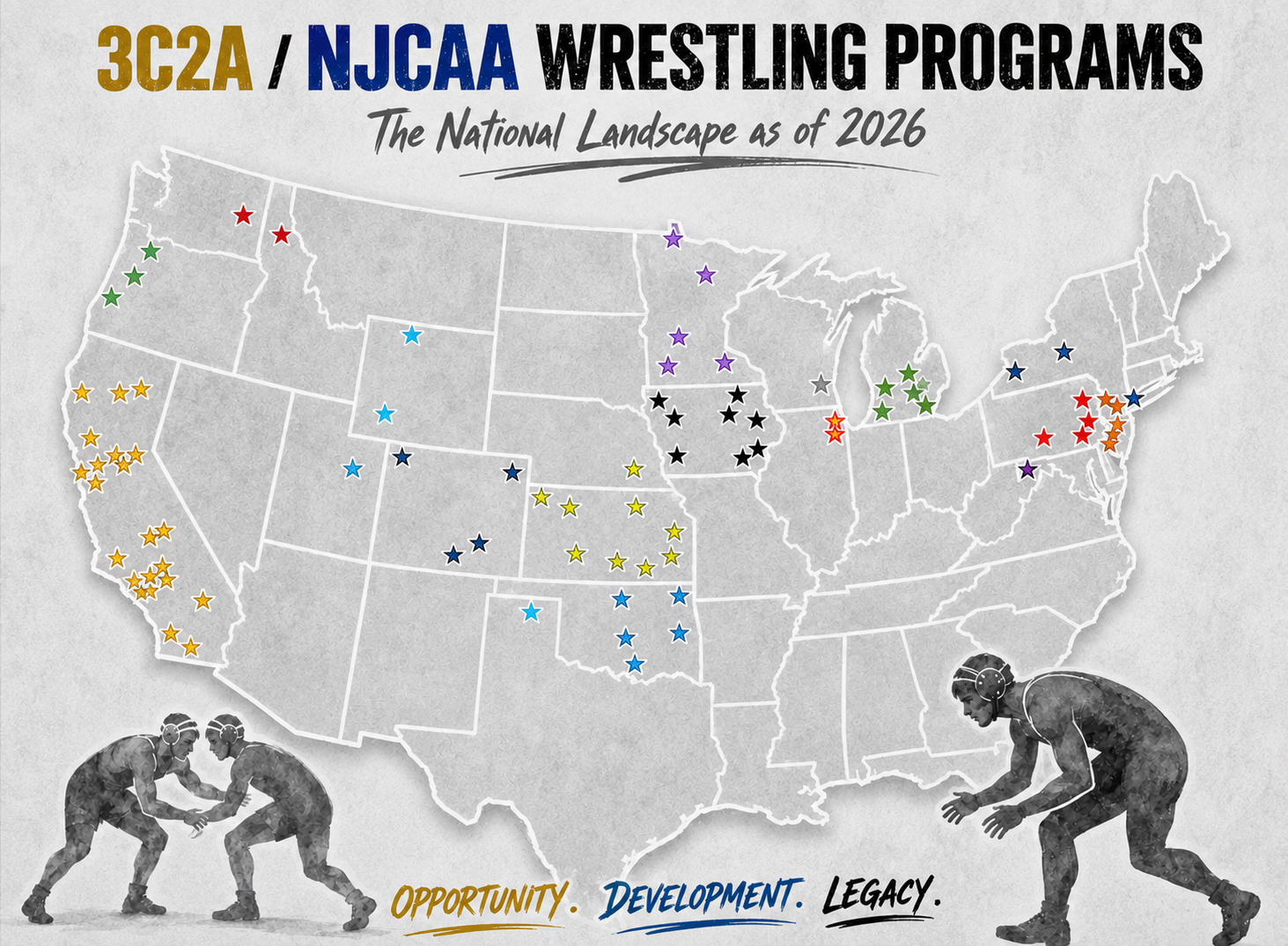
The 2026 landscape of junior college wrestling includes more than 80 programs nationwide, representing one of the most important developmental pathways in American wrestling.
This competitive environment is comprised primarily of institutions competing within the National Junior College Athletic Association (NJCAA), along with California’s 3C2A wrestling structure, which currently includes 24 programs.
Together, these institutions provide opportunities for student-athletes to continue competing while pursuing higher education, developing academically and athletically, and preparing for future success.
While NCAA Division I wrestling often dominates national discussion, junior college wrestling continue to serve as the foundation for countless athletes who might otherwise leave the sport after high school.
For decades, these programs have developed champions, All-Americans, coaches, and lifelong contributors to wrestling.
They represent one of the sport’s most important bridges between high school competition and four-year collegiate success.
The 2026 NJCAA Wrestling Landscape: 61 Programs Across 20 States
The National Junior College Athletic Association (NJCAA) has served as one of the most important developmental pathways in collegiate wrestling for more than six decades. In 2026, the NJCAA men’s wrestling landscape consists of 61 programs across 20 states, reflecting a diverse but geographically concentrated structure within two-year collegiate wrestling.
These programs represent more than competitive opportunities. They serve as academic and athletic launching points for student-athletes seeking to continue their wrestling careers, improve their skills, earn degrees, and prepare for opportunities at four-year institutions.
While the NCAA Division I level often receives the greatest attention within the wrestling community, the NJCAA has consistently played a vital role in developing athletes who contribute to every level of collegiate wrestling.
For many wrestlers, the junior college pathway provides the opportunity to continue pursuing a goal that may not have immediately been available after high school. It allows athletes to develop physically, academically, and competitively while remaining connected to the sport they love.
The importance of the NJCAA is not measured solely by championships or rankings. Its significance is measured by the number of athletes who have been given an opportunity to continue their wrestling journey.
Regional Strength and Program Concentration
The largest concentrations of NJCAA wrestling programs are found throughout the Midwest and Great Plains regions, where decades of wrestling tradition, strong youth participation, established high school programs, and institutional commitment have created some of the strongest developmental pipelines in the country.
Iowa and Kansas currently lead the nation with eight NJCAA wrestling programs each, combining for 16 programs and accounting for 26% of the entire NJCAA wrestling membership.
Beyond these two states, significant program clusters exist in:
- Minnesota — 5 programs
- New Jersey — 5 programs
- Oklahoma — 5 programs
- Colorado — 4 programs
- Michigan — 4 programs
- Pennsylvania — 4 programs
Collectively, the five leading states of Iowa, Kansas, Minnesota, New Jersey, and Oklahoma account for 31 programs, representing nearly half of all NJCAA wrestling opportunities nationwide.
The remaining programs are distributed across a diverse geographic footprint that includes historically significant wrestling states such as Idaho, Illinois, Oregon, New York, Utah, Washington, Wyoming, and Texas.
Currently, nine states sponsor three or more NJCAA wrestling programs, demonstrating established regional wrestling pipelines, while eight states maintain only a single NJCAA program.
This distribution illustrates both the strength of existing junior college wrestling communities and the opportunity for future expansion into areas where athletes currently have limited access to collegiate competition.
Future Programs
- Vincennes Univ. [IN]. Scheduled for 2026-27 academic year
- Hill College [Texas]. Schedule for 2027-28 academic year.
California’s 3C2A: A National Model of Opportunity
While the NJCAA represents the primary national structure for junior college wrestling, California’s community college wrestling system remains one of the most unique and opportunity-rich environments in collegiate wrestling.
The California Community College Athletic Association (3C2A) continues to serve as a vital pathway for student-athletes seeking opportunities to compete, develop their skills, and pursue their academic and athletic aspirations beyond high school. Through its 24 wrestling programs, the 3C2A provides an important bridge for athletes looking to continue their competitive careers while preparing for future opportunities at the collegiate level.
One notable distinction, however, is that the 3C2A conducts its wrestling season during the fall semester, whereas the National Junior College Athletic Association (NJCAA) aligns its wrestling season with the traditional collegiate calendar, competing primarily during the spring semester alongside the majority of collegiate wrestling programs nationwide. This scheduling difference creates a unique structure within California’s community college wrestling landscape and distinguishes it from the broader junior college model across the country.
With 24 wrestling programs spanning Northern and Southern California, the 3C2A represents one of the largest and most established community college wrestling systems in the nation.
What separates California’s model is not only the number of programs but also the combination of tradition, accessibility, geographic diversity, and competitive opportunity. The 3C2A provides opportunities across the state—from nationally recognized programs with decades of success to emerging programs building the next generation of champions.
California’s community college system demonstrates that opportunity and excellence can exist together.
Northern California’s Wrestling Tradition
Northern California has long been a foundation of community college wrestling excellence.
Programs such as:
- Fresno City College
- Chabot College
- Sacramento City College
- Sierra College
have developed generations of outstanding wrestlers while contributing significantly to the history of California collegiate wrestling.
These programs have produced state champions, All-Americans, coaches, and athletes who continued their careers at four-year institutions.
At the same time, newer additions such as Mission College demonstrate continued growth, expansion, and renewed investment in creating additional opportunities for student-athletes.
The continued development of programs throughout Northern California reflects the importance of maintaining accessible pathways for wrestlers across the region.
Southern California’s Community College Wrestling Legacy
Southern California remains equally impressive, featuring some of the most respected programs in the history of California community college wrestling.
Programs such as:
- Bakersfield College
- Palomar College
- Cerritos College
- Mt. San Antonio College
have played significant roles in developing wrestlers and maintaining California’s reputation as one of the nation’s strongest wrestling states.
Alongside these established programs, additional institutions continue providing opportunities for athletes throughout Southern California, strengthening one of the deepest wrestling talent pipelines in the country.
The depth of California’s community college system allows athletes from different backgrounds and competitive levels to find a pathway forward.
The 3C2A Pathway: More Than Competition
For California wrestlers, the 3C2A represents far more than another competitive division.
It represents opportunity.
It provides a proven launching point for athletes pursuing four-year opportunities, academic success, and lifelong connections within the sport.
Throughout its history, the 3C2A has helped develop:
- State champions
- National contenders
- NCAA contributors
- Coaches
- Wrestling leaders
For some athletes, the 3C2A serves as a bridge toward NCAA or NAIA opportunities. For others, it provides the chance to continue competing while earning a college education close to home.
The success of California’s community college model demonstrates the importance of accessibility within collegiate wrestling.
Not every athlete follows the same path.
Some wrestlers enter college as highly recruited prospects. Others develop later, improve through additional competition, and earn opportunities they may not have had immediately after high school.
The 3C2A ensures that those opportunities exist.
With a combination of tradition, accessibility, and geographic diversity, California continues to demonstrate that meaningful opportunities remain available for wrestlers willing to continue their journey.
Note: For a more comprehensive examination of the current landscape, growth, and continued impact of California’s 3C2A wrestling programs, readers are encouraged to explore the following article published by Simple Man Wrestling: “Built on the Mat: The Untold Legacy of California’s 3C2A Wrestling Championships.” at: The Untold Legacy of California’s 3C2A Wrestling Championships
The Geographic Challenge: 29 States Without NJCAA Wrestling Programs
Despite the success of NJCAA and 3C2A wrestling, significant geographic gaps remain throughout the United States.
As of the 2026 season, 29 states do not currently sponsor an NJCAA wrestling program.
These states represent every region of the country, including the Southeast, Northeast, Midwest, Mountain West, and Pacific regions.
The absence of NJCAA programs is particularly notable in states with strong wrestling participation and established high school traditions, including:
- Ohio
- Missouri
- Virginia
- North Carolina
- Georgia
- Florida
- Tennessee
- Nevada
These states produce thousands of high school wrestlers annually, yet athletes who do not immediately transition to NCAA or NAIA programs have limited junior college opportunities available within their state.
Several emerging wrestling states also lack NJCAA opportunities, including:
- Arizona
- New Mexico
- Montana
- South Dakota
- North Dakota
- Alaska
The absence of programs in these regions represents both a challenge and an opportunity.
Expanding the Wrestling Pipeline
For many wrestlers, geography plays a significant role in determining whether they continue competing after high school.
Not every athlete has the ability to relocate hundreds or thousands of miles away to pursue a collegiate opportunity. Financial considerations, academic responsibilities, and family circumstances often influence an athlete’s decision.
Expanding NJCAA opportunities into underserved regions could have a significant impact on athlete retention, participation growth, and the overall strength of the national wrestling pipeline.
New programs would not only create roster opportunities—they would create communities.
They would provide additional coaching positions, strengthen local wrestling cultures, and offer more athletes the chance to continue developing within the sport.
The future growth of wrestling will depend not only on maintaining successful programs but also on creating new opportunities where they are needed most.
Six Decades of NJCAA Championship Excellence
For more than six decades, NJCAA men’s wrestling has produced a remarkable championship legacy built by community colleges and junior colleges throughout the United States.
Since the inaugural championship era began in 1960, the NJCAA National Wrestling Championships have represented far more than team titles. They have reflected the growth of the sport, the expansion of wrestling opportunities, the dedication of coaches and athletes, and the ability of developing programs to establish nationally recognized traditions.
The history of NJCAA wrestling is a reflection of American wrestling itself—one defined by opportunity, perseverance, regional pride, and the belief that athletes deserve a pathway to continue competing.
Colorado’s Early Dominance and the Expansion of NJCAA Wrestling
The foundation of NJCAA wrestling was established in Colorado, where junior college programs quickly became national powers during the early years of the championship era.
Colorado programs captured eight of the first nine NJCAA national championships, establishing one of the earliest dynasties in junior college wrestling history.
Leading that early dominance were programs such as:
- Lamar Junior College
- Northeastern Junior College
These institutions helped establish the standard for excellence and demonstrated that junior colleges could develop nationally competitive wrestling programs capable of producing championship-caliber athletes.
As NJCAA wrestling expanded beyond its Colorado roots, new programs and new regions began making their mark on the national stage.
In 1968 and 1969, Phoenix College became Arizona’s first NJCAA national champion, signaling the continued geographic expansion of junior college wrestling.
The 1970s introduced an era of greater competitive balance, with seven different states producing national champions and demonstrating that excellence was developing throughout the country.
North Idaho College: Building One of Wrestling’s Greatest Dynasties
Few programs in the history of collegiate wrestling—at any level—have matched the sustained excellence of North Idaho College.
The Cardinals’ 14 NJCAA National Team Championships remain the all-time record and represent one of the greatest dynasties in collegiate wrestling history.
North Idaho College’s dominance helped establish Idaho as the most successful state in NJCAA wrestling history and demonstrated the impact that a committed institution, dedicated coaching staff, and strong wrestling culture can have on a program.
The Cardinals’ most dominant stretch came from 1985 through 1990, when North Idaho College captured six consecutive national championships.
That remarkable run reflected every element required to build a championship program:
- Strong recruiting
- Athlete development
- Coaching excellence
- Institutional commitment
- A culture built around success
Beyond championships, North Idaho College created opportunities for hundreds of wrestlers to continue competing, earn an education, and advance their careers.
Its influence extends beyond trophies and banners.
The program represents the very purpose of junior college wrestling—providing athletes with a platform to grow.
Illinois’ Championship Tradition
Alongside North Idaho College, Illinois institutions have created one of the deepest championship traditions in NJCAA wrestling history.
Programs such as:
- Joliet Junior College
- Triton College
- Lincoln College
- Harper College
combined for 11 national championships, establishing Illinois as one of the most influential states in the history of junior college wrestling.
Illinois’ success demonstrates the importance of sustained institutional commitment and the impact that regional wrestling traditions can have on developing successful collegiate programs.
Iowa, Kansas, Oregon, and the Modern Era of NJCAA Wrestling
Several additional states have played defining roles in shaping NJCAA wrestling history.
Iowa
Iowa has become one of the most successful states in modern NJCAA wrestling, led by Iowa Central Community College, which has captured eight national championships.
The state’s success reflects Iowa’s deep wrestling culture and its ability to consistently produce athletes, coaches, and programs committed to excellence.
Kansas
Kansas has also established a remarkable championship tradition, producing eight national championships across four different programs.
This success highlights the strength and consistency of Kansas junior college wrestling.
Oregon
Oregon’s influence has been highlighted by Clackamas Community College, which produced one of the defining championship runs of the modern era.
Clackamas captured four consecutive national championships from 2019 through 2022, reinforcing the program’s place among the elite institutions in NJCAA wrestling history.
The Modern NJCAA Championship Era
The championship landscape has continued to evolve in recent years, with new programs emerging as national contenders.
Western Wyoming captured consecutive NJCAA national championships in 2023 and 2024, continuing the tradition of developing programs reaching the highest levels of success.
Following that accomplishment, Indian Hills Community College emerged as the newest national powerhouse by winning back-to-back championships in 2025 and 2026.
These recent championship runs demonstrate an important characteristic of NJCAA wrestling:
Success is not limited to traditional powers.
Programs can build championship cultures through commitment, leadership, athlete development, and investment in the sport.
The Division III Era and Expanded Opportunity
The NJCAA Division III wrestling era, which existed from 1994 through 2009, further expanded opportunities for student-athletes and institutions.
Programs such as:
- Gloucester County College
- Nassau Community College
- Harper College
contributed to the growth and history of the division while providing additional pathways for wrestlers seeking collegiate competition.
The Division III era reinforced a central principle of junior college wrestling:
Every athlete deserves an opportunity to compete, develop, and pursue academic success.
The Future of Junior College and Community College Wrestling
From Colorado’s early dominance to North Idaho College’s historic dynasty, Illinois’ championship tradition, Iowa and Kansas’ continued success, Clackamas’ modern excellence, and today’s emerging NJCAA powers, junior college wrestling has created a legacy defined by opportunity and achievement.
California’s 3C2A programs have contributed equally to that mission by demonstrating how a statewide community college system can provide access, develop athletes, and create sustainable pathways for wrestlers pursuing academic and athletic success.
Together, the NJCAA and 3C2A represent two of the most important foundations within collegiate wrestling.
Their importance cannot simply be measured by national championships.
It must also be measured by the athletes who found a second opportunity.
The wrestler who improved academically.
The athlete who developed physically.
The competitor who earned a scholarship opportunity at a four-year institution.
The coach who began a career because of a junior college program.
The lifelong wrestling advocate who remained connected to the sport because a community college provided a place to continue competing.
That is the true impact of junior college wrestling.
A Pathway Worth Protecting and Expanding
As collegiate wrestling continues to evolve, the future of the sport will depend not only on protecting its traditional powerhouses but also on expanding opportunities for the next generation of athletes.
The growth of wrestling cannot rely on one division, one region, or one level of competition.
It requires a complete ecosystem.
Youth wrestling creates the foundation.
High school wrestling develops the athlete.
NCAA, NAIA, NJCAA, and 3C2A programs provide the opportunities that allow athletes to continue their journey.
Every level matters.
Every program matters.
Every wrestler matters.
The NJCAA and California’s 3C2A have already proven their value by developing champions, creating opportunities, and preserving wrestling traditions.
The next chapter should focus on strengthening existing programs, expanding into underserved regions, and ensuring that more athletes have access to collegiate wrestling opportunities.
Because the future of wrestling will not be built by one division alone.
It will be built by every coach, every institution, every community, and every athlete willing to continue the pursuit.
Junior college and community college wrestling are not simply stepping stones.
They are essential pillars of the sport.
They represent history.
They represent opportunity.
And most importantly, they represent the future of wrestling.
NOTE: Simple Man Wrestling staff writers Aaron LaFarge and Al Fontes are preparing an in-depth exploration of the junior college wrestling landscape, with a special focus on the NJCAA and California’s 3C2A programs. This upcoming series will spotlight the elite programs, storied traditions, influential coaches, and the countless student-athletes who have helped shape the foundation and future of our great sport.
From championship legacies to the people who built them, we will take a closer look at the impact junior college wrestling has made—and continues to make—across the national wrestling community. Stay tuned as we celebrate the past, examine the present, and highlight the future of junior college wrestling.
Follow me on X @Coach_Al_1984 | on Instagram @tier_one_idaho | on Facebook @TIER1 WRESTLING


Leave a Reply