
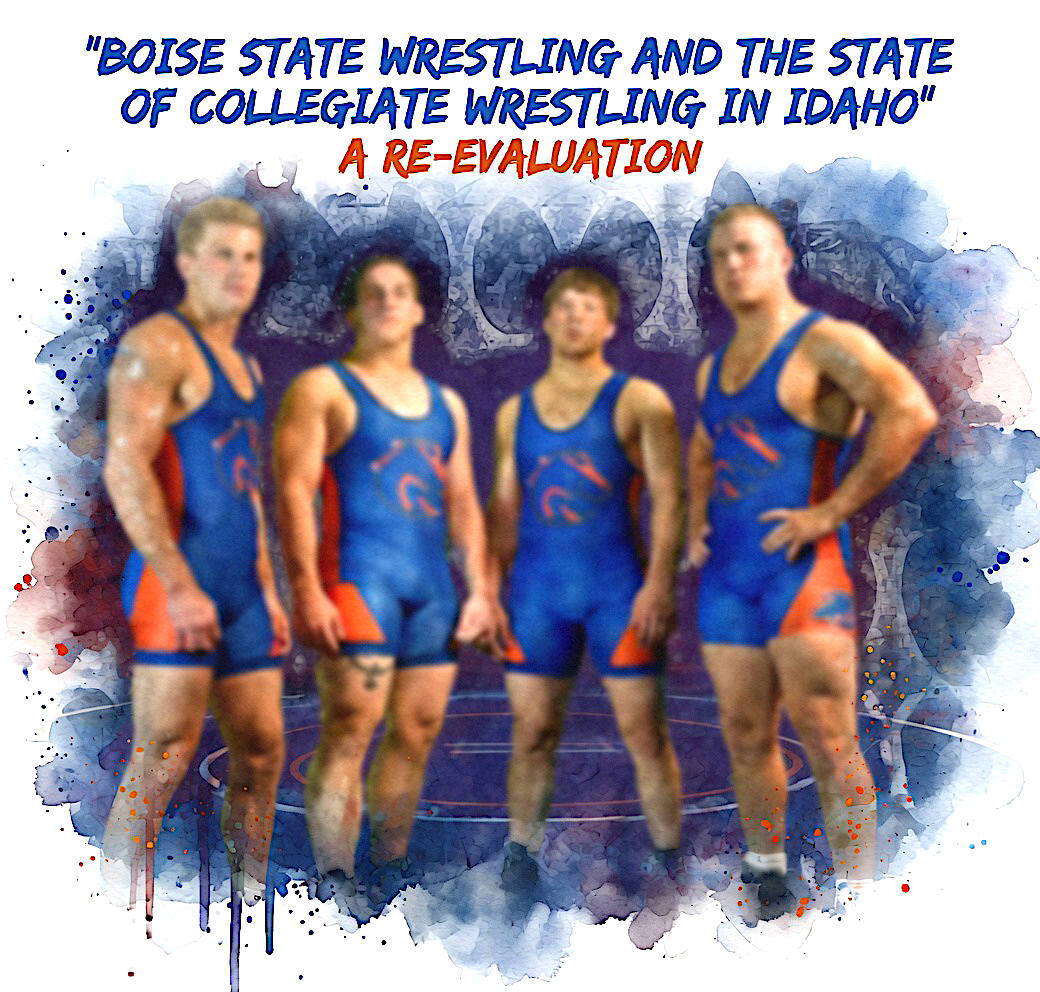

From championship tradition to modern NIL realities, the legacy of Boise State wrestling—and the rise of Idaho’s boys’ and girls’ pipelines—raises a renewed case for restoring collegiate opportunity in the Gem State.
By Al Fontes, NWHOF Writer
For nearly six decades, Boise State wrestling stood as one of the most respected programs in the western United States. What began as a small junior college initiative in the Treasure Valley evolved into a nationally recognized NCAA Division I program, producing champions, All-Americans, and coaches whose influence extended far beyond Idaho.
Its rise was not accidental. It was built through discipline, continuity, and leadership—sustained by athletes and coaches who turned Boise State into a legitimate national power. More than a competitive program, it became a cultural engine for wrestling in Idaho, shaping youth development, high school standards, and the state’s competitive identity for generations.
Although discontinued in 2017, its impact remains deeply embedded in the sport. The story of Boise State wrestling is not simply one of wins and losses—it is the story of how a single program helped define an entire state’s wrestling culture, and why its absence is still being felt today.

Foundation Years: Building from the Ground Up
Boise State wrestling traces its origins to the 1959–‘60 season, when the institution was still Boise College, a junior college founded in 1932. Led by coach and alumnus Ray Lewis—who also served as defensive coordinator for football and head track coach—the program began under modest conditions in the Intermountain Collegiate Athletic Conference (ICAC).
Success came quickly.
By 1961, Boise College produced three ICAC champions: Wayland Vance, Dennis Faulk, and Gail Wright. In 1962, the program captured its first conference team title, followed by another in 1963. That season marked a breakthrough year, producing five individual champions and national success at the Junior College National Championships.
Bud Johnson and Bill Pederson became national champions, while Wayland Vance placed runner-up. All three earned All-American honors, signaling Boise’s arrival on the national stage.
By the end of the decade, athletes such as Ron Wright, Ron Warner, and Ed Terry had established Boise as a consistent producer of national-caliber talent—setting the stage for its transition to four-year competition.

Transition to Division I: Rising Expectations
The 1968–‘69 season marked a turning point as Boise College transitioned into Boise State College. Under Dr. Bill Bowman, a former Boise High School coach, the program adapted to the demands of four-year collegiate wrestling.
In 1971, Boise State joined the Big Sky Conference, elevating its competitive platform. Early contributors including Bruce Edgerton, Ron Thompson, Bill Knox, Tom Herrington, Pat Valiant, and Bruce White immediately made their mark, guiding Boise State to second-place Big Sky finishes in 1971 and 1972.
A foundation of credibility had been established. A higher ceiling was now within reach.
The Mike Young Era: A Western Power Emerges
In 1973, Boise State wrestling entered its defining era under head coach Mike Young.
A four-time Idaho state champion, collegiate standout at BYU, and international medalist in freestyle competition—including the Pan American Championships, World Freestyle Championships, and the elite Tbilisi Tournament—Young brought a championship culture that reshaped the program’s identity.
Over nearly three decades (1973–2002), he transformed Boise State into one of the most consistent powers in the Big Sky and PAC-10, producing:
- 10 Big Sky team championships
- 2 PAC-10 team championships
- 38 Big Sky individual champions
- 10 PAC-10 individual champions
- 10 NCAA Division I All-Americans
- Boise State’s first NCAA Division I national champion
Boise State’s emergence on the national stage began in 1975 when Dave Chandler became the program’s first NCAA Division I All-American, placing fifth nationally while also capturing four Big Sky Conference titles. His breakthrough performance helped establish the foundation for what would become one of the West’s most respected wrestling programs. A few years later, Scott Barrett elevated that standard even further, earning All-American honors and advancing all the way to the NCAA Championship finals.
The program’s national success continued throughout the following decades with a steady line of elite performers. Nels Nelson placed seventh nationally in 1992, followed by Brett Bingham’s third-place NCAA finish in 1994. Charles Burton added another third-place finish in 1996 before later representing the United States as a member of the 2000 Olympic Team in freestyle wrestling. Rusty Cook further strengthened Boise State’s legacy with a fourth-place NCAA finish in 2001. During that same era, Larry Quisel and Cash Edwards each earned back-to-back All-American honors between 1999 and 2001, underscoring the program’s sustained excellence at the Division I level.
The program reached its competitive peak with Kirk White, Boise State’s first NCAA Division I national champion and a three-time All-American, who later earned international medals at the World Cup and Pan American Games.
By the end of Young’s tenure, Boise State had firmly established itself as a legitimate Western national power.

The Greg Randall Era: Sustaining National Relevance
Following Young’s retirement in 2002, Greg Randall assumed leadership.
A four-time Iowa state champion and NCAA finalist under Dan Gable, Randall brought a relentless, pressure-driven style that maintained Boise State’s national standing.
During his tenure, the Broncos captured four PAC-10 team championships and produced 12 NCAA All-Americans. In 2006, Ben Cherrington became the program’s second NCAA Division I national champion.
Key contributors included Jason Chamberlain, Andrew Hochstrasser, Adam Hall, Kirk Smith, Larry Quisel, Ben VomBaur, Jake Swartz, Tyler Sherfey, Cash Edwards, Larry Collin Robertson, Boe Rushton, and Geo Martinez.
Boise State remained firmly in the national top 25 and continued to serve as one of the premier mid-major development programs in the country.
The Modern Era: NIL, Transfers, and Structural Division
Today’s Division I wrestling landscape is defined by NIL collectives, donor-driven funding, and the transfer portal.
Programs such as Penn State, Iowa, and Oklahoma State have leveraged deep financial ecosystems to retain elite talent and aggressively recruit transfers, reshaping competitive balance at the highest level.
In contrast, many mid-major programs function increasingly as developmental systems—training athletes who later transfer into resource-rich environments.
In this environment, any future reinstatement of Boise State wrestling would require immediate and sustained investment in NIL infrastructure, donor engagement, facilities, and transfer-portal strategy to compete at the Division I level.

The Coaching Network: A System Beyond Wins
Boise State’s long-term success was not built by head coaches alone, but by a deep and influential coaching network.
Figures such as Chris Owens, Kirk White, Greg Randall, Mike Davies, Brad Penrith, Glenn Amador, Levi Jones, Rusty Cook, Andrew Hochstrasser, Ben Cherrington, Tommy Owen, Dave Burnett, David “Doc” Bennett, and Riley Orozco helped sustain a developmental system that produced elite competitors and lifelong contributors to the sport.
Their collective impact extended beyond results—forming a pipeline of athletes who became coaches, mentors, and program builders throughout Idaho and the national wrestling community.
The End of an Era
By the mid-2010s, Boise State wrestling entered a period of institutional transition. Following the 2015–‘16 season, program restructuring led to leadership changes under head coach Mike Mendoza.
Despite uncertainty, the program continued to produce NCAA qualifiers and maintain strong academic performance.
In 2017, Boise State discontinued wrestling to reinstate baseball and realign athletic priorities within the Mountain West Conference. That baseball program was later eliminated during COVID-era financial constraints.
With that decision, one of the most successful athletic programs in university history came to an end.
Lasting Impact: A State Still Built on Its Foundation
Although the program no longer exists, its influence remains deeply embedded in Idaho wrestling.
Youth participation continues to grow, and high school programs are producing increasingly competitive national-level results. Idaho athletes regularly place at Fargo Nationals and USA Wrestling events, and in recent years several have found success on the international stage, including Pan American and age-group world championship competition. Much of this sustained progress can be traced to the standards, coaching tree, and competitive culture established during the decades of Boise State wrestling’s existence.
A major driver of this continued growth is Chris Owens, Director of Idaho USA Wrestling and former Oklahoma State All-American, who has helped expand the state’s development structure and elevate Idaho’s presence on the national stage. Alongside a growing network of former Boise State wrestling alumni, he represents a direct continuation of the program’s legacy.
At the collegiate level, North Idaho College remains the state’s lone wrestling program—and it continues to perform at a high level under head coach Derrick Booth, who has done an outstanding job year after year producing All-Americans and keeping NIC in contention for top national team finishes.
Yet a structural gap remains. With NIC as the only in-state option, Idaho continues to lose a significant share of its top high school talent to out-of-state programs.
That loss carries long-term consequences. When elite athletes leave, many do not return as coaches, mentors, or program builders. Over time, this weakens the athlete-to-coach pipeline that sustains long-term wrestling ecosystems and limits the sport’s ability to fully reinvest its highest-level talent back into the state.

Charles Burton: NCAA All-American and Olympic Freestyle Competitor
Boise State wrestling standout Charles Burton, a Centennial High School alum, placed third at the 1996 NCAA Division I Wrestling Championships at 167 pounds, earning All-American honors and cementing himself among the nation’s elite collegiate competitors. Burton went on to become a member of the 2000 Olympic team, representing the United States in freestyle wrestling at the Olympic Games. He further elevated his international résumé by earning medals at the Pan American Games, underscoring Boise State’s reach in developing athletes capable of excelling at the highest levels of both collegiate and international wrestling.
The Rise of Girls Wrestling: A New Frontier
The fastest-growing segment of Idaho wrestling is unmistakably on the girls’ side.
From 2023 through 2026, Idaho has produced a steadily expanding pipeline of collegiate commits across NCAA Division II and III programs, NAIA institutions, NJCAA opportunities, and NCWA and club programs.
This growth is not only quantitative but structural—Idaho female athletes are now being recruited nationally across multiple competitive levels, reflecting the sport’s rapid evolution at the high school and collegiate tiers.
However, Idaho still lacks a dedicated in-state collegiate destination for women’s wrestling.
Establishing such a program—whether through a reinstated Boise State wrestling model or an NAIA program aligned with institutions such as the College of Idaho in the Cascade Collegiate Conference—would immediately stabilize this rapidly expanding pipeline.
It would also strengthen coaching retention, increase recruiting visibility, and ensure Idaho’s fastest-rising demographic has a place to develop without leaving the state.
Nationally, as women’s wrestling continues to gain momentum at the NCAA Division I level, Idaho is uniquely positioned not simply to contribute to the sport’s growth, but to emerge as a national leader. Despite a population of just over two million residents and the relatively recent emergence of girls’ wrestling within the state, Idaho currently boasts seven nationally ranked female wrestlers according to the SBLive rankings compiled by Bill Buckheit. For a state of Idaho’s size and the developmental stage of its girls’ wrestling programs, this level of national recognition is both remarkable and indicative of the sport’s rapidly expanding talent base.
A Legacy Worth Rebuilding
Boise State wrestling was more than a program. It was a developmental system that produced champions, All-Americans, Olympians, coaches, and leaders who helped shape wrestling in Idaho and throughout the West.
Its absence did not erase its impact—it revealed its importance.
In today’s collegiate landscape, defined by NIL economics, roster mobility, and rapidly expanding wrestling opportunities nationwide, Idaho’s lack of a Division I wrestling program is no longer just a historical footnote. It is a strategic gap in the state’s athletic infrastructure.
A modern reinstatement of Boise State wrestling would require full institutional commitment—competitive NIL support, donor alignment, facilities investment, and long-term roster development. But the return would extend far beyond athletics. It would restore a proven championship culture, strengthen Idaho’s wrestling identity, and reestablish a direct pathway for the state’s elite athletes to compete and develop at the highest level without leaving home.
Another often-overlooked aspect of Boise State wrestling’s legacy is the program’s long-term impact on coaching development and talent retention throughout the region. Boise State did not simply produce Idaho wrestlers—it attracted elite athletes from neighboring states who ultimately chose to build their lives and coaching careers in Idaho, strengthening the sport for future generations.
One prominent example is Brad Muri, a standout prep wrestler from Washington who remained in Idaho following his career at Boise State and is now the head coach of Meridian High School Wrestling, one of the premier programs in the state. His staff also includes former Boise State standout Cash Edwards, whose continued involvement in Idaho wrestling reflects the enduring influence of the Broncos’ program.
Muri and Edwards are far from isolated examples. For decades, Boise State served as a regional hub that brought high-level athletes into Idaho, many of whom stayed after graduation to coach, mentor, officiate, and invest in local wrestling communities. Their influence helped elevate training standards, expand youth development, and strengthen Idaho’s competitive culture at every level of the sport.
That pipeline of athlete-to-coach development remains one of the clearest indicators of Boise State wrestling’s lasting value. The program’s impact was never confined to collegiate competition alone—it became embedded within the very infrastructure of wrestling across Idaho.
At the same time, Idaho’s most immediate opportunity may lie in expansion at the NAIA level. The addition of men’s and women’s wrestling programs at institutions such as The College of Idaho—already competing within the nationally respected Cascade Collegiate Conference—would immediately expand collegiate opportunities, improve in-state retention, and reinforce the state’s rapidly growing wrestling pipeline.
That opportunity is especially important on the women’s side, where Idaho girls wrestling continues to experience historic growth. As participation and national competitiveness rise, the demand for collegiate pathways within the state continues to increase alongside it.
For nearly sixty years, Boise State wrestling represented discipline, resilience, and competitive pride.
That legacy did not end in 2017.
It simply became unfinished.
And in Idaho wrestling today, unfinished is no longer acceptable—it is an opportunity.
BIG SKY CONFERENCE CHAMPIONS
4X CHAMPIONS
142/150 – Ben Coronado, 1982, ’83, ’86, ‘87
126 – Scott Barrett, 1979, ’80, ’81, ’83
150/158 – Randy Watson, 1974, ’75, ’76, ‘77
158 – Dave Chandler, 1972, ’73, ’74, ’75 (2x OW)
3X CHAMPIONS
126/134 – Stan Armstrong, 1984, ’85, ‘86
118/126 – Tracy Yeates, 1983, ’84, ‘86
167 – Kevin Wood, 1979, ’80 (OW), ‘82
177 – Bill Braseth, 1979, ’80, ‘81
2X CHAMPIONS
142 – Randy Schimmel, 1985, ‘86
190 – Harold Wittman, 1981, ‘82
134/142 – Brad Allred, 1978, ‘79
177/190 – Tim Mathews, 1976, ‘77
177/190 – Steve Needs, 1976, ‘77
142 – Jeff Howell, 1974, ‘75
134 – Tom Harrington, 1972, ’73
1X CHAMPIONS
134 – Travis Krawl, 1987
285 – Pat McDade, 1987
150 – Dan Bicandi, 1984
190 – John Bauman, 1983
134 – Clay Armstrong, 1982
134 – James Williams, 1981
167 – Homer Lord, 1981
142 – Doug Pugmire, 1980
150 – Dan Bicandi, 1984
118 – Mark Jordine, 1978 (OW)
126 – Leon Madson, 1978
177 – Roy Rose, 1978
118 – Hector Cedillo, 1977
167 – Lou Grasso, 1977
150 – Dan Warren, 1976
167 – Don Evans, 1976
285 – Ed Ritt, 1976
190 – Shane Colburn, 1975
285 – Mark Bittick, 1975
126 – Mark Hatten, 1974
167 – Greg Leonard, 1974
177 – Rory Needs, 1974
190 – Jerry Elliott, 1972
BIG SKY CONFERENCE TEAM
CONFERENCE CHAMPIONS
1974, ’75, ’76, ’77, ’78, ’79, ’80, ’82, ’85, ‘86
CONFERENCE RUNNER-UP FINISHES
1971, ’72, ’81, ’83, ‘87
PAC 10/12 CONFERENCE
3X CHAMPIONS
184 – Jacob Swartz, 2012, ’13, ’14**
149 – Jason Chamberlain, 2009, ’11, ’13**
184/197 – Brent Chriswell, 2008, ’09, ’12
133 – Scott Jorgensen, 2004, ’05, ‘06
2X CHAMPIONS
141/149 – Geo Martinez, 2015, ‘16
157 – Adam Hall, 2010, ‘11
133 – Andrew Hochstrasser, 2009, ‘11
184 – Kirk Smith, 2009, ’10**
174 – Nate Lee, 2008, ‘09
149/157 – Ben Cherrington, 2005, ’06**
133/141 – Jesse Brock, 2002, ’04
125 – Ben VomBaur, 2001, ‘03
197 – Rusty Cook, 2000, ‘01
157 – Larry Quisel, 1999, ‘00
150 – Nels Nelson, 1991, ‘92
1X CHAMPIONS
157 – Chris Castillo, 2016
133 – Brian Owen, 2012
157 – Georgi Ivanov, 2012
165 – Kurt Swartz, 2011
165 – Tyler Sherfrey, 2009
133 – Cory Fish, 2008
285 – Jacob McGinnis, 2004
141 – Gabe Vigil, 2003
149 – Collin Robertson, 2002
133 – K.C. Rock, 2000 (OW)
165 – Kirk White, 1999
142 – Dustin Young, 1997
285 – Pat McDade, 1989
** Wrestler of the Year Award
PAC 10/12 TEAM CHAMPIONS
2000, 2002, ’04, 08, ’09, ’11*
PAC 10/12 TEAM RUNNER-UP FINISHES
1999, ’01, ’03, ’05, ’10, ’12*, ‘13*
*PAC 12
PAC 10/12 WRESTLING HONORS
WRESTLER OF THE YEAR
184 – Jake Swartz, 2014
149 – Jason Chamberlain, 2013
184 – Kirk Smith, 2010
157 – Ben Cherrington, 2006
FRESHMAN/NEWCOMER OF THE YEAR
Geo Martinez, 2015
Jason Chamberlain, 2009
Kirk Smith, 2008
Tyler Sherfey, 2006
Andrew Hochstrasser, 2005
COACH OF THE YEAR
Greg Randall, 2008, ‘09
Mike Young, 1999, ‘00, ’02
ALL-ACADEMIC TEAMS
2017 – Kaydn Del Toro, First Team
2017 – Dakota Wall, First Team
2017 – Carson Kuhn, Second Team
2016 – Geo Martinez, Second Team
2016 – Jake Velarde, Second Team
2015 – Carson Kuhn, Second Team
2014 – J.T. Felix, First Team
2014 – Jake Swartz, First Team
2014 – Holden Packard, Second Team
2014 – Rami Haddadin, Second Team
2013 – Jake Swartz, First Team
2013 – J.T. Felix, Second Team
2013 – Holden Packard, Second Team
2012 – J.T. Felix, First Team
2012 – Josh Strait, First Team
2012 – Jake Swartz, First Team
2011 – Alan Bartelli, First Team
2011 – Michael Cuthbertson, First Team
2011 – Josh Straight, First Team
2011 – Jake Swartz, Second Team
2010 – Alan Bartelli, First Team
2010 – Adam Hall, First Team
2010 – Kirk Smith, Second Team
2009 – Adam Hall, First Team
2009 – Alan Bartelli, Second Team
2008 – Adam Hall, Second Team
2007 – Justin Smith, First Team
2007 – Jeffrey Newby, Second Team
2006 – Lex Case, First Team
2006 – Casey Phelps, First Team
2005 – Lex Case, First Team
2004 – Jesse Brock, Second Team
2004 – Casey Phelps, Second Team
2003 – Pat Owens, First Team
2003 – Jesse Brock, Second Team
2003 – Collin Robertson, Second Team
2003 – Ben VomBaur, Second Team
2002 – Jesse Brock, First Team
2002 – Pat Owens, First Team
2001 – Pat Owens, First Team
2001 – Kirk White, First Team
2001 – Jesse Brock, Second Team
2001 – Rusty Cook, Second Team
2000 – Larry Quisel, First Team
2000 – Kirk White, First Team
1999 – Larry Quisel, First Team
1999 – Kirk White, First Team
1997 – Jeremy Clayton, Second Team
1997 – Adam Swisher, Second Team
1996 – Jeremy Clayton, First Team
1995 – Mark Taylor, Second Team
1993 – Tony Vanek, First Team
1992 – Nels Nelson, First Team
NCWA DI SCHOLAR ALL-AMERICANS
BOISE STATE WRESTLERS
2016 – Geo Martinez
2014 – J.T. Felix
2014 – Jake Swartz
2013 – Jake Swartz
2013 – J.T. Felix
2012 – Jake Swartz
2011 – Jake Swartz
2011 – Adam Hall
2011 – Alan Bartelli
2010 – Adam Hall
2010 – Kirk Smith
2009 – Adam Hall
2007 – Luke Smith
2003 – Collin Robertson
2003 – Ben VomBaur
2002 – Pat Owens
2000 – Larry Quisel
2000 – Kirk White
2000 – K.C. Rock
1999 – Kirk White
1999 – Larry Quisel
1995 – Brett Bingham

NCAA DIVISION I ALL-AMERICANS
3X ALL-AMERICAN
165 – Kirk White – Champion ’99, 5th ’00, 6th ’01
2X ALL-AMERICANS
149 – Jason Chamberlain, 3rd ’11, 2nd ’13
133 – Andrew Hochstrasser, 4th ’09, 2nd ’11
157 – Adam Hall, 3rd ’10, 5th ‘11
184 – Kirk Smith, 8th ’08, 2nd ’10
125 – Ben VomBaur, 4th ’02, 6th ’03
184 – Cash Edwards, 7th ’00, 6th ’01
157 – Larry Quisel, 3rd ’99, 2nd ‘00
ALL-AMERICANS
149 – Geo Martinez, 8th ‘16
184 – Jake Swartz, 7th ‘14
165 – Tyler Sherfey, 8th ‘09
157 – Ben Cherrington, NCAA Champion ’06
197 – Brent Chriswell, 6th ’09
149 – Collin Robertson, 6th ’03
285 – Boe Rushton, 3rd ’03
197 – Rusty Cook, 4th ‘01
167 – Charles Burton, 3rd ’96
118 – Brett Bingham, 3rd ’94
150 – Nels Nelson, 7th ’92
126 – Scott Barrett, 2nd ’82
158 – Dave Chandler, 5th Place ‘75

ACKNOWLEDGEMENT
This article was the result of a lengthy but rewarding process of research and reflection. My understanding of Boise State wrestling deepened significantly after moving to Idaho nearly six years ago, as I came to appreciate the program’s lasting impact on athletes, the wrestling community, and the state of Idaho.
I am sincerely grateful to Kevin Wood, Coach Mike Young, Chris Owens, Ben Cherrington, Adam Hall, Stan Armstrong, Kirk White, Cliff Laughlin, David “Doc” Bennett, Mike Davies, Levi Jones, Russell Brunson, Brad Muri, Cash Edwards, and others for generously sharing their insight, knowledge, and historical perspective. Their contributions were essential to this work.
Follow me on X @Coach_Al_1984 | on Instagram @tier_one_idaho
Leave a Reply