
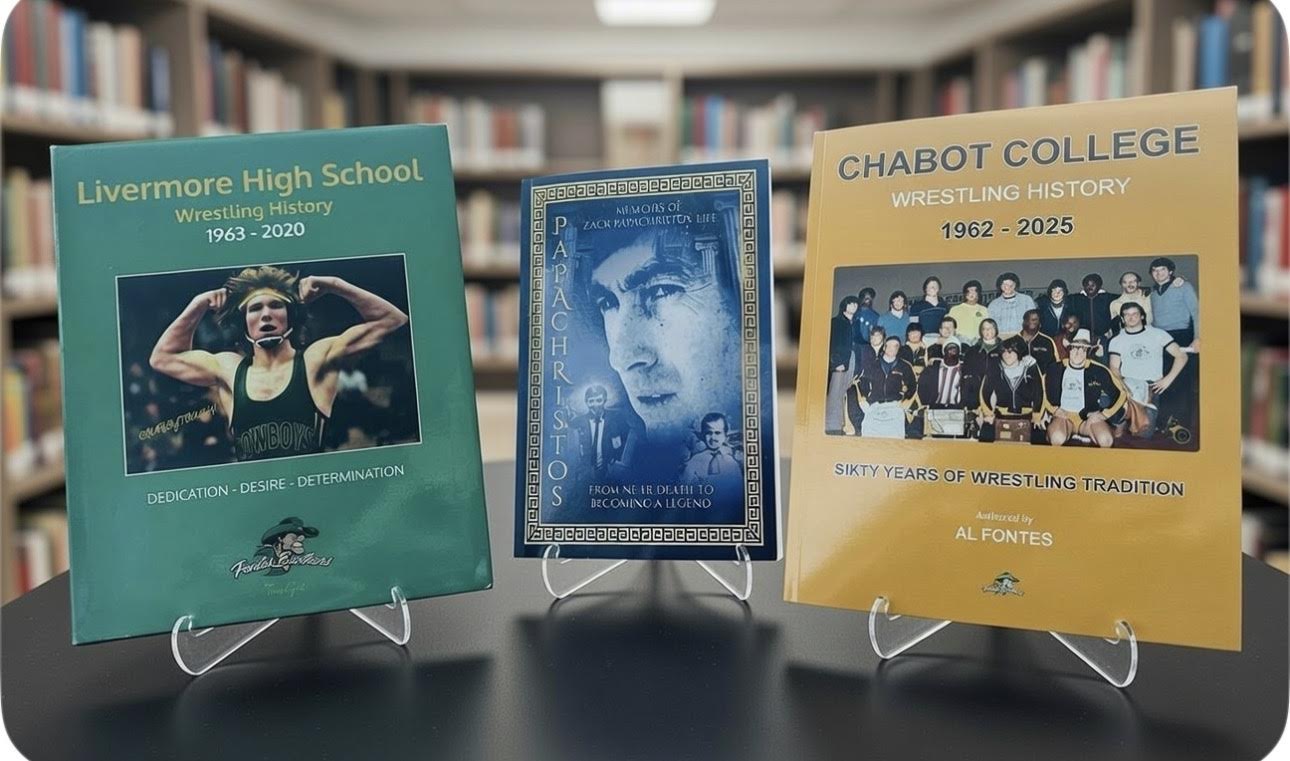
This past month, I hit a major personal milestone. I just finished my third book – a deep dive into the 60 years of wrestling at my alma mater, Chabot College. It’s been an honor to follow up my work on Livermore High and the memoir of the legendary Coach Zack Papachristos with this new project. The hours of research and writing were long, but seeing these legacies preserved makes every minute worth it.
The preservation of our rich wrestling history holds paramount importance. It is the anchor in our shifting world, grounding us in a shared heritage that defines where we’ve been and where we are going. In an era where digital data is easily erased, recorded history serves as a vital bridge to our past, offering a lasting foundation for belonging within a fast-paced society.
When I first stepped onto the wrestling mat in the late ’70s, a team’s legacy lived in physical form: hall-of-fame boards, printed programs, and scrapbooks thick with newspaper clippings and candid photos. Today, that world is predominately digital. The ubiquity of digital platforms, including social media and real-time tournament feeds, has subjected us to a daily volume of information that exceeds what was once gathered over several decades. This raises a critical question: how much of this record is maintained in tangible form? While data is lacking, I hypothesize that physical preservation has declined significantly compared to previous generations.
Driven by a lifelong passion for wrestling, I am committed to expanding my efforts in promoting this great sport through new historical volumes. My recent work, Chabot College Wrestling History 1962-2025, stands as a meticulously compiled time capsule. It preserves the legacy of the program by celebrating the legendry coaches, alumni, and exceptional wrestlers who have brought national recognition to Chabot College.
The inspiration for this book traces back to a pivotal conversation with legendary Coach Zack Papachristos a few weeks after the 1989 3C2A State Championships. Disheartened by not accomplishing my mat goals, his counsel was sought. Coach Papachristos taught that failure is a necessary part of the learning process. He immediately encouraged taking that setback and using its energy to pursue other aspirations. The guiding principle behind this book was Zack Papachristos’ wisdom to “always strive for perfection, but settle for excellence.” While the process was long, it was a profound labor of love. Reflecting back, it is now realized that my work in promoting wrestling was the start of a journey that would culminate in an ambition to promote the sport at the highest echelons in the country and abroad.
The history of Chabot College wrestling (1962–2025) stands as a testament to the powerful collaboration between coaches, alumni, and myself. While my initial archive provided the foundation, the project was brought to life by their generous donations of photos, newspaper clippings, and memorabilia. This book was a true labor of love, requiring an extensive process of networking, curating, and editing physical materials—much of which had been tucked away in boxes for decades.
As we look to the future, I urge the wrestling community—from coaches to promoters—to prioritize the preservation of program history. While digital platforms offer incredible real-time visibility, they also carry the risk of a ‘digital fade.’ To truly secure our legacy, we must continue to maintain tangible records such as physical photos, tournament programs, and published books. Safeguarding the rich tapestry of wrestling’s history is a vital responsibility that bridges our past with our future. These recent books exist only because the physical archives—the tangible records of the sport—were meticulously preserved. Moving on to my next book, History of the East Bay Athletic League, 1965-2026.
Photo credit – Al Fontes
Leave a Reply