
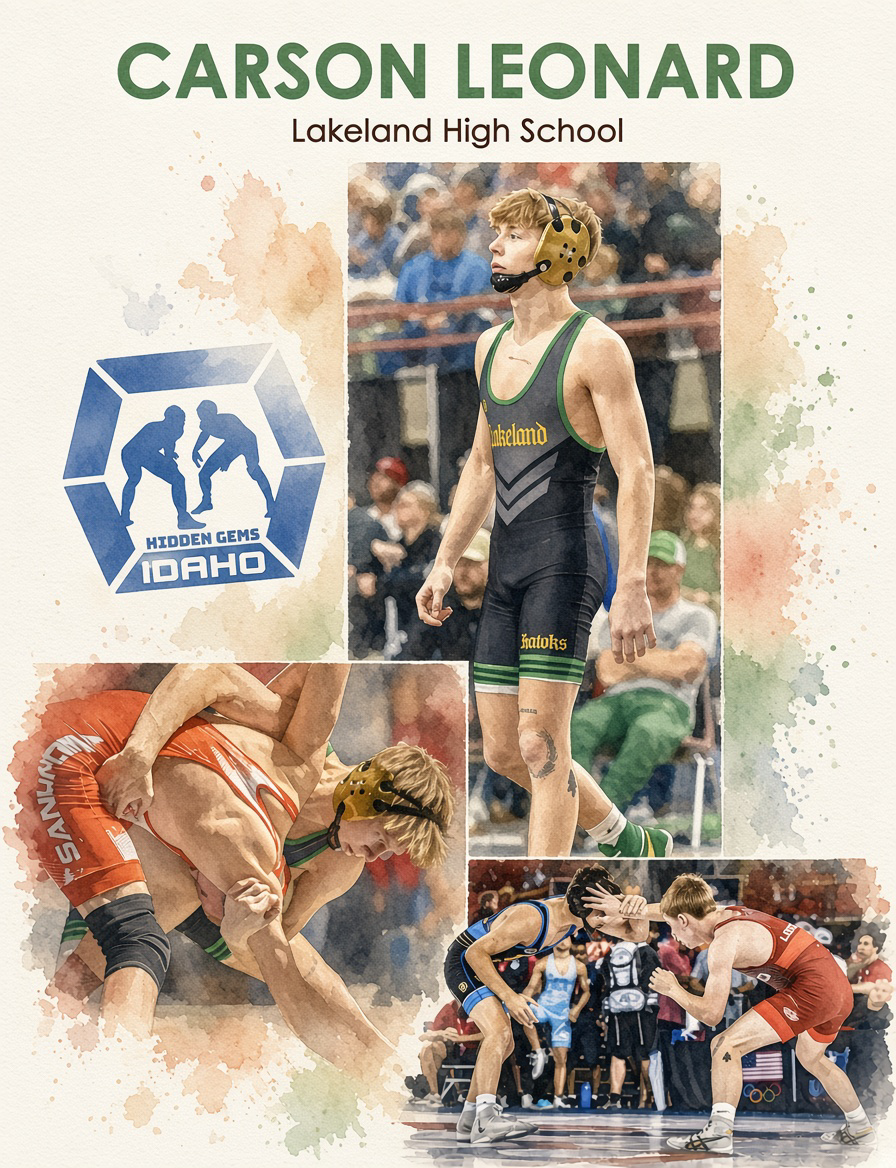

Lakeland High School | Class of 2027 | 138 Pounds
Two-time Idaho state champion. Three-time state finalist. More than 100 career victories. But Carson Leonard’s story is about considerably more than championships. It is about growing up in a wrestling family, learning to overcome adversity, discovering a passion for competition, and developing an identity that is uniquely his own.
There are certain families in wrestling whose influence extends well beyond the accomplishments of a single athlete. Their traditions are built through generations, their lessons are passed from one mat to another, and their appreciation for the sport becomes part of the family’s identity.
In Idaho, the Leonard family is building just such a tradition.
For Lakeland High School’s Carson Leonard, wrestling has never been something he simply stumbled upon. It has been part of his life since he was four years old, introduced to him by his father, Clint Leonard, a three-time Idaho state champion and one of Lakeland’s accomplished wrestling alumni.
Carson doesn’t remember much about those earliest days in the sport, although his father certainly does.
“He always likes to remind me I never won a match my first year,” Carson recalls.
It is a humorous beginning to a wrestling journey that has developed into something considerably more impressive. By December 2025, Carson had surpassed 100 career victories. He has established himself as a three-time Idaho state finalist and two-time state champion, competing against some of the state’s best talent in both the 4A and 5A classifications.
Yet, for all the victories, medals, and accomplishments, perhaps the most interesting part of Carson’s story is what happened between those early losses and his emergence as one of Idaho’s accomplished prep wrestlers.
His development wasn’t simply about becoming stronger, faster, or more technically proficient. It was about learning how to compete when the stakes were highest, understanding how to respond to defeat, and ultimately discovering something that would make all the difference: a genuine love for wrestling.
And according to Lakeland head coach Will Edelblute, Carson’s greatest qualities extend well beyond what he accomplishes on the mat.
THE LEONARD LEGACY: LEARNING FROM THE BEST
Having a father who was a three-time state champion can create some interesting expectations for a young wrestler. There is the family tradition, the competitive environment, and the inevitable comparisons that accompany following in the footsteps of someone who has already achieved considerable success.
For Carson, however, his father’s greatest contribution has never been about expecting him to duplicate his accomplishments.
“My dad is hands down my biggest influence,” Carson explains. “He is so knowledgeable and constantly involved in the sport. Hearing stories from him and others always made me look up to him. He was a three-time state champ and has plenty of national accolades, too.”
What makes their relationship particularly meaningful is the freedom Clint has given his son to develop his own approach to wrestling.
“No one has helped me grow into the wrestler I am today like him. He never demanded that I wrestle like him or do what he did. He always wanted me to develop my own style. On top of that, nothing beats having your own dad in your corner.”
That last statement captures something special about the Leonard family relationship. The technical instruction, tournament preparation, and competition are important, but having someone who understands the sport and the athlete on such a personal level can be invaluable.
And apparently, the father-son competition hasn’t completely disappeared.
Even at 42, Clint remains a capable athlete and occasionally serves as Carson’s warmup partner at tournaments. Their shared wrestling experiences have created a bond that extends beyond the traditional coach-and-athlete relationship.
But Carson’s admiration for his father goes far beyond wrestling.
“He’s the hardest-working man I know. I’ve never seen him sit down for more than 30 minutes. He is always finding something around the house to work on during weekends.”
Carson describes a father whose commitment to providing for his family sometimes means leaving for work at 5 a.m. and not returning until the following morning.
“If he gets a callout, no matter when or where he is, he will take it. There have been times where he’s left for work at 5 a.m. and didn’t get back home until I was leaving school the next day. He sacrifices a lot for my family, and that means the world. I would be happy to have half the work ethic he has.”
Those observations reveal something about Carson that statistics cannot measure. He recognizes that success is not simply about what happens in competition. It is also about commitment, responsibility, sacrifice, and the willingness to work when nobody is watching.
Those are lessons that will serve him well long after his high school wrestling career concludes.
FINDING HIS IDENTITY: FROM EARLY FRUSTRATION TO A PASSION FOR THE SPORT
One of the more revealing aspects of Carson’s story is that wrestling wasn’t always something he particularly enjoyed.
Despite growing up in a wrestling household, surrounded by the sport and influenced by his father’s accomplishments, he admits that he actually disliked wrestling until approximately eighth grade.
That admission is particularly interesting considering what he has accomplished since.
Asked what advice he would offer a young wrestler hoping to achieve success, Carson didn’t immediately discuss technique, conditioning, strength training, or tournament preparation.
Instead, his message was simple.
“You have to learn to enjoy it.”
He understands that enjoyment means something different to everyone, but believes developing a genuine appreciation for the sport is essential to long-term success.
“I hated wrestling until about 8th grade. I can’t say that there was a deciding factor that made me really love and enjoy wrestling, but I noticed. It was like I just rolled out of bed one day and was so excited to get in the mat room.”
That change in attitude helped transform his relationship with the sport.
“Truly enjoying the sport made it so much easier to get better and work hard to achieve my goals.”
There is an important lesson in that perspective. Wrestling is demanding, often unforgiving, and requires an extraordinary investment of time and effort. Athletes who remain involved for the right reasons often discover that their greatest motivation comes from within.
For Carson, that motivation eventually became the desire to improve every day.
LEARNING TO WIN, LEARNING TO LOSE, AND LEARNING TO COMPETE
Carson’s development has also been shaped by his experiences competing against elite national-level competition.
Through opportunities at the NHSCA Junior Nationals, Preseason Nationals, and Fargo Nationals as a member of Team Idaho, he has experienced the challenges of competing against accomplished wrestlers from throughout the country.
Those experiences provided valuable lessons, although not necessarily the ones he initially expected.
Carson openly acknowledges that competing when it mattered most was once a significant challenge.
“I always had a hard time competing when it mattered. More often than not, I let the moment get to me.”
His biggest breakthrough came when he learned to relax in high-pressure situations.
He discovered that allowing the moment to overwhelm him often affected his ability to react, make sound decisions, and wrestle intelligently.
Learning to control those emotions helped him become a more composed and educated competitor.
But perhaps his most important lesson came from learning how to lose.
“When I was younger, I didn’t travel a lot, so I didn’t lose a lot. Because of this I didn’t respond well when I did lose. I had a hard time rebounding and having good matches the rest of the tournament.”
That experience eventually forced him to reconsider his approach.
He realized that regardless of how disappointed or frustrated he might be following a loss, the outcome could not be changed.
“I could be as mad as I wanted about a match, I could be as disappointed in myself as I wanted, but I couldn’t change the result. So as long as I went out there and gave that match 100%, I wasn’t mad. All you can do is move on to the next match.”
That is an important perspective for any developing wrestler.
The ability to recover from adversity, learn from mistakes, and move forward is often what separates athletes who experience temporary success from those who continue developing throughout their careers.
For Carson, those lessons have become an integral part of his competitive identity.
THE DAILY GRIND: BUILDING SUCCESS BEFORE THE SCHOOL DAY BEGINS
While Carson has developed a healthier competitive mindset, his continued improvement is also the result of a consistent training commitment.
His typical day begins at 5:30 a.m., well before the school day gets underway.
Depending on his training needs, those early-morning sessions may involve weightlifting, jump rope, stance and motion, or even yoga for recovery.
He doesn’t subscribe to an overly complicated nutritional program, instead emphasizing whole foods and proper hydration.
Later in the afternoon, he returns to the wrestling room for practice under Lakeland head coach Will Edelblute.
Practices generally begin at 4 p.m. and feature the traditional components of a demanding wrestling program, including drilling, technique development, and live wrestling.
There is also a philosophy behind the way the Lakeland staff approaches conditioning.
Carson explains that the team generally doesn’t spend much time running sprints because of its belief that the best way to develop wrestling-specific conditioning is through wrestling itself.
It is a straightforward approach that reflects the physical and technical demands of the sport.
For Carson, the commitment is about more than preparing for the next tournament.
“Every day I leave the wrestling room I can confidently say I got better.”
That statement is particularly telling. At a point in his career when he has already accumulated significant accomplishments, he remains focused on incremental improvement rather than becoming satisfied with what he has achieved.
COACH WILL EDELBLUTE: THE COMPLETE PACKAGE
While Carson’s father has been his greatest influence and mentor throughout his wrestling journey, Lakeland head coach Will Edelblute has had a firsthand view of his continued development as both an athlete and a young man.
Edelblute’s assessment provides an interesting perspective on what makes Carson such an important part of the Lakeland wrestling program. His praise goes beyond tournament results and individual accomplishments, emphasizing the characteristics that coaches value when building a successful team culture.
“Coaching this group with Carson has been the most fun I’ve had in the sport as an athlete or as a coach. Seeing him grow and develop as a wrestler and a young man has been an absolute pleasure,” Edelblute explains.
He describes Carson as the type of athlete every coach hopes to have in a program.
“Coaches look for a couple things within an athlete, and Carson is the complete package in those aspects. He does everything right on the mat and off the mat.”
That distinction is important. Individual talent can produce victories, but the qualities that make an athlete valuable to an entire program often extend well beyond individual performance.
Edelblute believes Carson has helped establish the standards that Lakeland wants to become synonymous with as a wrestling program.
“He has helped reinforce the things we are working to cement as pillars of our program at Lakeland. Consistent effort, dedication, leadership, accountability, ownership and being coachable.”
Those are not simply words on a practice-room wall. They are characteristics that must be demonstrated consistently through preparation, training, competition, and interactions with teammates.
According to Edelblute, Carson’s approach to training exemplifies those principles.
“I’ve never met a kid who has bought into the process of training as much as Carson. He’s thoughtful with his training, always asking questions and every rep of every practice is purposeful.”
That observation helps explain the commitment behind Carson’s early-morning workouts and his willingness to continually evaluate his performance. He isn’t simply going through the motions or relying on his natural abilities. He wants to understand the process, learn the details, and make every opportunity to improve count.
Perhaps the most intriguing part of Edelblute’s evaluation concerns Carson’s potential.
“He’s got a high floor already but his ceiling is whatever he wants it to be. I truly believe when he is wrestling at his best he can beat anyone in country.”
That is a significant endorsement from a coach who works with him daily and understands the demands of high-level competition.
For Carson, the message is clear: his accomplishments have established a strong foundation, but his development is far from complete.
A CHAMPIONSHIP FOUNDATION AT LAKELAND
Carson’s accomplishments have placed him among an impressive group of Lakeland wrestlers who have established themselves as three-time Idaho individual state champions.
The list includes:
- Sky Pruitt: 2000, 2001, 2002
- Clint Leonard: 2000, 2002, 2003
- Larry Johnson: 2015, 2016, 2017
- Sam Edelblute: 2017, 2018, 2019
Carson’s father, Clint, is part of that distinguished group, making the family’s connection to Lakeland wrestling particularly meaningful.
Carson has already captured two individual state championships and will have an opportunity to pursue a third during his senior season.
His high school championship progression reflects both his individual accomplishments and his ability to adapt as Lakeland moved from the 4A to the 5A classification.
2024 – Freshman State Champion | 4A | 113 Pounds
Carson announced his arrival as one of Idaho’s promising young wrestlers by capturing the 4A 113-pound championship in Pocatello. He defeated Bonneville’s Rydge Vail by an 8-3 decision in the championship finals.
2025 – Sophomore State Champion | 5A | 120 Pounds
Following Lakeland’s move into the 5A classification, Carson moved up to 120 pounds and captured his second consecutive state championship.
2026 – Junior State Runner-Up | 5A | 120 Pounds
Returning to the 5A championship finals, Carson finished second after falling to Skyline’s Ayden Tokita.
His three consecutive appearances in the state championship finals demonstrate the consistency he has established at the highest level of Idaho high school competition.
Heading into his senior campaign, Carson has the opportunity to add another chapter to an already impressive Lakeland career.
THE NEXT GENERATION: THE LEONARD FAMILY WRESTLING TRADITION
The Leonard family wrestling tradition doesn’t end with Carson and his father.
His younger sister, Kinley Leonard, is also developing an impressive résumé of her own.
Carson describes her as “super tough,” and with good reason. Kinley has placed at Girls Nationals multiple times and has captured state championships in freestyle, folkstyle, and Greco-Roman wrestling.
The competitive environment within the Leonard household undoubtedly provides a unique opportunity for both siblings to learn from one another.
With Clint’s experience, Carson’s accomplishments, and Kinley’s continued development, the family represents the type of wrestling environment that can help sustain the sport at the youth and high school levels.
Carson also sees a future role for himself in helping develop the next generation.
He would love to return to Lakeland someday as an assistant coach, potentially once Kinley reaches high school.
That aspiration speaks to his appreciation for the people who have helped him along the way and his desire to eventually give something back to the program that has played such an important role in his life.
A FUTURE THAT REMAINS OPEN
As Carson approaches the conclusion of his high school career, the possibility of continuing to compete beyond graduation remains very much on the table.
He is realistic about where he currently stands in the recruiting landscape and doesn’t pretend to be something he isn’t.
“Given the right opportunity and circumstances I am very open to wrestling after high school. I know I’m not a D1 level wrestler at this point in my career, but I still feel like I have so much left to offer this sport.”
That statement is refreshing in its honesty.
Rather than allowing a particular classification or recruiting label to define his future, Carson recognizes that he still has considerable room to develop.
His recent growth, renewed appreciation for the sport, and commitment to daily improvement have strengthened his desire to continue competing.
“I love the sport more than ever now and it would be a shame if that came to an end after high school.”
For an athlete who once struggled to enjoy wrestling, that is perhaps one of the most meaningful statements in the entire interview.
His favorite wrestler is legendary Oklahoma State and Olympic champion John Smith. Carson appreciates Smith’s technical ability, creativity, and slickness on the mat, describing his style as something that always appeared effortless.
It is an appropriate choice for a wrestler who values technique and the ability to think through situations rather than simply relying on physical attributes.
GROWING WRESTLING: MAKING THE SPORT A CULTURE
Carson’s appreciation for wrestling also extends to the future of the sport.
When asked how he would approach expanding wrestling at the youth and high school levels, his answer focused on something that has become increasingly important to the sport: creating an environment that attracts participants, families, and spectators.
He believes wrestling needs to become more visible and more entertaining to the general public.
“If high school duals could bring in the numbers that a football game did, that would do huge things for the sport.”
He also believes that wrestling should become more than an extracurricular activity.
“I would make the sport of wrestling more of a culture, lifestyle from the earliest age.”
Carson recognizes that wrestling isn’t necessarily for everyone, but believes those who experience the excitement of the sport can develop an appreciation for its competitive nature.
It is an interesting perspective from a young athlete who understands firsthand that the road to becoming a successful wrestler doesn’t always begin with an immediate love for the sport.
Sometimes, it takes years of participation, personal development, and the right experiences before everything comes together.
BEYOND THE MAT
Although wrestling occupies a significant portion of Carson’s life, he also enjoys spending time outdoors.
Hunting, fishing, and other outdoor activities provide opportunities to step away from the demands of training and competition.
He also enjoys video games, including Elden Ring and Bloodborne, and is looking forward to spending some time with GTA 6.
Academically, Carson maintains a 3.2 GPA while participating on the mathematics competition team, including calculus, and completing college-level English and mathematics coursework.
His interests and academic pursuits reflect a young man whose life extends well beyond the wrestling room.
THE HIDDEN GEM: MORE THAN THE RECORD AND THE MEDALS
The Idaho Elite Report’s Hidden Gems of Idaho Prep Wrestling series is designed to introduce readers to athletes whose stories deserve recognition beyond the traditional rankings, records, and tournament results.
Carson Leonard certainly has the credentials to attract attention.
A two-time Idaho state champion, three-time state finalist, District I-II champion, Team Idaho Fargo representative, and a wrestler who has surpassed 100 career victories, he has already established himself as an accomplished competitor.
But his story is about more than the numbers.
It is about a father who introduced his son to wrestling at four years old and provided the guidance, knowledge, and example necessary to help him develop.
It is about a young athlete who openly acknowledges that he once struggled with pressure and disappointment but eventually learned how to compete with a clearer mindset.
It is about discovering that the enjoyment of wrestling can become a powerful motivator.
It is about a family that continues to embrace the sport through multiple generations.
And it is about a young man who, despite his accomplishments, believes he still has much more to offer.
Perhaps the most telling aspect of Carson’s personality is the philosophy he has adopted for himself:
“If you are going to do something, do it right.”
It is a simple statement, but one that reflects the work ethic he admires in his father, the commitment he brings to his training, and the attitude he hopes to carry into the future.
Coach Edelblute’s assessment provides a fitting perspective on what makes Carson special and what may lie ahead.
His coach sees an athlete who has embraced every aspect of the process, established himself as a leader, and helped reinforce the values Lakeland wants its wrestling program to represent.
And perhaps Edelblute’s most powerful observation says everything about Carson’s potential:
“I truly believe when he is wrestling at his best he can beat anyone in country.”
As Carson prepares for his senior season at Lakeland, he has an opportunity to add another championship to his family’s legacy while continuing to establish his own.
Whether his future takes him to the collegiate wrestling ranks, back to Lakeland as a coach, or into another chapter of life, the lessons he has learned through wrestling will remain.
For a young man who once couldn’t wait to leave the wrestling room, there may be no greater accomplishment than discovering that he now can’t imagine life without it.
Carson Leonard is still writing his wrestling story. The next chapter promises to be an interesting one.
Photos courtesy of Clint Leonard.
Follow me on X @Coach_Al_1984 | on Instagram @tier_one_Idaho
Leave a Reply