
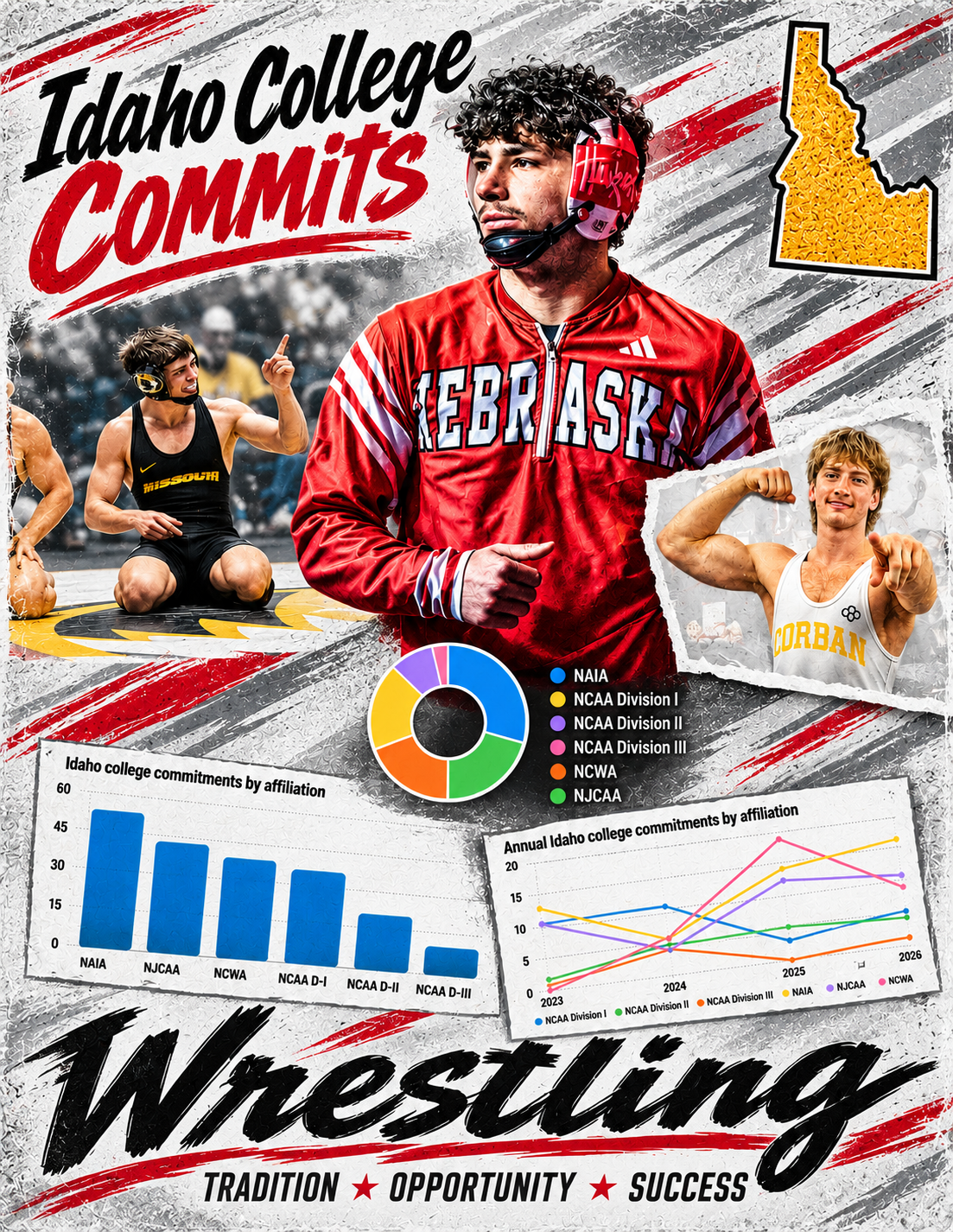

NAIA Leads All Collegiate Affiliations in Recruiting Idaho Wrestlers as 64 Colleges and Universities Emerge as Destinations for Idaho Talent
Idaho high school wrestling continues to produce student-athletes who are pursuing opportunities at the collegiate level. Over the past four seasons, from 2023 through 2026, a total of 170 reported college commitments have been identified across six collegiate wrestling affiliations: NCAA Division I, NCAA Division II, NCAA Division III, NAIA, NJCAA, and NCWA.
One of the most significant findings is the role played by the NAIA, which accounts for more reported Idaho commitments than any other collegiate affiliation. The NAIA leads the four-year totals with 49 commitments, representing 28.8% of the overall total. The NJCAA follows with 37 commitments (21.8%), while the NCWA accounts for 32 (18.8%).
Combined, the NAIA and NJCAA account for 86 commitments, or 50.6% of the four-year total. When NCWA commitments are included, those three affiliations represent 118 of the 170 reported commitments, or approximately 69.4%.
Beyond those numbers, an examination of the individual college destinations reveals an even broader picture of Idaho’s recruiting reach. Idaho wrestlers have been identified as committing to 64 different colleges and universities across six collegiate affiliations during the four-year period.
Those destinations include nationally recognized NCAA Division I programs, established NCAA Division II and III institutions, a strong collection of NAIA wrestling programs, junior colleges throughout the western United States and beyond, and NCWA club programs.
The findings offer an opportunity to examine where Idaho wrestlers are finding collegiate opportunities, how those opportunities have changed over the past four seasons, and what the figures may suggest about the future of wrestling in the state.
STATISTICAL NOTES AND METHODOLOGY
The statistics presented in this article are based on information reported, collected, or available at the time of publication. Every effort has been made to provide an accurate accounting of Idaho high school wrestling participation, programs, and collegiate commitments for the 2023–2026 seasons.
College commitments are subject to change, and additional announcements or previously unreported information may become available. Therefore, these figures should be viewed as a statistical snapshot of the information available when this article was prepared, rather than a permanently finalized accounting.
Commitment totals reflect reported commitments and do not necessarily represent verified college enrollment or actual collegiate wrestling participation. High school participation figures are based on available National Federation of State High School Associations (NFHS) reporting.
Annual commitment-to-participation percentages are provided for comparison and perspective. They should not be interpreted as the percentage of graduating seniors receiving college opportunities, since participation totals include wrestlers across all high school grade levels.
The college destination directory identifies institutions associated with reported commitments and the years in which Idaho wrestlers committed. A year listed beside an institution does not indicate the number of individual commitments, as multiple wrestlers may have committed to the same school in a given year.
This study aims to identify recruiting patterns, examine year-to-year trends, and provide an informed statistical perspective on the direction of Idaho boys high school wrestling and its collegiate opportunities.
IDAHO HIGH SCHOOL WRESTLING: PARTICIPATION AND PROGRAMS
Before examining the college commitments, it is important to consider the size of Idaho’s high school wrestling population.
According to the available NFHS participation figures, Idaho had more than 3,000 boys participating in high school wrestling in both 2024 and 2025. The number declined in 2026, although the state’s overall participation remains above its 2023 total.
| Season | Participants | Schools | Reported Commitments | Commitments as % of Participation |
| 2023 | 2,668 | 108 | 38 | 1.4% |
| 2024 | 3,055 | 108 | 36 | 1.2% |
| 2025 | 3,066 | 109 | 52 | 1.7% |
| 2026 | 2,846 | 111 | 44 | 1.5% |
| Four-year average | 2,909 | 109 | 42.5 | Approximately 1.5% |
Over the four-year period, Idaho averaged approximately 2,909 boys participating in high school wrestling annually, with an average of 109 schools sponsoring the sport. The state also averaged 42.5 reported college commitments per season.
Several observations stand out:
- Participation growth since 2023: The number of participants increased from 2,668 in 2023 to 2,846 in 2026, a gain of 178 wrestlers, or approximately 6.7%.
- More schools: The number of participating schools increased from 108 in 2023 to 111 in 2026.
- The 2025 high point: Idaho recorded 3,066 participants and 52 reported college commitments in 2025, the highest totals in the four-year period for each category.
- A 2026 decline in participation: The 2026 participation figure decreased by 220 wrestlers from 2025, a decline of approximately 7.2%.
- Commitments remain relatively consistent: Despite the year-to-year fluctuations, Idaho recorded between 36 and 52 commitments annually.
Across the four seasons, the 170 reported commitments represent approximately 1.5% of the 11,635 combined annual participation entries. This comparison illustrates the relatively small number of reported collegiate commitments in relation to Idaho’s overall high school wrestling population. It should not, however, be interpreted as an individual athlete’s probability of receiving a college opportunity or as a recruiting success rate among graduating seniors.
WHERE IDAHO WRESTLERS ARE GOING: A BREAKDOWN BY COLLEGIATE AFFILIATION
The 170 reported commitments are distributed across six collegiate wrestling affiliations. The NAIA leads the overall totals, followed by the NJCAA and NCWA.
| Collegiate Affiliation | 2023 | 2024 | 2025 | 2026 | Four-Year Total | % |
| NCAA Division I | 11 | 11 | 3 | 5 | 30 | 17.6% |
| NCAA Division II | 2 | 5 | 5 | 4 | 16 | 9.4% |
| NCAA Division III | 1 | 4 | 0 | 1 | 6 | 3.5% |
| NAIA | 13 | 6 | 14 | 16 | 49 | 28.8% |
| NJCAA | 11 | 4 | 12 | 10 | 37 | 21.8% |
| NCWA | 0 | 6 | 18 | 8 | 32 | 18.8% |
| Total | 38 | 36 | 52 | 44 | 170 | 100% |
Percentages may not total exactly 100% due to rounding.
The numbers show that Idaho wrestlers are finding opportunities across a broad range of collegiate programs. However, the distribution is not evenly divided.
The NAIA accounts for more than one-quarter of all reported commitments. The NJCAA and NCWA each account for approximately one-fifth, while NCAA Division I represents 17.6%.
The combined numbers also demonstrate the importance of opportunities outside NCAA Division I. More than two-thirds of the reported commitments went to NAIA, NJCAA, or NCWA programs.
NAIA: THE LEADING DESTINATION FOR IDAHO WRESTLERS
With 49 reported commitments over four seasons, the NAIA leads all collegiate affiliations in attracting Idaho high school wrestlers.
The NAIA’s 49 commitments represent 28.8% of the overall total, making it the largest destination for Idaho wrestlers in this study.
Its annual totals were:
- 2023: 13 commitments
- 2024: 6 commitments
- 2025: 14 commitments
- 2026: 16 commitments
The NAIA led all affiliations in both 2023 and 2026. Although it did not lead in 2024 or 2025, its four-year total remained the highest among the six affiliations.
Perhaps the most encouraging development for NAIA programs is the increase from six commitments in 2024 to 16 in 2026. That represents a 166.7% increase over the two-year period.
The 16 NAIA commitments in 2026 accounted for approximately 36.4% of all reported Idaho commitments that season.
These figures reinforce the NAIA’s importance in providing collegiate wrestling opportunities for Idaho student-athletes. They also suggest that NAIA programs have become an increasingly significant part of the state’s recruiting landscape.
NJCAA: AN IMPORTANT PATHWAY TO THE NEXT LEVEL
The NJCAA accounted for 37 commitments over the four-year period, representing 21.8% of the total.
Its annual numbers were:
- 2023: 11 commitments
- 2024: 4 commitments
- 2025: 12 commitments
- 2026: 10 commitments
The NJCAA provides an important opportunity for wrestlers to continue developing after high school while pursuing their academic goals. Junior college wrestling can also serve as a stepping stone for athletes who hope to transfer to four-year institutions.
The 22 commitments recorded in 2025 and 2026 represent approximately 59.5% of all NJCAA commitments during the four-year period. This indicates that junior college opportunities have remained a significant part of Idaho’s recent recruiting activity.
For Idaho, the NJCAA carries additional importance because North Idaho College is the state’s only current men’s NJCAA wrestling program. Its history and accomplishments make it one of the most recognizable junior college wrestling programs in the country.
North Idaho College has earned 14 NJCAA national team championships, produced 253 All-Americans, and crowned 56 individual national champions. Under the leadership of Derek Booth, the program continues to provide an important collegiate opportunity for wrestlers from Idaho and beyond.
However, having only one men’s NJCAA program in the state also illustrates a limitation in Idaho’s collegiate wrestling infrastructure.
NCWA: A GROWING PART OF THE COLLEGIATE LANDSCAPE
The NCWA accounted for 32 reported commitments, or 18.8% of the four-year total.
Its annual numbers show a particularly interesting progression:
- 2023: 0 commitments
- 2024: 6 commitments
- 2025: 18 commitments
- 2026: 8 commitments
The 18 commitments in 2025 represented 34.6% of all reported commitments that season, making the NCWA the leading affiliation that year.
Although the total declined to eight in 2026, the four-year numbers demonstrate that NCWA programs have become an important part of the collegiate options available to Idaho wrestlers.
The NCWA should not be confused with an NCAA division. It is a separate collegiate wrestling association that provides opportunities for student-athletes at participating colleges and universities.
Its presence in the recruiting landscape is important because it broadens the range of opportunities available to wrestlers who want to continue competing while pursuing a college education.
NCAA DIVISION I: A DECLINE IN REPORTED COMMITMENTS
NCAA Division I programs accounted for 30 reported commitments over the four-year period, representing 17.6% of the total.
The annual numbers were:
- 2023: 11 commitments
- 2024: 11 commitments
- 2025: 3 commitments
- 2026: 5 commitments
The decline in reported Division I commitments is one of the more notable findings in the study.
Idaho recorded 22 Division I commitments during the first two seasons, 2023 and 2024. That number fell to eight during the next two seasons, 2025 and 2026, a decline of approximately 63.6%.
Comparing 2023 with 2026, Division I commitments decreased from 11 to five, a reduction of approximately 54.5%.
These numbers do not necessarily mean that Idaho is producing fewer Division I-caliber wrestlers. Recruiting totals can be influenced by available roster positions, scholarship opportunities, coaching changes, individual recruiting decisions, and the number of athletes who choose to pursue other collegiate affiliations.
Nevertheless, the trend deserves attention.
The decline warrants further examination, particularly as Idaho continues to develop athletes capable of competing at the NCAA Division I level. Future comparisons will help determine whether this represents a temporary fluctuation in recruiting activity or a longer-term trend.
Division I wrestling remains the highest level of NCAA collegiate competition, and maintaining a strong pipeline of Idaho wrestlers to that level should remain an important objective for the state’s high school and club wrestling communities.
NCAA DIVISION II AND DIVISION III
NCAA Division II accounted for 16 reported commitments, or 9.4% of the four-year total.
The annual numbers were:
- 2023: 2 commitments
- 2024: 5 commitments
- 2025: 5 commitments
- 2026: 4 commitments
Division II commitments have been relatively consistent over the last three seasons, with four or five reported commitments annually.
NCAA Division III accounted for six commitments, representing 3.5% of the overall total.
Its annual numbers were:
- 2023: 1 commitment
- 2024: 4 commitments
- 2025: 0 commitments
- 2026: 1 commitment
Although the Division III numbers are smaller, these programs provide another pathway for student-athletes who want to continue wrestling while pursuing a college education.
It is important to recognize that collegiate opportunities are not limited to the NCAA Division I level. Each affiliation provides a different competitive and academic environment, and the best opportunity for a student-athlete depends on individual goals, academic interests, and athletic fit.

THE COLLEGE DESTINATION DIRECTORY: 64 INSTITUTIONS ACROSS SIX AFFILIATIONS
One of the most revealing additions to this four-year study is the identification of the individual colleges and universities attracting Idaho wrestlers.
Between 2023 and 2026, Idaho wrestlers were reported as committing to 64 different institutions across NCAA Division I, NCAA Division II, NCAA Division III, NAIA, NJCAA, and NCWA club wrestling.
The following directory identifies each institution and the seasons in which Idaho wrestlers were listed as committing.
The list is organized by collegiate affiliation, with the years representing reported commitment activity rather than the number of wrestlers attending each institution.

1. NCAA DIVISION I
14 institutions
| College / University | Commitment Years |
| Air Force Academy | 2026 |
| CSU, Bakersfield | 2025 |
| Lehigh University | 2023, 2024 |
| University of Missouri | 2023, 2024 |
| University of Nebraska | 2023 |
| North Dakota State University | 2024, 2026 |
| Northwestern University | 2023 |
| Oklahoma State University | 2023, 2024 |
| Oregon State University | 2023 |
| Princeton University | 2025 |
| Stanford University | 2023, 2024 |
| University of Wisconsin | 2024 |
| University of Wyoming | 2023, 2024 |
| Utah Valley University | 2023, 2024, 2026 |
The Division I destinations illustrate the national reach of Idaho wrestling. Wrestlers have been connected to established programs across the country, including Lehigh, Missouri, Nebraska, Oklahoma State, Stanford, Wyoming, and Utah Valley.
2. NCAA DIVISION II
11 institutions
| College / University | Commitment Years |
| Ashland University | 2023 |
| Augustana University | 2024 |
| Colorado Mesa University | 2024 |
| Colorado State Univ. Pueblo | 2025 |
| Menlo College | 2025 |
| Quincy University | 2026 |
| St. Cloud State University | 2025 |
| University of Sioux Falls | 2024 |
| Western Colorado University | 2023, 2024, 2025, 2026 |
| West Liberty University | 2024 |
| Tiffin University | 2026 |
Western Colorado University stands out for appearing in all four years of the study, demonstrating a consistent connection with Idaho recruiting.
3. NCAA DIVISION III
4 institutions
| College / University | Commitment Years |
| Maine Maritime Academy | 2024 |
| Pacific University (Oregon) | 2026 |
| Southern Virginia University | 2023, 2024 |
| Wartburg College | 2024 |
Although Division III accounts for a smaller portion of Idaho’s reported commitments, these institutions provide additional opportunities for wrestlers to continue competing while pursuing their academic goals.
4. NATIONAL ASSOCIATION OF INTERCOLLEGIATE ATHLETICS (NAIA)
19 institutions
| College / University | Commitment Years |
| Central Christian College of Kansas | 2026 |
| Corban University | 2023, 2026 |
| Doane University | 2024, 2026 |
| Eastern Oregon University | 2023, 2024, 2025, 2026 |
| Life University | 2025 |
| Midland University | 2024 |
| Missouri Baptist University | 2023 |
| Missouri Valley College | 2025 |
| Montana State University–Northern | 2026 |
| Northwestern College (Iowa) | 2025 |
| Reinhardt University | 2026 |
| Saint Ambrose University | 2025 |
| Southeastern University | 2023, 2025 |
| Southern Oregon University | 2024, 2025 |
| University of Providence (Montana) | 2023, 2025, 2026 |
| Wayland Baptist University | 2025, 2026 |
| William Penn University | 2025 |
| William Woods University | 2025 |
| York University | 2023 |
The NAIA’s 19 institutional destinations represent the largest collection of college destinations in the four-year directory.
Eastern Oregon University is particularly noteworthy, appearing in all four recruiting classes. The University of Providence also has established a consistent recruiting connection with Idaho, appearing in three of the four years.
At the time this study was prepared, reports indicated that the University of Providence was expected to close in the near future. That development would represent a significant change for Idaho wrestlers who have viewed Providence as a collegiate destination. The university has been an important recruiting connection for Idaho athletes, including both men and women, and its expected closure further underscores the need to expand collegiate wrestling opportunities within the state.
These destinations reinforce the important role NAIA programs play in providing opportunities for Idaho wrestlers.
5. NATIONAL JUNIOR COLLEGE ATHLETIC ASSOCIATION (NJCAA)
13 institutions
| College | Commitment Years |
| Big Bend CC | 2025, 2026 |
| Clackamas CC | 2023, 2026 |
| Colby CC | 2023 |
| Colorado NW CC | 2025, 2026 |
| Ellsworth CC | 2023 |
| Iowa Western CC | 2025 |
| North Idaho (NIC) | 2023, 2024, 2025, 2026 |
| Northwest College | 2023 |
| Snow College | 2024 |
| Southeast CC | 2023 |
| Umpqua CC | 2023, 2026 |
| Western Wyoming CC | 2024, 2025 |
| Wyoming CC | 2026 |
North Idaho College is the only institution in this NJCAA directory located within Idaho. Its appearance in all four seasons demonstrates its continued importance to the state’s collegiate wrestling pipeline.
The other destinations illustrate how Idaho wrestlers are pursuing junior college opportunities throughout the region and across the country.
6. NATIONAL COLLEGIATE WRESTLING ASSOCIATION (NCWA) — CLUB WRESTLING
3 institutions
| College | Commitment Years |
| Treasure Valley CC | 2024, 2025, 2026 |
| University of Idaho | 2025, 2026 |
| Utah Tech Univ. | 2025, 2026 |
Collegiate Club Wrestling: Opportunities for Future Varsity Growth
The NCWA directory currently includes three institutions, one of which is located in Idaho. Across the country, several collegiate club wrestling programs competing in the National Collegiate Wrestling Association (NCWA) are working toward eventually establishing varsity programs within their respective collegiate athletic associations, including the NJCAA.
The University of Idaho and Treasure Valley Community College (TVCC) provide additional opportunities for student-athletes to continue competing through club wrestling while pursuing their college education. Both programs have demonstrated their competitive potential, with the University of Idaho producing an NCWA All-American in 2024 and several TVCC wrestlers earning All-American honors at the NCWA Collegiate National Championships in recent years.
Under the leadership of Head Coach Luis Cisneros, TVCC has done an outstanding job of creating opportunities for Idaho wrestlers in both the men’s and women’s divisions. The program has provided student-athletes with a pathway to pursue higher education while continuing their competitive careers, with multiple wrestlers earning NCWA All-American recognition in both divisions. These accomplishments reflect the program’s continued development and its ability to compete on a national level.
Cisneros recognizes the opportunities available within the region and sees the potential for TVCC to take the next step in its development by establishing an NJCAA varsity program.
“We are in a position to attract quality student-athletes from throughout the region. Fortunately, Treasure Valley Community College is located in a wrestling-rich area, surrounded by other NJCAA and NAIA programs that contribute to a strong collegiate wrestling environment. Since I became head coach in 2023, three of our wrestlers have successfully transitioned to four-year institutions to continue competing at the NAIA and NCAA Division I levels. Building on that success, my goal is to elevate our club program into a fully funded varsity wrestling program within the NJCAA.”
— Luis Cisneros, Head Coach, Treasure Valley Community College
Cisneros’s vision reflects an important opportunity for collegiate wrestling in Idaho. If Treasure Valley Community College or the University of Idaho were to eventually transition its wrestling program to varsity status and compete within its respective collegiate athletic association, it would represent an exciting and significant development. Beyond expanding opportunities for student-athletes, establishing additional varsity programs would create more pathways for Idaho’s homegrown talent to remain in-state and continue competing at the collegiate level.
It is important to distinguish between NCWA club wrestling, NCAA varsity wrestling, and NJCAA varsity competition when evaluating Idaho’s overall collegiate wrestling landscape. Although club programs provide valuable opportunities for student-athletes to continue competing, they remain distinct from varsity programs operating under their respective collegiate athletic associations. Recognizing that distinction is essential when assessing the current state of collegiate wrestling in Idaho and identifying opportunities for future growth.
IDAHO’S COLLEGIATE ALL-AMERICANS: MEASURING SUCCESS BEYOND HIGH SCHOOL (2020–2026)
While college commitments provide an indication of where Idaho wrestlers are finding opportunities, collegiate All-American honors offer another important measure of the state’s wrestling development.
Between 2020 and 2026, at least 23 Idaho high school graduates are represented in the All-American records compiled for this study, spanning five collegiate affiliations: NCAA Division I, NCAA Division II, NAIA, NJCAA, and NCWA.
Collectively, these wrestlers accounted for 32 All-American selections during the seven-year period. Several distinguished themselves multiple times, demonstrating sustained success at the collegiate level. The group also includes three national champions: Ridge Lovett of Nebraska, Kenneth Copley of Embry-Riddle (AZ), and Casey Randles of Grand View (IA).
The following directory identifies Idaho wrestlers who earned collegiate All-American honors, their high schools, the years they achieved recognition, and their respective college programs.
1. NAIA ALL-AMERICANS
The NAIA accounts for the largest group of Idaho collegiate All-Americans in this listing, with 12 wrestlers and 19 All-American selections during the 2020–2026 period.
| Wrestler | Idaho H.S. | All-American Years | College |
| Hunter Hobbs | So. Fremont | 2025, 2026 | Providence |
| Isaiah Twait | Meridian | 2025, 2026 | Corban University |
| Kenneth Copley | Sugar-Salem | 2024, 2025, 2026 | Embry-Riddle |
| Nico Rodriguez | Columbia | 2025, 2026 | Eastern Oregon |
| Sawyer Hobbs | So. Fremont | 2023, 2025 | Providence |
| Gentry Smith | Post Falls | 2025 | Southeastern |
| Casey Randles | Coeur d’Alene | 2021, 2022 | Grand View |
| Tyler Hall | Meridian | 2019, 2021 | Embry-Riddle / Lindsey Wilson |
| Levi Perry | Kuna | 2020 | Corban University |
| Drake Foster | Post Falls | 2020 | Oklahoma City |
| John Hensley | Meridian | 2020 | Providence |
| Taylor Owens | Borah | 2020 | Embry-Riddle |
NAIA National Champions:
- Kenneth Copley — Embry-Riddle
- Casey Randles — Grand View
2. NCAA DIVISION I ALL-AMERICANS
Idaho has produced three NCAA Division I All-Americans represented in this listing since 2020, accounting for five All-American selections during the period.
| Wrestler | Idaho H.S. | All-American Years | College |
| Ridge Lovett | Post Falls | 2022, 2024, 2025 | Nebraska |
| Demitrius Romero | Mountain View | 2021 | Utah Valley |
| Tanner Hall | Meridian | 2017, 2020 | Arizona State |
NCAA Division I National Champion:
- Ridge Lovett — University of Nebraska
Ridge Lovett stands out with three All-American finishes and an NCAA Division I national championship, representing one of the most accomplished collegiate careers by an Idaho high school graduate in recent years.
3. NCAA DIVISION II ALL-AMERICANS
| Wrestler | Idaho H.S. | All-American Year | College |
| Kash Anderson | Bishop Kelly | 2023 | Colorado Mesa |
| Braydon Huber | Post Falls | 2021 | University of Mary |
4. NJCAA ALL-AMERICANS
The NJCAA has also provided an important pathway for Idaho wrestlers to achieve national recognition. Five Idaho athletes earned All-American honors through junior college wrestling during the period.
| Wrestler | Idaho H.S. | All-American Year | College |
| Colton Tucker | Coeur d’Alene | 2026 | North Idaho College |
| Seth Martin | Post Falls | 2026 | North Idaho College |
| Porter Craig | Coeur d’Alene | 2024 | North Idaho College |
| Destin Summers | Blackfoot | 2021 | Western Wyoming CC |
| Wyatt Kearn | American Falls | 2021 | Western Wyoming CC |
North Idaho College’s three representatives further illustrate the importance of the state’s only current men’s NJCAA wrestling program in developing collegiate All-Americans.
5. NCWA CLUB WRESTLING ALL-AMERICAN
| Wrestler | Idaho H.S. | All-American Year | College |
| Avian Martinez | Blackfoot | 2023 | Treasure Valley CC |
| James Greene | Moscow | 2026 | University of Idaho |
Although NCWA competition is classified as collegiate club wrestling rather than NCAA or NJCAA varsity competition, it provides another opportunity for Idaho athletes to continue competing at the collegiate level and earn national recognition.
A NOTE ABOUT THE ALL-AMERICAN RECORDS
The All-American listings identify collegiate accomplishments from 2020 through 2026 and should not be confused with the 2023–2026 high school commitment totals presented earlier in this study.
Not every athlete listed committed to compete at the collegiate level during the 2023–2026 period. Several wrestlers began their collegiate careers and earned All-American honors before 2023. The list also includes two earlier All-American seasons: Tyler Hall’s 2019 recognition and Tanner Hall’s 2017 recognition. Those earlier seasons provide additional career context but are not included in the 2020–2026 selection totals.
The records demonstrate that Idaho’s collegiate wrestling success extends across multiple affiliations. From NCAA Division I national championships to NAIA, NJCAA, and NCWA All-American honors, Idaho wrestlers continue to establish themselves on the national collegiate stage.
WHAT THE ALL-AMERICAN NUMBERS TELL US
The 2020–2026 records provide another important perspective on Idaho’s wrestling development:
- 23 individual Idaho wrestlers are represented in the listings.
- 32 All-American selections were recorded during the 2020–2026 period.
- 12 NAIA wrestlers account for 19 selections.
- Three NCAA Division I wrestlers account for five selections.
- Two NCAA Division II wrestlers represent NCAA Division II success.
- Five NJCAA wrestlers represent junior college success.
- Idaho athletes have also earned recognition through NCWA club wrestling.
- Three national champions are identified: Ridge Lovett, Kenneth Copley, and Casey Randles.
These accomplishments reinforce an important point: Idaho is not simply producing high school wrestlers who receive college opportunities. The state is developing athletes capable of achieving national recognition after reaching the collegiate level.
That success also strengthens the argument for expanding Idaho’s collegiate wrestling infrastructure. With athletes earning All-American honors across multiple affiliations, the state has demonstrated the talent and competitive foundation necessary to support additional collegiate programs.
More opportunities within Idaho could help retain homegrown talent, strengthen recruiting relationships, and provide future generations with additional opportunities to pursue collegiate wrestling without having to leave their home state.
WHAT THE 64-COLLEGE DIRECTORY TELLS US
The destination directory provides another perspective on the recruiting numbers.
Idaho wrestlers are not limited to a handful of regional colleges. Their reported commitments extend across 64 institutions, representing a broad geographic footprint and multiple levels of collegiate competition.
Several observations stand out:
- 64 different institutional destinations have been identified across the six affiliations.
- 14 NCAA Division I institutions have attracted Idaho commitments.
- 11 NCAA Division II institutions appear in the directory.
- Four NCAA Division III institutions have been identified.
- 19 NAIA institutions represent the largest group of college destinations.
- 13 NJCAA institutions provide junior college opportunities.
- Three NCWA institutions represent the club wrestling pathway.
- North Idaho College is the only men’s NJCAA institution in Idaho represented in the directory.
The directory also shows that several institutions have maintained recruiting connections with Idaho over multiple seasons.
Eastern Oregon University, North Idaho College, and Western Colorado University each appear in all four years of the study. Other institutions, including Utah Valley University, University of Providence, and Treasure Valley Community College, appear in three seasons.
These recurring appearances suggest that certain programs have established consistent relationships with Idaho’s wrestling community.
However, the directory should be viewed as a record of reported commitments, not a verified enrollment roster. It does not establish how many athletes ultimately enrolled, remained on a roster, or competed for each institution.
THE FOUR-YEAR TREND: 170 COMMITMENTS AND A CHANGING RECRUITING LANDSCAPE
Looking at the annual commitment totals provides another perspective on Idaho’s recruiting activity.
| Season | Total Commits | Change From Previous Season |
| 2023 | 38 | — |
| 2024 | 36 | -5.3% |
| 2025 | 52 | +44.4% |
| 2026 | 44 | -15.4% |
The four-year high came in 2025, when Idaho recorded 52 reported commitments. That was a substantial increase from the 36 commitments in 2024.
Although the total declined to 44 in 2026, it remained higher than the 2023 and 2024 totals.
The four-year average of 42.5 commitments per season provides a useful benchmark for future comparisons.
The distribution among collegiate affiliations also changed considerably. NCAA Division I led the totals in 2023 and 2024, while the NCWA led in 2025 and the NAIA led in 2026. The NAIA, however, finished with the highest four-year total.
This changing picture reinforces the importance of looking beyond one season when evaluating recruiting trends.
IDAHO’S COLLEGIATE WRESTLING OPPORTUNITY GAP: WHY MORE IN-STATE PROGRAMS ARE NEEDED
Does Idaho Have Enough Collegiate Wrestling Opportunities?
The commitment totals, college destination directory, and collegiate All-American records presented in this study provide a valuable picture of where Idaho wrestlers are finding opportunities and achieving success. However, they also raise a larger question:
Does Idaho have enough collegiate wrestling programs to support the talent being developed throughout the state?
With 111 high school wrestling programs in 2026 and an average of approximately 2,909 boys participating annually, Idaho has established a substantial high school wrestling foundation. Yet the number of in-state collegiate opportunities for men remains limited.
North Idaho College is currently the state’s only men’s NJCAA wrestling program. Under the leadership of Derek Booth, the program has maintained an outstanding tradition of national success, including 14 NJCAA team championships, 253 All-Americans, and 56 individual national champions.
NIC provides an important pathway for Idaho wrestlers, but even a nationally competitive program cannot accommodate the broader needs of a state with Idaho’s wrestling population.
The 64-college destination directory reinforces this concern. Idaho wrestlers are finding opportunities throughout the country, but relatively few of the identified institutions are located within the state. Although the commitment data do not establish exactly how many athletes leave Idaho to compete, they illustrate the limited availability of in-state destinations.
The collegiate All-American records provide another important perspective. Idaho athletes have demonstrated that they can compete successfully at the national level, producing NCAA Division I and NAIA national champions along with All-Americans across multiple collegiate affiliations.
Together, these findings raise legitimate questions about whether Idaho’s collegiate wrestling infrastructure adequately supports the participation and talent being developed at the high school level.
Exploring Additional Opportunities Within Idaho
Two possibilities deserve particular consideration: restoring Boise State wrestling and establishing another men’s NAIA or NJCAA program.
A POTENTIAL NEW OPPORTUNITY: COLLEGE OF IDAHO
One possibility deserving further consideration is the potential addition of wrestling at the College of Idaho in Caldwell.
Within wrestling circles, word has surfaced that discussions have taken place with College of Idaho administration regarding the possibility of establishing a collegiate wrestling program. Although no formal announcement or institutional commitment has been made, the possibility is worth exploring.
Geographically, the College of Idaho is well-positioned. Located in Caldwell, it sits within the Boise metropolitan area, providing access to a substantial concentration of high school wrestling programs and athletes throughout the Treasure Valley and surrounding communities. Its location also offers practical advantages from a transportation and travel standpoint. The College is within reasonable driving distance of the Boise Airport and major regional transportation corridors, making travel more manageable for visiting teams, particularly those coming from outside Idaho. Nearby lodging accommodations and access to transportation infrastructure could also support the hosting of dual meets, tournaments, and other collegiate wrestling events.
The College of Idaho already sponsors a broad range of intercollegiate athletic programs, currently offering 19 sports, including nine men’s and 10 women’s sports, according to the College of Idaho Yotes. Its athletic programs compete in the Cascade Collegiate Conference (CCC), providing an established conference affiliation and access to a competitive NAIA environment.
The conference’s existing wrestling footprint further strengthens the possibility. In men’s wrestling, the Cascade Collegiate Conference currently includes 11 varsity programs, consisting of four full-time conference members and seven affiliated programs. Those institutions are located across Oregon, Washington, Arizona, California, and Montana, creating an established regional network of collegiate wrestling programs.
The conference also has an established presence in NAIA women’s wrestling, currently fielding eight varsity programs, including three full-time CCC members and five affiliate members. This provides an existing conference structure that could potentially accommodate a women’s wrestling program at the College of Idaho.
From a geographic and scheduling standpoint, the CCC offers a practical competitive environment for both men’s and women’s wrestling, with programs distributed throughout the western United States. The existing conference structure could provide opportunities for regional competition while helping manage travel considerations for participating institutions. Combined with the College’s proximity to the Boise Airport, regional highways, and lodging accommodations, these factors could make hosting visiting teams and collegiate events more manageable.
The recruiting numbers presented in this study further strengthen the rationale for considering this possibility. The NAIA leads all collegiate affiliations with 49 reported Idaho commitments over the four-year period and accounts for the largest share of Idaho’s collegiate All-American representation. An NAIA men’s wrestling program at the College of Idaho could provide another destination for student-athletes seeking to continue their wrestling careers while representing an in-state institution.
THE WOMEN’S WRESTLING OPPORTUNITY
The opportunity extends beyond men’s wrestling. Establishing a women’s wrestling program could provide an equally important pathway for Idaho’s female student-athletes to continue their careers at the collegiate level without necessarily having to leave the state.
At present, Idaho does not have an in-state varsity women’s collegiate wrestling program. That absence is particularly noteworthy given the extraordinary growth of girls wrestling at both the state and national levels.
Since the inaugural official IHSAA girls state wrestling tournament in 2022, Idaho has experienced substantial growth in participation. During the 2021–22 season, Idaho reported 390 female wrestling participants. By the 2024–25 season, that number had increased to 881, representing a 125.9% increase in just three seasons.
The national growth trajectory has been remarkably similar. Across the United States, girls wrestling participation increased from 31,654 in 2021–22 to 74,064 in 2024–25, a 133.98% increase over the same period. Although the national growth rate was slightly higher, Idaho’s participation expansion closely mirrors the nationwide trend, demonstrating that the state’s girls wrestling movement is developing alongside one of the fastest-growing segments of high school athletics.
The continued growth of girls wrestling, combined with Idaho’s emerging nationally ranked athletes, presents an opportunity to address an increasingly important need. During the past season, as many as 11 Idaho female wrestlers appeared in national rankings, providing another indication of the state’s developing talent base and competitive potential.
Despite this growth, Idaho currently lacks an in-state varsity women’s collegiate wrestling program. Consequently, female wrestlers seeking to continue their careers at the collegiate level must generally look beyond state borders for varsity opportunities. Many of Idaho’s top female wrestlers are pursuing collegiate opportunities outside the state.
Establishing a women’s program at the College of Idaho could help retain some of that talent while providing additional opportunities for future generations of Idaho wrestlers. With eight existing NAIA women’s wrestling programs competing within the Cascade Collegiate Conference, a potential College of Idaho program would also have an established regional conference environment in which to compete.
A more detailed examination of Idaho’s female collegiate commitments and the number of athletes leaving the state for wrestling opportunities will be addressed in a future analysis. That information should help further illustrate the demand for an in-state women’s collegiate program and provide a clearer picture of how much Idaho talent is pursuing opportunities elsewhere.
Taken together, the College of Idaho’s location, existing athletic infrastructure, potential conference affiliation, transportation accessibility, and the growing participation base in both boys’ and girls’ wrestling make it a candidate worthy of further exploration.
Ultimately, establishing men’s and women’s wrestling programs would require institutional commitment, financial support, qualified coaching leadership, facilities, recruiting resources, and a sustainable operating plan. However, the potential benefits extend beyond the institution itself. Such an investment could strengthen Idaho’s collegiate wrestling landscape, create additional opportunities for homegrown athletes, and help retain more of the state’s wrestling talent.
Boise State: Restoring an NCAA Division I Opportunity
Boise State discontinued its wrestling program in 2017. Its reinstatement would restore an NCAA Division I opportunity within Idaho and provide another destination for the state’s most accomplished high school wrestlers.
Boise State wrestling has a proud and accomplished history. Throughout its years of competition, the program produced numerous NCAA Division I All-Americans and national champions, achieved top-10 national rankings, and captured several PAC-10 team championships.
Its influence also extended well beyond collegiate competition. Many former Boise State wrestlers went on to become coaches throughout the Gem State, helping shape and develop the Idaho wrestling community that exists today.
Restoring the program would provide benefits beyond the athletes who earn roster positions. A Division I program in Boise could strengthen the connection between youth, high school, and collegiate wrestling throughout the state, increase the sport’s visibility, and create additional opportunities for Idaho athletes to compete closer to home.
Reinstatement would require significant institutional commitment, financial resources, facilities, staffing, and a sustainable long-term plan. Nevertheless, given Idaho’s wrestling population, its continued development of collegiate-caliber athletes, and Boise State’s established wrestling tradition, the possibility deserves serious consideration.
The Value of Another NAIA or NJCAA Program
The case for expanding Idaho’s collegiate wrestling opportunities does not end with Division I.
The NAIA and NJCAA combined for 86 of the 170 reported commitments, representing 50.6% of the four-year total. These affiliations clearly play an important role in providing opportunities for Idaho wrestlers.
Adding another men’s NAIA or NJCAA program could create additional pathways for student-athletes who want to continue their wrestling careers while remaining closer to home. It could also expand the geographic reach of collegiate wrestling and establish stronger recruiting relationships with Idaho high schools and clubs.
North Idaho College has demonstrated what a successful junior college wrestling program can accomplish. Establishing a second NJCAA program would complement NIC’s tradition by providing another pathway for Idaho athletes rather than diminishing the accomplishments of an already nationally recognized institution.
Similarly, another NAIA program could build upon the affiliation that has attracted the largest number of Idaho commitments over the past four seasons.
The objective should not simply be to increase the number of collegiate teams. Any expansion would require an institution willing to make a long-term commitment, along with qualified leadership, financial support, appropriate facilities, and a sustainable operating plan.
However, the participation figures, recruiting patterns, and collegiate accomplishments presented in this study provide a compelling reason to explore these possibilities.
DEVELOPING IDAHO’S WRESTLING PIPELINE: THE NEXT STEP
Idaho’s wrestling community has made considerable progress in developing participation and producing athletes capable of competing successfully at the collegiate level. That progress is reflected not only in the number of Idaho wrestlers advancing to college programs but also in those who have distinguished themselves on national and international stages.
Idaho’s success on the national stage extends well beyond individual accomplishments. The Gem State has produced numerous Folkstyle, Freestyle, and Greco-Roman National Champions and All-Americans, demonstrating the depth and continued development of its wrestling talent.
In 2023, Idaho made history at the USA Wrestling Fargo Nationals, becoming the lowest-populated state in the nation to capture a team championship in Greco-Roman wrestling. In more recent years, Idaho has also earned team title honors in Folkstyle competition.
A driving force behind this progress has been Chris Owens, Director of Operations for Idaho USA Wrestling, whose leadership has helped advance the state’s vision of competing at the highest levels of national competition. Another significant contributor has been Ivan Ivanov, founder of Suples and a former world medalist representing Bulgaria. Ivanov has made an enormous impact on the development of Greco-Roman wrestling in Idaho, helping elevate the state’s athletes and programs through his technical expertise, training philosophy, and international perspective. His influence has extended beyond national competition, helping Idaho wrestlers gain greater exposure to the international level of the sport.
Their contributions, combined with the commitment of numerous coaches, club leaders, parents, and volunteers, have helped create an environment where Idaho wrestlers can develop, compete, and succeed on national and international stages.
This strong grassroots effort is directly connected to the talent being produced at the high school level. Idaho’s youth and club programs provide the developmental foundation, while high school programs continue to prepare athletes for increasingly competitive opportunities. However, a significant percentage of Idaho’s top prep wrestlers ultimately leave the state to compete for out-of-state colleges and universities. While their success reflects positively on Idaho’s wrestling community, it also underscores the need to develop additional collegiate opportunities within the Gem State.
That national success has also translated to the international level. Idaho has produced wrestlers who have advanced to international competition, earning opportunities to represent the United States in age-group World Team competition.
Borah High School standout Aden Attao has earned multiple age-group World Team selections and international medals. Attao has also captured three Pan American medals, including a gold.
Jadon Skellenger, a Bishop Kelly graduate who now competes for Lehigh University, has represented the United States on multiple age-group World Teams, highlighted by an age-group world championship in Greco-Roman wrestling. Skellenger has also earned three Pan American medals, including a gold.
Shilo Jones, a Mountain View graduate who attends North Dakota State University, has also earned an age-group World Team selection.
Idaho wrestlers have continued to make their mark in international events, including the Pan American Championships. Bishop Kelly graduates Christopher and Matthew Martino, both of whom went on to compete for Princeton University, achieved notable success on that stage.
Matthew captured two gold medals and was named the tournament’s Outstanding Wrestler, while his brother Christopher earned a gold medal in Freestyle and a silver medal in Greco-Roman.
Derek Matthews of Declo, a four-time state champion, multi-All-American, also captured a Pan American gold medal, while Ridge Lovett, a Post Falls High School graduate who went on to compete for the University of Nebraska, earned Pan American gold as well.
Collectively, these accomplishments demonstrate that Idaho’s wrestling talent extends well beyond state and national competition. The Gem State has developed athletes capable of competing against some of the world’s best.
The next step is ensuring that these athletes have meaningful opportunities to continue their careers.
That responsibility extends beyond high school coaches. It involves club programs, state associations, college administrators, alumni, local communities, and institutions willing to invest in wrestling.
High school programs must continue developing technically sound, academically prepared student-athletes. College programs must maintain strong relationships with Idaho coaches and identify talent throughout the state. Club programs must continue providing developmental opportunities that prepare athletes for higher levels of competition.
At the same time, the wrestling community must continue advocating for a stronger collegiate presence within Idaho.
A more developed in-state collegiate landscape could strengthen local recruiting relationships, provide additional opportunities for athletes to remain closer to home, and give younger wrestlers a clearer understanding of what may be possible after high school.
It would also create additional programs for Idaho’s wrestling community to support, follow, and take pride in. Most importantly, it would strengthen the connection between youth development, high school competition, and collegiate wrestling.
Building that pipeline will require cooperation and sustained investment from every level of the wrestling community.
Idaho has demonstrated that it can develop nationally and internationally competitive wrestlers. The next challenge is ensuring that the state’s collegiate opportunities grow alongside its talent, creating a stronger and more sustainable wrestling pipeline for future generations.
FINAL THOUGHTS: THE NUMBERS TELL AN IMPORTANT STORY
The four-year study of Idaho boys high school wrestling commitments from 2023 through 2026, combined with the collegiate All-American records from 2020 through 2026, reveals several important findings:
- 170 reported college commitments were identified across six collegiate affiliations.
- 64 different colleges and universities appear in the consolidated destination directory.
- The NAIA led all affiliations with 49 commitments, representing 28.8% of the total.
- The NJCAA accounted for 37 commitments, while the NCWA recorded 32.
- The NAIA, NJCAA, and NCWA combined for 118 commitments, or 69.4% of the overall total.
- Idaho averaged approximately 2,909 boys participating annually across an average of 109 schools.
- The state averaged 42.5 reported college commitments per season.
- NCAA Division I commitments declined from 22 during 2023–2024 to eight during 2025–2026.
- The NAIA recorded its highest annual total of the study in 2026, with 16 commitments.
- North Idaho College remains the state’s only men’s NJCAA wrestling program.
- At least 23 individual Idaho wrestlers are represented in the 2020–2026 collegiate All-American listings.
- Those athletes accounted for 32 All-American selections during the seven-year reporting period.
- Three national champions are identified: Ridge Lovett, Kenneth Copley, and Casey Randles.
These findings reveal a state that is producing student-athletes who want to continue wrestling beyond high school and, in many cases, are demonstrating that they can compete successfully on the national collegiate stage.
The 64 institutional destinations demonstrate the geographic reach of Idaho’s recruiting landscape. Wrestlers are pursuing their goals at Division I universities, Division II and III institutions, NAIA programs, junior colleges, and NCWA club programs.
The All-American records provide further evidence of the quality of athletes being developed throughout Idaho. From NCAA Division I and NAIA national champions to All-Americans across multiple collegiate affiliations, Idaho wrestlers are making their mark nationally.
That success reflects the dedication of the state’s high school coaches, club programs, families, and wrestling community.
However, the findings also reveal an opportunity gap. Idaho has developed a substantial high school wrestling population and produced athletes capable of competing at the highest levels, yet its in-state collegiate infrastructure remains limited.
Restoring Boise State wrestling would bring back an NCAA Division I opportunity. Establishing another men’s NAIA or NJCAA program could provide an additional pathway for athletes seeking to continue their careers closer to home. Exploring possibilities such as the College of Idaho would be a meaningful step in that direction.
These possibilities will require institutional support, financial resources, qualified leadership, and long-term planning. They will also require the continued cooperation of Idaho’s wrestling community.
Idaho has demonstrated that it can develop collegiate-caliber wrestlers. The next challenge is building the opportunities that allow more of those athletes to compete, succeed, and represent the Gem State at the next level.
Photo images courtesy of Tony Rotundo (WAW), Corban University Athletics, and the University of Missouri Athletics.
Follow me on X @Coach_Al_1984 | on Instagram @tier_one_idaho
Leave a Reply