
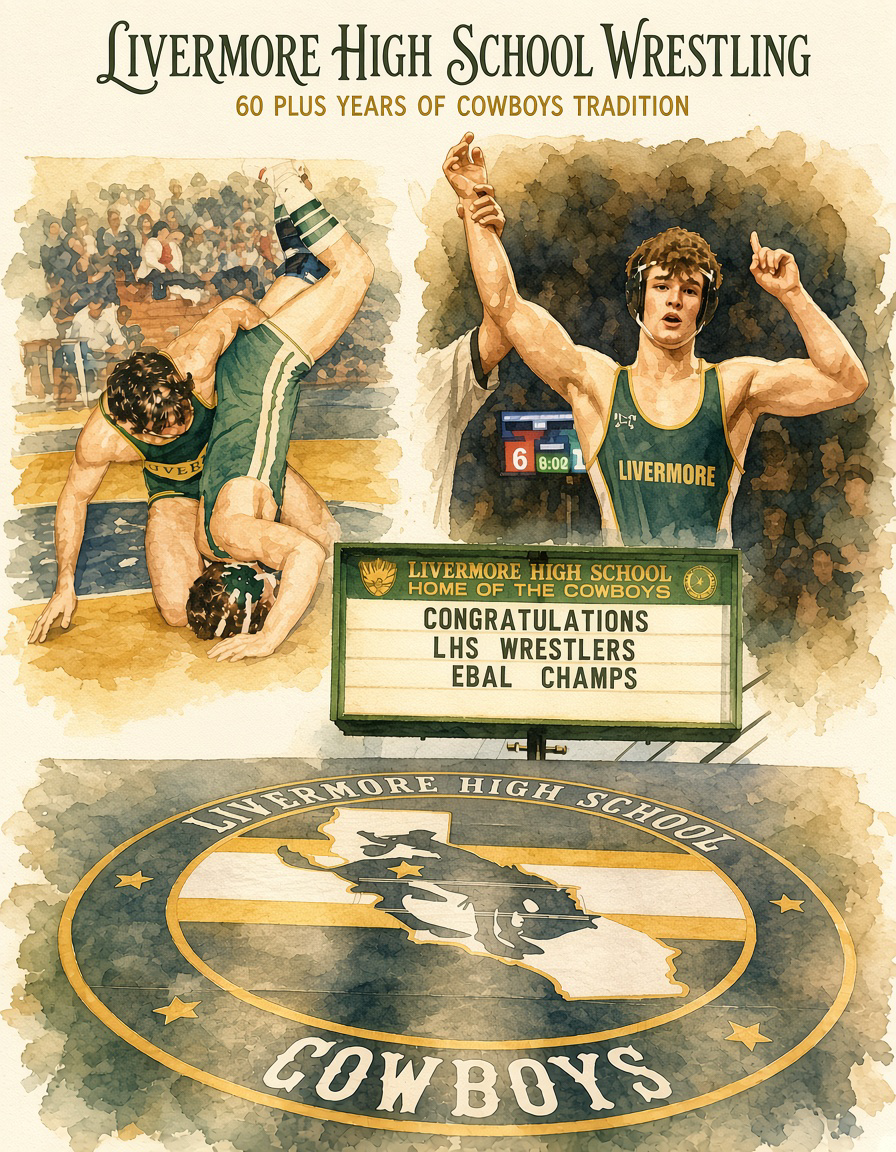

A Tradition of Excellence, Opportunity and Family
For more than six decades, Livermore High School wrestling has built a tradition defined by championships, individual achievement, outstanding coaches, perseverance and family. Since the program’s beginnings in the early 1960s, the Cowboys have developed generations of successful wrestlers and teams while continually adapting to the changing landscape of the sport.
Yet the significance of Livermore wrestling extends far beyond its record book. Its greatest legacy may be found in the lives it has influenced, the relationships it has created and the lessons that former wrestlers continue to carry long after their competitive careers have ended.
As I reflect on my own life and the path that brought me here, I increasingly appreciate the profound influence wrestling—and the people who guided me through the sport—has had on my journey. From middle school and high school through college and beyond, I was fortunate to learn from coaches, teachers, teammates and mentors who gave me far more than wrestling instruction. They taught me discipline, accountability, perseverance, humility, preparation, leadership and the importance of embracing difficult challenges.
Those lessons extended well beyond the wrestling room and became part of the foundation upon which I built my life.
Wrestling also gave me the opportunity to become part of something larger than myself: a tradition connecting generations of athletes, coaches and families. The lessons passed from coach to wrestler, teammate to teammate, and one generation of Cowboys to the next create a bond that can endure for a lifetime.
When I look back, I recognize how many of the positive directions in my life can be traced to those experiences and the mentors who invested their time, energy and belief in me. Their influence helped shape not only the wrestler I became, but also the person I continue to strive to be.
In many ways, wrestling was the catalyst that set me on a positive course in life.
That sentiment is shared by generations of Livermore wrestlers whose experiences illustrate the lasting influence of the Livermore program.
WHEN WRESTLING CHANGES A LIFE
Andrew Koponen — Class of 1989
Andrew Koponen was an NCS medalist at Livermore who continued his wrestling career at Humboldt State University, where he became a multiple-time Greco-Roman All-American. His experience illustrates how the lessons learned in high school can continue to influence a person decades later.
Reflecting on his Livermore experience, Koponen wrote:
“Graduating from Livermore High School in 1989, I can say without hesitation that the wrestling program changed the entire direction of my life. It instilled in me a lifelong desire to keep learning, to do good in the world, and to always strive to be the best version of myself. The discipline, perseverance, and mental toughness I developed on those wrestling mats stayed with me throughout my life and, on more than one occasion, helped save my life as an Oakland police officer. Livermore High wrestling didn’t just teach me how to compete; it taught me how to live.”
Koponen’s words underscore the importance of lessons that remain relevant long after the final whistle. Discipline, perseverance and mental toughness are not confined to athletic competition. They can become essential tools for navigating life’s most demanding circumstances.
Clark Conover — Class of 1990
Clark Conover’s connection to Livermore wrestling began before he ever wore the Cowboy singlet. As a middle school student, he attended Livermore dual meets, read newspaper accounts of the team and listened to stories from his older brothers (Andrew, Marc) about the program. Those experiences inspired him to become part of something larger than himself.
A CIF State medalist and two-time collegiate All-American, Conover later contributed to the Livermore coaching community and pursued a career in education and leadership. He now serves as principal of Granada High School.
Reflecting on his experience, Conover wrote:
“When I was in middle school, I would go to the Livermore High School duals, read about the Livermore High School wrestling team in the newspapers, and hear stories about the Livermore High School wrestling team and wanted to be a part of Livermore High wrestling.
“When I finally was a part of the Livermore High School wrestling team, I knew I was a part of something special.”
Conover’s recollection captures the power of tradition to inspire the next generation. Before becoming a State medalist, All-American, coach or educational leader, he was a young student watching the Cowboys and hoping to become part of their story.
That is how traditions endure: one generation establishes something worth following, the next grows up watching it, and eventually those young athletes become the coaches, educators, parents and mentors who inspire others.
Rich Diaz — Class of 1996
Rich Diaz, a member of Livermore’s Class of 1996, a 16U state medalist, and a team captain, credits the wrestling program and Coach Steve Page with helping shape his path—one grounded in discipline, family, a championship culture, and service to others.
Reflecting on his experience, Diaz wrote:
“At eleven years old, I was at a pivotal fork in the road. One direction would have absolutely led me behind bars, in a grave or both. The opposite road which I am forever grateful for choosing led me to choosing the wrestling life/mindset. Coach Page opened the door for me and exposed me to a family and champion culture that would stay with me in the workforce as an electrician for Lawrence Livermore National Laboratory (LLNL) and ultimately becoming a Firefighter paramedic for the city of Berkeley, California. Wrestling for LHS changed my life and countless others and I am grateful beyond words.”
Diaz’s experience adds an important dimension to the Livermore story. For some young athletes, wrestling provides more than an opportunity to compete; it offers direction, accountability and a supportive environment at a pivotal moment in life.
The discipline and responsibility learned through the sport can become a foundation for success in the workplace, public service and family life.
Aaron Fontes — Class of 1986
Aaron Fontes, a 1986 Livermore graduate, team captain, NCS finalist and CIF State qualifier, offers a deeply personal perspective on how wrestling prepares young athletes for life’s challenges. His experience reflects the physical and emotional demands of the sport, the lasting influence of a dedicated coach, and the family bond that has defined Livermore wrestling for generations.
Reflecting on his wrestling journey, Aaron wrote:
“When a person chooses to go out for wrestling for the first time, they usually discover that failure, pain, and sometimes humiliation are part of the deal. It’s hard to win a wrestling match when you’re a newbie, and practice is painful! Most of the time, the losses and the pain that come with them are on display for all to see—family, friends, teachers, and classmates. The center of a wrestling mat is a lonely place to stand when you’re losing, and it can feel humiliating at times. For some, quitting is the answer. But the wrestler who doesn’t quit, who faces these challenges head-on and sticks with it, gains the tools to deal with life’s adversity and fight through pain and hardship. That’s what wrestling did for me. It prepared me for life.”
Aaron’s words capture the demanding reality of wrestling. The sport places athletes in difficult situations where failure is visible, adversity is unavoidable, and progress requires persistence. Learning to confront those challenges can build resilience that extends into every aspect of life.
For a young athlete who struggles with self-confidence, the decision to keep showing up, continue learning and refuse to quit can become a turning point. Wrestling does not eliminate life’s hardships, but it can help prepare a person to face them.
Aaron also reflected on the influence of Steve Page, whose coaching helped shape his confidence, character and outlook long after his high school career ended.
“When I graduated from LHS, Coach Page had been there for three seasons. During my senior year, we tied San Ramon for the EBAL title. Coach Page was the perfect coach for me. He was tough on me, but at the time, I didn’t believe in myself. He helped shape my life in the way a father would. After high school, I coached alongside Page for several seasons, and I remember winning a lot. That was really fun!”
Aaron’s recollections reinforce Steve Page’s influence beyond wins and losses. For Aaron, Coach Page provided more than technical instruction and competitive direction; he helped shape a young athlete who struggled to believe in himself. Aaron’s later return as a coach further illustrates how the lessons learned in the Livermore wrestling room can inspire former athletes to invest in the next generation.
But Aaron’s final reflection may best capture the heart of the Cowboy tradition.
“One last thing I’ve always remembered: Coach preached the idea that we weren’t just a wrestling team but something much more than that—we were a family. As such, we should look out for one another, help each other, and protect one another. It’s been 40 years since my senior year, and this family just keeps getting bigger! LHS Wrestling for life!”
Four decades after his senior season, Aaron still identifies with the program and the people who helped shape his life. His closing words express a bond that championships alone cannot explain.
For Aaron and generations of Cowboys, wrestling was never simply about learning how to win a match. It was about learning how to persevere, believe in oneself, support others and become part of something that lasts long after the final whistle.
Joe Iacono — Class of 1996
Joe Iacono, a multi-sport athlete, team captain and one of the hardest-working wrestlers in Livermore history, offers another perspective on the culture that defined the program.
His experience illustrates how demanding standards, consistent effort and a commitment to improvement helped develop athletes from different backgrounds and experience levels.
Reflecting on his experience, Iacono wrote:
“The coaches created a culture built on sacrifice, commitment, and work ethic. From day one, we learned that being comfortable with being uncomfortable was the foundation of our wrestling tradition. Our coaches developed athletes from all walks of life and skill levels, and we outworked everyone. You could feel the energy in the room. When you accomplished something, the coaches made you feel that it mattered—not just on the mat, but in life. We were part of something special.
“More importantly, they taught us to push beyond our perceived mental and physical limits. When I entered the wrestling room as a freshman, I had never wrestled before. Surrounded by alpha males, the experience was intimidating, but something told me to stay. I had no idea what to expect. Looking back, staying in that room shaped my character and gave me the life lessons and tools to succeed.
“Today, I am a committed husband and father, an active member of the Livermore community, and an entrepreneur. I credit much of that foundation to being part of the Livermore Cowboys Wrestling Tradition. I will always be grateful for the experience.”
Iacono’s testimony reinforces a defining characteristic of Livermore wrestling: athletes did not need to enter the room as experienced wrestlers or accomplished competitors to become part of something meaningful. What mattered was their willingness to stay, work, learn and embrace the challenges before them.
His reflection on being comfortable with being uncomfortable captures one of wrestling’s most enduring lessons. Growth rarely occurs when everything comes easily. It develops when athletes confront unfamiliar challenges, respond to setbacks and discover that they are capable of more than they initially believed.
For a freshman entering the room without any wrestling experience, choosing to stay and commit to the process became a formative decision—one that helped shape his character and the life he built afterward.
Together, the experiences of Koponen, Conover, Diaz, Aaron Fontes and Iacono illustrate five dimensions of the Cowboy legacy: perseverance under pressure, inspiration through tradition, direction during a pivotal stage of life, resilience through adversity, and the personal growth that comes from embracing discomfort.
Their stories demonstrate why a wrestling program’s value cannot be measured solely by championships, State medals or college accomplishments. Its impact is also reflected in the people its athletes become.
Former Cowboys have gone on to become professionals, educators, military personnel, police officers, firefighters, community leaders, coaches, promoters and advocates for the sport. Many have returned to mentor younger athletes, while others now watch their own children step onto the mat.
The legacy of Livermore wrestling lives on through those individuals and the families who continue to carry the Cowboy tradition forward.

BUILDING THE FOUNDATION
Livermore wrestling began competing in the early 1960s as a member of the Diablo Valley Athletic League (DVAL). Before entering the East Bay Athletic League (EBAL), the Cowboys were already establishing themselves as competitive wrestlers.
In 1963, four Livermore wrestlers placed among the top four at the DVAL championships. Ron Knott finished second and became the program’s first NCS qualifier, according to the historical record; Bob Horton placed third, while Warren McPherson and Ray Newbery each finished fourth.
These early accomplishments provided an important foundation for what would become one of Livermore High School’s longest-running athletic traditions.
Beginning with the 1964–65 season, Livermore competed in the EBAL. The Cowboys immediately made their presence known, winning the 1965 EBAL championship with 10 individual league champions:
Gary Turner, Dale Turner, Mark Dodd, Ralph Ammendolia, Steve Brandt, Del Lounsbury, Ray Newbury, Warren McPherson, Tim Vargas and Scott Humphrey.
Since those formative years, Livermore has captured 19 EBAL dual-meet championships, along with numerous tournament titles. That early success established expectations of competitiveness and achievement that would carry through successive generations of wrestlers and coaches.

SIX DECADES OF COWBOY COACHES
The history of Livermore wrestling is inseparable from the coaches who built, sustained and passed forward the program’s traditions. From the original coaching staff in 1963 to the modern era, each generation contributed to the identity of Cowboy wrestling.
JAMES COMELLA AND DON MUENTZ | 1963–1964
James Comella and Don Muentz guided Livermore during the program’s inaugural seasons, establishing the foundation for what would become one of the school’s longest-running athletic traditions.
Competing initially in the DVAL, their teams produced early league place-winners, including Ron Knott, Bob Horton, Warren McPherson and Ray Newbery. Their tenure represents the beginning of Livermore wrestling and the first chapter of the Cowboy tradition.
GENE LARRIGAN | 1964–1965
Gene Larrigan led Livermore during its transition into the EBAL. His 1965 team made an immediate impact, producing 10 individual league champions and capturing the EBAL championship.
That successful season established Livermore as an emerging force in East Bay wrestling.
BOB BRONZAN | 1966–1970, 1983
Bob Bronzan became one of the most influential early coaches in Livermore wrestling history. During his first tenure, the Cowboys won three EBAL dual-meet championships, in 1967, 1968 and 1970, along with EBAL tournament titles in 1967 and 1970.
Bronzan returned to lead Livermore in 1983, adding another chapter to his legacy. His two coaching eras demonstrate the lasting influence he had on the development of Cowboy wrestling.
JACK LOPEZ | 1971–1976
Jack Lopez continued the momentum established by Livermore’s early championship teams. His tenure produced EBAL tournament championships in 1971, 1972 and 1974 and dual-meet championships in 1971 and 1972.
His teams also produced North Coast regional and North Coast Section place-winners, helping establish Livermore as a consistent championship-level program in the East Bay.
EDDY KING | 1977–1979
Eddy King presided over another successful period in Livermore wrestling. His first season produced an EBAL dual-meet and tournament championship double in 1977, while his teams continued to develop outstanding individual wrestlers.
Among King’s leading wrestlers were Garen McDonald, Darryl Hansen, Naish Piazza, Robert Baird, Jim Sampson and Dave Farfan.
McDonald emerged as a particularly significant figure, winning an EBAL championship in 1979 and advancing to the North Coast Section finals.
KEVIN GUNN | 1980–1981
Kevin Gunn coached Livermore during the beginning of a landmark championship era. His most significant achievement came through Garen McDonald, who won the CIF State championship at 191 pounds in 1980 during California’s single-class era.
McDonald became Livermore’s first documented CIF State champion, giving the program a defining achievement on the statewide stage.
DON BAIRD | 1982
A Livermore wrestling alumnus from the program’s championship era of the 1970s, Don Baird returned to the Cowboys as head coach in 1982.
His connection to Livermore as both an athlete and coach represents an important element of the program’s identity: the alumni-to-coach tradition, in which former Cowboys return to help develop the next generation.
STEVE PAGE | 1984–2004
Steve Page is one of the defining figures in Livermore High School wrestling history. His 21-year tenure established a sustained culture of competitiveness, athlete development and championship-level performance.
Under Page, Livermore produced four CIF State place-winners: Clark Conover, Scott Page, Peter Matheson and Marc Kavanagh. His wrestlers also captured numerous North Coast Section championships, including those won by Frisbee Goodall, Bryan Vashus, Clark Conover, Derek Bowerman and Richard Ybarra.
Perhaps most significantly, Page led Livermore to 11 EBAL dual-meet championships and nine EBAL tournament championships during his tenure.
Page’s legacy extends beyond titles and medals. He developed generations of wrestlers and helped establish the standards and coaching culture that subsequent Cowboy coaches inherited. His era represents one of the most successful sustained periods in the program’s history.
MARC KAVANAGH | 2005–2008
Marc Kavanagh, a former Livermore standout under Steve Page, continued the program’s tradition when he became head coach in 2005.
His tenure produced another generation of accomplished wrestlers, highlighted by Stephen De La Cruz, who placed at the CIF State Championships in 2008. Kavanagh’s 2008 team also captured the EBAL tournament championship.
His transition from Livermore wrestler to head coach further strengthened the connection between the program’s past and future.
ZACK PHILBRICK AND REX ANDERSON | 2009
The 2009 season featured shared leadership from Zack Philbrick and Rex Anderson. Their team produced five EBAL champions and several North Coast Section place-winners.
Philbrick was not simply an outside coach who joined the program. He was a Livermore wrestling alumnus who returned to become a head coach, continuing the tradition of former Cowboys giving back to the program that had helped shape them.
His path from wrestler to coach illustrates how the influence of Livermore wrestling can extend across generations.
BRAD VADNAIS | 2010–2013
Brad Vadnais led Livermore through a productive four-year period marked by strong individual performances at the league and section levels.
Tyler Rardon became the standout of the era, winning consecutive NCS championships at 152 pounds in 2012 and 2013 and qualifying for the CIF State Championships both years. Rardon became Livermore’s first two-time NCS champion, establishing a standard that would stand for another decade before another Cowboy matched the accomplishment.
Vadnais also coached Nico Lang, who captured an NCS championship in 2013.
HERB GUIDRY | 2014–PRESENT
Herb Guidry has guided Livermore wrestling through a period of continued development, postseason success and significant growth in girls wrestling.
His tenure produced accomplished league, section and State-level wrestlers, highlighted by Timothy Cowan. Cowan placed at the 2021 Open State Championships, which replaced the traditional CIF State tournament during the COVID-era season, and won NCS titles in 2020 and 2022.
Cowan became the second wrestler in Livermore history to win two NCS championships, joining Tyler Rardon. He also qualified for the CIF State Championships three times.
Other State qualifiers during Guidry’s tenure included Xavier Williams, Tallon Chambers (NCS Champion), Ryan Petersen and Asher Nischke.
The program also produced numerous NCS champions and place-winners. Nischke became a two-time NCS placer and won the 2025 heavyweight championship, while Williams was a two-time NCS place-winner. Aiden Ochoa captured three consecutive EBAL titles from 2022 through 2024.
The Guidry era reached a team milestone in 2025, when Livermore captured the CIF North Coast Section Division II East Bay Dual Meet Championship.
Guidry also played an important role in developing girls wrestling. His tenure included State qualifiers Francee Richmond, Mya Waechtler and Ximena Pulido, along with numerous NCS place-winners.
His era represents an important modern chapter in Livermore wrestling: continued boys’ success, increased opportunities for girls, and a renewed team championship achievement.
FROM COACHES TO CHAMPIONS
The accomplishments of Livermore’s coaches are ultimately reflected in the wrestlers they developed.
Gary Turner became Livermore’s first documented NCS champion in 1967, while Garen McDonald became the school’s first CIF State champion in 1980.
Over the decades, the Cowboys have produced numerous EBAL champions, NCS champions, CIF State qualifiers and State medalists. Among the program’s most accomplished wrestlers are Frisbee Goodall, Bryan Vashus, Clark Conover, Scott Page, Peter Matheson, Marc Kavanagh, Derek Bowerman, Stephen De La Cruz, Nico Lang, Tyler Rardon and Timothy Cowan.
Vashus became the program’s first and only four-time EBAL champion.
Rardon won consecutive NCS titles in 2012 and 2013, becoming Livermore’s first two-time NCS champion. Cowan later matched that achievement with titles in 2020 and 2022.
These accomplishments demonstrate a consistent pattern throughout Livermore history: strong coaching develops individual excellence, and individual excellence strengthens the team.

COWBOY ALL-AMERICANS AND COLLEGIATE SUCCESS
Livermore’s wrestling tradition has continued well beyond high school. Many Cowboys have continued their careers at Chabot College and other institutions throughout the state and country, extending the program’s influence into collegiate wrestling.
Livermore has developed a particularly strong connection with Chabot College, where generations of Cowboys continued competing. Among those who earned collegiate All-American honors were:
- Stephan De La Cruz — Two-time 3C2A All-American, Chabot College.
- Peter Matheson — 3C2A All-American, Chabot College.
- Marc Kavanagh — Two-time 3C2A All-American, Chabot College.
- Clark Conover — Two-time 3C2A All-American at Chabot College; qualified for the NCAA Division I Championships at Cal Poly San Luis Obispo.
- Garen McDonald — Two-time 3C2A All-American at Chabot College and NCAA Division II All-American at CSU Bakersfield.
Conover and McDonald were also California community college State champions.
Additional Livermore wrestlers who earned medals at the California Community College Athletic Association (3C2A) State Championships include Aaron Fontes, James Coats and Steve Karlotski.
Together, these accomplishments demonstrate that the Cowboy tradition does not end at graduation. Livermore wrestlers have continued to compete for collegiate championships, earn All-American recognition and represent their high school at the next level.

FROM THE COWBOY MAT TO THE UFC
The reach of Livermore wrestling has extended beyond high school and collegiate competition into mixed martial arts. Two Livermore alumni, Jerry Bohlander and Pete Williams, went on to become accomplished UFC fighters.
Their careers offer a distinctive example of how the discipline, conditioning, toughness and competitive confidence developed on the Cowboy mats can translate into another demanding sport.
Jerry Bohlander emerged as an early standout in the UFC’s formative years. At UFC 12 in 1997, he won the organization’s Lightweight Tournament, establishing himself as a tournament champion during a period when mixed martial arts was still developing its modern identity.
Pete Williams became a respected UFC heavyweight competitor. His most memorable victory came at UFC 17, when he defeated former UFC heavyweight champion Mark Coleman with a dramatic head kick in one of the most memorable upsets of early UFC history.
The bout was later recognized through induction into the UFC Hall of Fame Fight Wing in 2016, further cementing its place in the sport’s history.
Williams also challenged for the UFC heavyweight championship and became one of the prominent heavyweight fighters of the organization’s early era.
The accomplishments of Bohlander and Williams add another dimension to Livermore wrestling. The program helped develop athletes whose competitive careers reached far beyond traditional scholastic and collegiate wrestling.
From the Livermore wrestling room to the UFC Octagon, their journeys demonstrate that the habits developed as Cowboys can carry forward into entirely different arenas.
The mat teaches lessons that can travel far beyond the mat.
NATIONAL ALL-AMERICANS
Livermore wrestlers have also earned national All-American recognition in freestyle, Greco-Roman (aka, Greco) and folkstyle wrestling.
- Clark Conover — Cadet (16U), Junior and Espoir All-American in Greco.
- Andy Koponen — Two-time Espoir All-American in Greco; Olympic Festival bronze medalist in Greco.
- Bryan Vashus — AAU Grand Nationals champion in Greco.
- Scott Page — Espoir All-American in freestyle.
- Timothy Cowan — USA Wrestling Nationals All-American in folkstyle.
- Ximena Pulido — Cadet (16U) Girls Nationals All-American in folkstyle.
These achievements broaden the definition of Livermore wrestling success. The program has developed athletes capable of competing at the community college, NCAA and national levels, across multiple wrestling styles, as well as in professional mixed martial arts.

A LEGACY RECOGNIZED IN HALLS OF FAME
Perhaps the strongest evidence of Livermore wrestling’s lasting influence is the recognition its athletes, coaches and contributors have received from wrestling and community halls of fame.
These honors span several generations and reflect achievements in competition, coaching, service and historical preservation.
STEVE PAGE — HEAD COACH, 1984–2004
Steve Page guided Livermore for more than two decades and presided over one of the most successful eras in program history. His teams captured 11 EBAL dual-meet championships and nine tournament championships while producing numerous accomplished wrestlers.
His contributions were recognized with induction into the California Wrestling Hall of Fame with its Lifetime Service Award in 2016.
BOB BRONZAN — COACH, TEACHER, ADMINISTRATOR AND PROMOTER
Bob Bronzan has been associated with Livermore wrestling since 1966. As a coach, teacher, administrator, mentor and promoter, he helped establish the foundation of Cowboy wrestling.
His career earned him induction into the California Wrestling Hall of Fame in 2023. He also received the CIF State Irv Oliner Award in 2019.
GAREN McDONALD — CLASS OF 1980
Garen McDonald remains one of the most accomplished wrestlers in Livermore history. He became the school’s first CIF State champion in 1980, continued his career at Chabot College and CSU Bakersfield, and earned All-American honors at both levels.
His accomplishments were recognized through induction into the Livermore Sports Hall of Fame in 2009 and the Chabot College Hall of Fame in 2010.
CLARK CONOVER — CLASS OF 1990
Clark Conover was a highly accomplished high school wrestler (NCS Champion/CIF State Medalist), two-time 3C2A All-American and NCAA Division I national qualifier who continued to contribute to wrestling as a successful coach and mentor.
His accomplishments have been recognized through induction into the Chabot College Hall of Fame in 2010, the California Wrestling Hall of Fame with its Lifetime Service Award in 2018, the Livermore Sports Hall of Fame in 2018 and the Livermore High School Hall of Fame in 2025.
Today, he continues a tradition of service through education and leadership as principal of Granada High School.
MARC KAVANAGH — CLASS OF 1993
Marc Kavanagh carried on the Cowboy tradition as both a wrestler and a coach. A CIF State medalist as a senior, he went on to become a two-time 3C2A All-American at Chabot College before returning to Livermore as head coach from 2005 to 2008. During his tenure, he led the Cowboys to the 2008 EBAL tournament championship while producing many accomplished wrestlers.
His accomplishments were recognized with induction into the Chabot College Hall of Fame in 2016.
AL FONTES — CLASS OF 1984
Al Fontes, a Livermore wrestler and EBAL champion, has continued his connection to the sport as a coach, writer, editor, podcaster and historian.
His career in wrestling journalism, coaching, promotion and historical preservation has earned numerous national and state honors, including:
- National Wrestling Hall of Fame, Lifetime Service Award, Idaho Chapter (2024).
- National Wrestling Hall of Fame, Bob Dellinger Media Award (2018).
- California Wrestling Hall of Fame, Lifetime Service Award (2016).
- Dan Gable America Needs Wrestling Award, NWCA (2007).
- Wrestling USA Magazine Editor of the Year (2001).
- Wrestling USA Magazine Person of the Year (2001).
Collectively, these recognitions tell an important story: Livermore wrestling has produced not only champions, but also coaches, mentors, administrators, writers, promoters and ambassadors who have continued serving the sport long after their competitive careers ended.

THE COWBOYS’ GOLDEN ERAS
Livermore’s history includes many outstanding teams, but the 1989 and 1992 seasons remain particularly prominent.
The 1989 Cowboys finished 17–0, won the EBAL championship and placed second at the NCS championships. Led by four-time EBAL champion Bryan Vashus and CIF State medalist Clark Conover, the team established itself as one of the strongest in school history.
The 1992 team produced another extraordinary season, combining undefeated dual-meet success with outstanding individual performances at the EBAL, NCS and CIF State levels. It remains one of the most decorated teams in Livermore history.
These seasons represent the collective strength of the program: talented athletes, demanding preparation, effective coaching and a team culture built around shared goals.
The broader Steve Page era was equally significant. His teams captured 11 EBAL dual-meet championships and nine tournament championships, setting a sustained standard of excellence that continues to influence the program.

THE RISE OF LIVERMORE GIRLS WRESTLING
While Livermore’s first several decades were largely defined by the boys’ program, the emergence of girls wrestling has created an important new chapter in Cowboy history.
Amanda French established an early milestone by placing third at the NCS Championships in 2012 and qualifying for the CIF State Championships at 132 pounds.
A particularly strong generation followed, led by Mya Waechtler and Ximena Pulido.
Waechtler became a three-time NCS placer, finishing sixth in 2017, seventh in 2018 and third in 2019. She also qualified for the CIF State Championships in 2019.
Pulido likewise became a three-time NCS placer, finishing eighth in 2018, fourth in 2019 and sixth in 2020. She qualified for the CIF State Championships in 2019 and later earned national recognition as a Cadet Girls Folkstyle All-American.
Francee Richmond continued the progression, placing fourth at NCS in 2019 and second in 2022 while qualifying for the CIF State Championships in 2022.
Other contributors included Emma Kavanagh, a two-time NCS placer; Kayla Smith, who placed at NCS in 2014 and 2015; and Meagan Parker, an NCS placer in 2012.
More recently, Rocio Ortiz placed eighth at NCS in 2023, while Romy Clevenger captured an EBAL championship at 143 pounds that year.
The 2026 season produced another significant milestone. Livermore had three CIF North Coast Section Division II East Bay girls placers: Diana Zarco, who won the 110-pound championship; Diana Garcia, who placed fifth at 105 pounds; and Lily Houle, who placed sixth at 100 pounds. Zarco also placed sixth in the overall NCS girls championships.
The growth of girls wrestling represents an important evolution of the Cowboy tradition. It has expanded opportunities, introduced new athletes to the sport and added another generation of competitors to Livermore’s history.

THE COWBOY TRADITION IS A FAMILY TRADITION
It has often been said within the Livermore wrestling program that the Cowboy tradition is also a family tradition.
Since the program’s beginnings in the 1960s, an estimated 40 to 50 family members—including brothers, fathers and sons, and fathers and daughters—have competed in the Cowboy singlet. Their stories reflect a tradition that extends well beyond individual accomplishments.
Among the families represented are:
- Baird: Don, Robert and Jack.
- Kavanagh: Marc, Adam and Donny, along with Marc’s children, Logan, Emma and Lief.
- Page: Scott and Shane.
- McPherson: Warren and his son, Dave.
- Kannel: Scott, Greg and Greg’s son, Brisk.
- Turner: Dale and Gary.
- Iacono: Joe and John.
- Cazarez: Pablo and Pedro.
- Conover: Andrew, Marc and Clark.
- Matheson: Pete and Sammy.
- Tennyson: Gary and Mike.
- Zeigler: Greg and Tom.
- Wong: Greg and Jeff.
- Diaz: Rich and Jesus.
- Philbrick: Kermit and Zack.
- Le: Minh Nat, Noel and Ferrier.
- Fontes: My brother Aaron and me.

These families represent more than a collection of names in a record book. They illustrate how Livermore wrestling has been passed from one generation to the next, with older siblings, parents and other family members introducing younger generations to the discipline, camaraderie and values of the sport.
For many, the wrestling room became a place where family members learned, competed, supported one another and created lifelong memories. That continuity is one reason the Cowboy tradition has endured for more than six decades.
The legacy is measured not simply in championships and accomplishments, but also in the families who have carried the tradition forward and helped make Livermore wrestling a community institution.
FROM COWBOY WRESTLERS TO COWBOY COACHES
The family connection also extends to the coaching staff. Don Baird, Zack Philbrick and Marc Kavanagh are examples of former Cowboys who returned to lead the program. Herb Guidry has continued that coaching legacy in the modern era.
The pathway from athlete to coach is one of the most meaningful aspects of Livermore wrestling. Those who were once coached eventually return to mentor and guide future generations.
A young wrestler learns from a coach. Years later, that wrestler may return as a coach, passing on the lessons learned—and those acquired through a lifetime of experience—to another generation.
The cycle continues, linking the program’s past with its future.
SIX DECADES OF EXCELLENCE—and STILL BUILDING
More than sixty years after Livermore first stepped onto the wrestling mat, the record continues to grow.
The Cowboys’ legacy includes:
- 19 EBAL dual-meet championships.
- Numerous EBAL tournament championships and generations of league champions.
- Multiple NCS champions and medalists.
- One CIF State champion: Garen McDonald, in 1980.
- Numerous CIF State qualifiers and State medalists.
- Two of the program’s most decorated teams in 1989 and 1992.
- Five collegiate 3C2A All-American wrestlers.
- Additional 3C2A State Championship medalists, including Aaron Fontes, James Coats and Steve Karlotski.
- NCAA Division II All-American honors and NCAA Division I Championship-level representation.
- Six additional national All-Americans across freestyle, Greco-Roman and folkstyle, as identified in the program’s historical record.
- Two accomplished UFC fighters: Jerry Bohlander and Pete Williams.
- Bohlander, champion of the UFC 12 Lightweight Tournament.
- Williams, whose UFC 17 victory over Mark Coleman was later recognized through the UFC Hall of Fame Fight Wing.
- Four CIF State girls qualifiers: Amanda French, Ximena Pulido, Mya Waechtler and Francee Richmond.
- Multiple two-time and three-time NCS girls medalists.
- An EBAL girls champion in Romy Clevenger.
- A 2026 NCS Division II East Bay girls champion in Diana Zarco.
- Alumni who returned to serve as head coaches, strengthening the connection between generations of Cowboys.
- Athletes, coaches and contributors recognized by wrestling, collegiate and community halls of fame.
These accomplishments are impressive, but the numbers alone do not explain what makes Livermore wrestling special.
The program’s history is also a story of continuity: coaches who invested in young athletes, wrestlers who accepted difficult challenges, families who supported one another, and alumni who returned to give back.
The names change. The coaches change. The rules and competitive landscape change.
Yet the essential character of Livermore wrestling remains remarkably consistent:
Work hard. Embrace the challenge. Support your teammates. Leave the program better than you found it.
Some Cowboys have carried the lessons of wrestling into collegiate competition. Others have become coaches, educators, military personnel, police officers, firefighters, professionals and community leaders. Some have dedicated themselves to writing, promoting and preserving the sport. Others, including Jerry Bohlander and Pete Williams, have carried their competitive foundations into the UFC.
Their paths have been different, but the underlying lesson is remarkably similar: the values developed through wrestling can provide a foundation for success far beyond athletic competition.
Andrew Koponen perhaps captures that legacy better than any statistic:
“Livermore High wrestling didn’t just teach me how to compete; it taught me how to live.”
Clark Conover offers the perspective of the young athlete who watched the tradition from the outside, dreamed of becoming part of it and eventually found his place within it:
“When I finally was a part of the Livermore High School wrestling team, I knew I was a part of something special.”
Rich Diaz reminds us that the influence of wrestling can be especially profound when a young person needs direction:
“Wrestling for LHS changed my life and countless others and I am grateful beyond words.”
Aaron Fontes reminds us that perseverance is learned by confronting adversity rather than running from it—and that the bonds formed through wrestling can endure for decades:
“That’s what wrestling did for me. It prepared me for life.”
And Joe Iacono’s reflection captures the demanding culture that helped so many Cowboys discover their potential:
“From day one, we learned that being comfortable with being uncomfortable was the foundation of our wrestling tradition.”
Separated by individual experiences but connected by the same program, these five alumni reflections capture the heart of the Cowboy legacy. They remind us that the true measure of a wrestling program is not only what its athletes accomplish while competing, but also how they carry its lessons into the rest of their lives.
For those who have worn the green and gold, it is an honor to be a Livermore High School wrestling alumnus.
For today’s Cowboys—and every wrestler who follows—the challenge is now theirs:
CARRY THE TRADITION FORWARD
Because Livermore wrestling is about more than championships and records. It is a tradition of excellence, opportunity, mentorship, perseverance and family. It is a program that has developed champions, All-Americans, coaches, educators, leaders, public servants, professionals and UFC fighters. It has inspired generations of young athletes to dream of becoming Cowboys and former wrestlers to return years later to guide, mentor and inspire the next generation.
This article is dedicated to every Livermore Cowboy wrestler who has stepped onto the mat since the program’s inaugural season in the early 1960s; to the parents and families who made sacrifices and provided unwavering support; to the stat girls that documented our history; to the community members and supporters who stood behind our wrestlers and the program; and to the administrators and coaches whose leadership, commitment and high standards established a tradition of striving to be the best one can be—not only as a wrestler, but also as a student, teammate and person. Each has played a meaningful role in building the legacy we celebrate today.
It is a legacy built by those who came before us, sustained by those who carried the torch, and entrusted to those who will shape its future. Every wrestler who has competed, every coach who has invested in a young athlete, every parent who has made sacrifices, and every supporter who has believed in the program has contributed to a story far greater than wins and losses.
After more than six decades, the story of Cowboys wrestling is far from finished. The names, faces and seasons may change, but the values remain: hard work, commitment, resilience, accountability and the belief that we are always capable of becoming something more.
To all who have been part of this journey, past and present, thank you for helping build a tradition worth honoring and a legacy worth preserving. May those who follow understand its history, embrace its values and carry its spirit into the next chapter.
The tradition is our legacy. The future is our responsibility. Carry it forward.
COWBOY TOUGH!

Photos courtesy of Livermore High School wrestling archives.
Follow me on X @Coach_Al_1984 | on Instagram @tier_one_idaho | on Facebook @TIER1 WRESTLING

Leave a Reply