
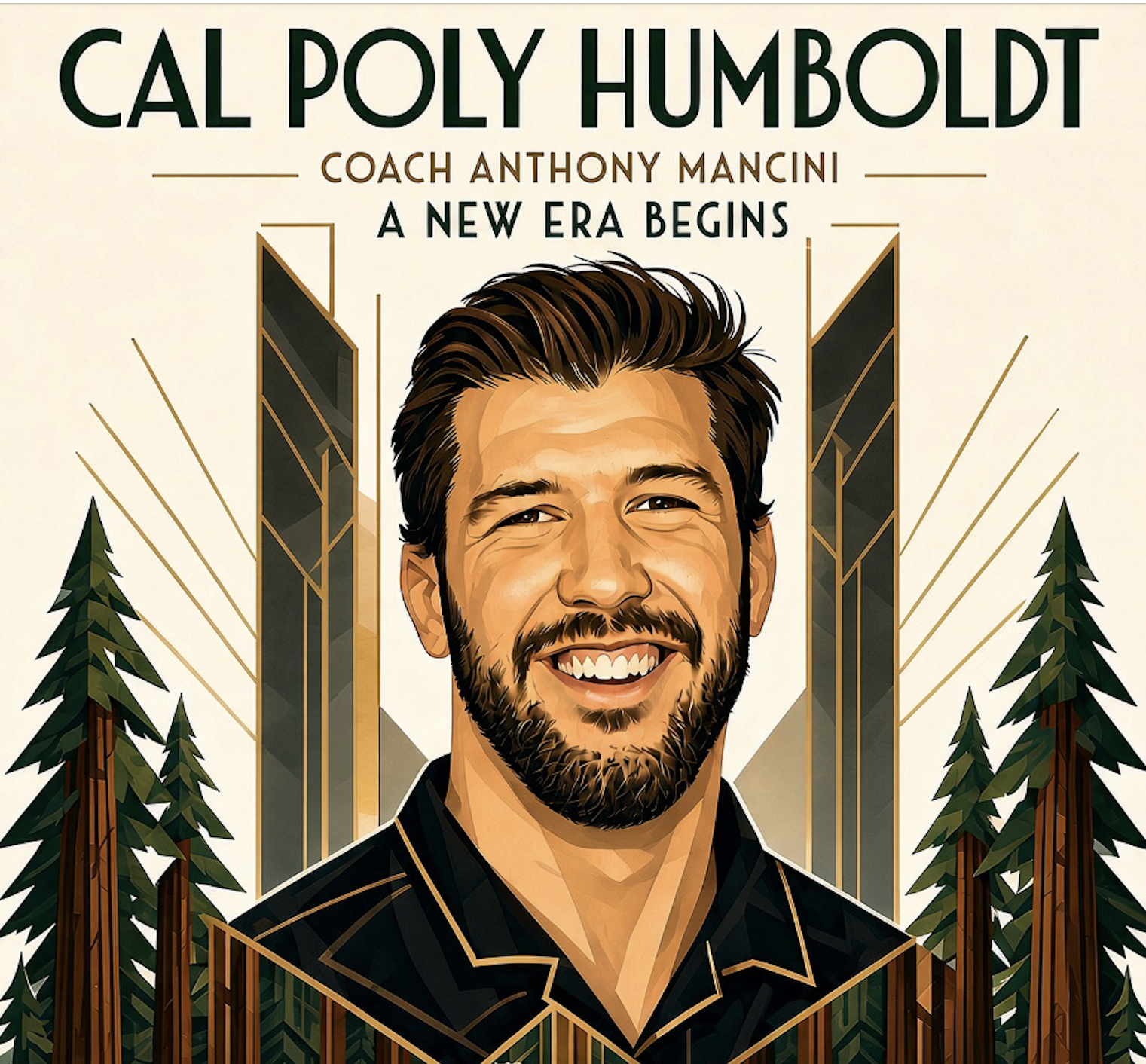

Anthony Mancini Brings Energy, Purpose and Vision to Cal Poly Humboldt Wrestling
When I think back to 1991, one memory stands above the rest—a somber phone call from Andy Koponen, then an underclassman wrestler at Humboldt State University. Andy was also an alumnus and All-American wrestler I had the privilege of coaching at Livermore High School in the late 1980s. His message was difficult to believe: Humboldt State, a program with a storied championship tradition and the recent distinction of producing NCAA Division II National Champion Luke Parham, was closing its doors and discontinuing a wrestling program that had long been a force throughout Northern California.
Thirty-five years later, I find myself writing a very different story.
What once seemed impossible has become reality. The program is back.
The restoration of wrestling at what is now Cal Poly Humboldt is more than the return of a college team. It is a testament to the passion, persistence and deep-rooted wrestling culture that has defined Northern California for generations. Programs with this kind of history do not simply disappear. They live on through the athletes who competed for them, the coaches who built them, the alumni who refused to let them be forgotten and the communities that continued to believe in what wrestling could mean.
Never say “never,” especially to a wrestler.
It is in our nature to keep fighting, to endure setbacks and to believe in something worth rebuilding.
The initial effort to restore Humboldt wrestling came from alumnus Virgil Moorehead, now one of the prominent coaches and respected figures in Northern California wrestling. Along with members of the community, university administration and a host of passionate wrestling supporters, Morehead helped develop a proposal that ultimately brought two of the sport’s most accomplished names to Humboldt—National Wrestling Hall of Fame members Lennie Zalesky and his older brother, Jim.
The Zalesky brothers brought far more than impressive wrestling résumés to the task. Both were accomplished All-Americans at the University of Iowa under legendary coach Dan Gable, but their influence extended well beyond their own competitive careers. Lennie went on to build highly successful NCAA programs at UC Davis and Cal Baptist, while Jim returned to his alma mater to lead the Iowa Hawkeyes to three consecutive NCAA team titles before later taking over at Oregon State and then the University of Jamestown in the early 2020s. Their collective experience as wrestlers and NCAA coaches gave Humboldt something invaluable: championship-level knowledge, credibility and a blueprint for rebuilding a program from the ground up.

Their mission was clear—to help restore the program, establish a foundation for success and guide it through its first seasons until a coach could be identified to lead Humboldt wrestling into the future.
The plan worked.
After those initial seasons, the program entered its next chapter—one that would ultimately lead to the return of a full-time competitive program and a new leader determined to take Cal Poly Humboldt wrestling to the next level:
Anthony Mancini.
Mancini arrives at Humboldt with something that is immediately apparent to anyone who spends time around him: energy. But it is not simply the energy of a young coach excited about his first opportunity to lead a collegiate program. It is the energy of someone who genuinely believes in the transformative power of wrestling and who understands firsthand what the sport can demand from a person—and what it can ultimately give back.
His vision for Humboldt is ambitious. He wants to build a championship program, develop NCAA All-Americans and national champions, reconnect the university with its alumni and surrounding community, strengthen youth wrestling throughout Northern California and establish Cal Poly Humboldt as a destination for wrestlers throughout California and the Pacific Northwest.
But Mancini’s definition of a championship program begins somewhere other than the wrestling room.
It begins with the person.
“I hope I can inspire my student athletes to chase the best version of themselves,” Mancini said. “I hope they can fall in love with the process of being great in all phases of their lives, and see the rewards they receive by giving everything they have.”
That philosophy is not something Mancini simply developed as a coach. It was forged through his own wrestling journey—a journey that began when he was only three years old and ultimately transformed virtually every aspect of his life.
Mancini’s introduction to wrestling was almost accidental. His older brother wanted to participate, and rather than hire a babysitter, his father brought Anthony along. There was just one problem: Mancini thought wrestling was WWE.
“My brother thought it was WWE and instead of getting a babysitter my dad took me along,” Mancini recalled.
What began as a young child’s introduction to the sport eventually became a lifelong passion. His father, who had wrestled for several years in high school, became one of Mancini’s first coaches and remained involved throughout his childhood. His mother became a constant presence at competitions, traveling to youth tournaments, college events across the country and even senior-level competitions.
His brother became another major influence.
“He was always the hardest worker in the room,” Mancini said. “He inspired me to push myself further than I ever thought possible.”
That work ethic would become one of the defining characteristics of Mancini’s own philosophy as both an athlete and coach.
Growing up in Delaware, Mancini benefited from competing in a small but highly competitive wrestling environment. He became a state champion in middle school and eventually won a high school state championship. Delaware’s geographic location also provided access to some of the strongest wrestling in the country. Mancini grew up within driving distance of both Pennsylvania and New Jersey, allowing him to regularly encounter high-level competition outside his home state.
Those experiences helped shape him, but his greatest transformation came during his college years.
Mancini began his collegiate career at Franklin and Marshall College in Lancaster, Pennsylvania. He had hoped to compete at the Division I level and start immediately. He got exactly what he wanted, but the experience did not unfold as he had imagined.
As a freshman, Mancini struggled on the mat, finishing somewhere around 6-28. His problems extended beyond wrestling. His grades began slipping, and he acknowledged that he was making poor decisions socially. By the end of the season, he had been removed from the team.
For many athletes, that could have been the end of the story. For Mancini, it became the turning point.
His coaches did not simply close the door. They gave him a roadmap to earn his way back.
“That was ultimately the moment that changed my life,” Mancini said.
Instead of allowing the setback to define him, Mancini committed himself to change. He began putting everything he had into improving—not only as a wrestler, but as a student and as a person. The results began to show. His wrestling improved, his life away from the mat improved, and by his junior year he had begun appearing in the national rankings.
Injuries, however, became a recurring obstacle. He took a redshirt season following offseason shoulder surgery, and another season was eventually cut short by injuries to his other shoulder and one of his knees.
Rather than ending his pursuit, those setbacks ultimately led him to Nebraska-Kearney for a sixth year. Mancini wanted another opportunity to compete for an individual national championship and a team championship, and he found a culture at Nebraska-Kearney that matched his ambitions.
“I loved the culture of that program, and being surrounded by guys who were chasing the same dream I was,” he said.
Mancini entered the postseason ranked second in the country, but once again injuries intervened. A shoulder injury and knee injury at the regional tournament ended his career.
Ironically, Mancini would later come to appreciate how that final injury shaped the conclusion of his wrestling career. His senior year was 2020, the year the NCAA Championships were cancelled because of the COVID-19 pandemic. Mancini had already experienced the disappointment of watching his own season end prematurely, but he realized that an injury was something he could understand in a way that the sudden cancellation of an entire championship was difficult to comprehend.
“I was grateful that an injury ended my career rather than the pandemic,” he said. “An injury is something rational, something that we have all heard of before. Having the championships cancelled when we were already in the arena was unheard of.”
The experience also allowed him to be there for his teammates as they dealt with a devastating and unprecedented ending to their seasons.
Those experiences helped form the foundation of Mancini’s philosophy today. He never achieved every competitive goal he had set for himself, but he refuses to view his wrestling career as a failure.
“I can’t say enough how much wrestling in college changed my life,” he said. “Everything I have in my life now is due to my college wrestling experience. It was truly transformative for me.”
Mancini learned that becoming a great wrestler required first becoming a better person. He learned the meaning of commitment, sacrifice and personal responsibility. Most importantly, he learned to embrace the process of improvement.
“I fell in love with the process of improving, and pursuing greatness in every aspect of my life,” he said. “I started evaluating everything I was doing, and instead of just walking through life, I realized that every single one of my actions was ultimately a choice.”
That concept of choice has become one of the cornerstones of his coaching philosophy.
Mancini believes athletes must develop the habit of making the difficult decision, even when the decision appears insignificant. Doing the dishes instead of leaving them in the sink. Taking out the trash when it is full. Completing schoolwork when distractions are more appealing. Choosing discipline when nobody is watching.
Those small decisions, he believes, eventually prepare athletes for the much larger decisions they will face in competition and in life.
“When we’re on the wrestling mat, in the third period wrestling through a tough situation, we don’t hesitate,” Mancini explained. “We make the hard choice because that’s what we constantly train to do.”
His decision to become a college coach was heavily influenced by the coaches who had helped transform his own life.
“I was inspired to coach because I had great coaches,” Mancini said. “I knew I could never pay them back for everything they did for me, but I hope I can pay even a fraction of it forward to my athletes.”
Among those coaches were Mike Rogers and Steve Borja at Franklin and Marshall, followed later by Dalton Jensen and Andrew Sorenson at Nebraska-Kearney. Mancini credits those coaches with believing in him when others might not have and teaching him lessons that went far beyond wrestling technique.
“Their faith in me, even when I didn’t deserve it, and the impact it made on my life is the reason I wanted to be a college coach,” he said.
Mancini began his coaching career as an assistant at Nebraska-Kearney, an ideal environment in which to learn the profession. That season, the program finished second nationally and produced nine All-Americans. But Mancini quickly learned that elite programs require much more than talented athletes and dedicated coaches.
“It showed me it’s not enough to just have coaches who work their tails off and athletes who buy in to the vision,” he said. “To be a truly elite team, it takes the full support of the community.”
That lesson would become particularly important when Mancini moved west to San Francisco State University.
After one season at Nebraska-Kearney, Mancini wanted a full-time coaching position and had always hoped to live on the West Coast. When an assistant position became available at San Francisco State, he immediately viewed it as an ideal opportunity.
The transition was significant. He was moving from a perennial national title contender at Nebraska-Kearney to a San Francisco State program that was rebuilding following the COVID hiatus.
“The biggest being going from a perennial title contender, to a team that was really just restarting after the COVID hiatus,” Mancini said.
The first season was difficult, but it taught him an important lesson: growth takes time. By the second season, however, the program had improved dramatically. Dual-meet results improved, the effort throughout the lineup became stronger, and Mancini began learning how to challenge athletes while believing in their ability to respond.
One particular moment during his time at San Francisco State remains with him.
The team had improved significantly, but for the first time in his coaching career, it failed to send a wrestler to the NCAA Championships. One athlete reached the match that would determine qualification but lost in the final minute.
Mancini looked inward.
“When I look back on that moment, I remember reflecting to myself that I had not truly given all I had to help our team,” he said. “I hadn’t worked as hard as I could have, and I let my athletes down.”
That realization became a source of motivation.
“I never want to feel that way again,” he said, “and it inspires me to give more every day.”
San Francisco State also reinforced another fundamental part of his coaching philosophy: relationships.
Mancini believes coaches must know their athletes as people, not simply as wrestlers. Understanding what an athlete is dealing with academically, socially and personally allows a coach to better understand what that athlete needs.
“Being able to connect with them, and to know what they’re going through helps me know what they need as their coach,” he said.
For Mancini, that relationship is also where trust begins.
“I want everyone I coach to know I care about them as a person far more than I do as an athlete,” he said. “That helps them know that when I’m giving them guidance, I truly have their best interest at heart.”
That philosophy now comes to Humboldt.
The transition, Mancini says, has been overwhelmingly positive. Rather than encountering resistance to change, he has found a group of student-athletes eager to improve and willing to embrace a new direction.
“The buy in from the student-athletes here has been unbelievable,” he said. “They have already shown an extraordinary commitment to bettering themselves.”
Mancini also credits assistant coach Nathan Aguilar, whose previous experience as a Humboldt wrestler and assistant coach has provided invaluable continuity. Aguilar knows the athletes, understands the university and already has relationships within the program.
“I have felt nothing but gratitude for our student athletes and the way they have handled the transition,” Mancini said.

He has also been impressed by the university itself. Mancini describes the support for athletics as tremendous and points to the positive attitudes of employees throughout campus.
“I’m constantly being greeted by smiling faces and positive attitudes,” he said. “Within our department, everyone is focused on helping each other succeed.”
Perhaps equally important, Mancini has quickly developed an appreciation for Humboldt’s wrestling history.
Under legendary Hall of Fame coach Frank Cheek, Humboldt State became a traditional Northern California wrestling power. The program captured several conference championships, produced multiple NCAA Division II and Division III All-Americans, and established itself as a consistent national contender with multiple top-10 NCAA finishes. That national success included two top-three finishes in the mid-1970s, cementing Humboldt’s reputation as one of the region’s premier collegiate wrestling programs.
For Mancini, restoring that tradition is about more than remembering the past. It is about understanding what made Humboldt special and carrying that standard forward. He has embraced the opportunity to learn from those who were part of the program’s earlier eras and to connect today’s student-athletes with the history they are now becoming part of.

The university’s current strength coach, Drew, was the strength coach when Humboldt had a wrestling team in the late 1980s and early 1990s.
“I have loved hearing his stories from the program,” Mancini said. “I work closely with him to try to keep that rich history alive in our current athletes.”
The community response to the restoration of wrestling has also made a profound impression.
Mancini specifically points to Humboldt alumnus Virgil Moorehead, whose passion for the program made a major impact on the restoration effort. Dan Phillips and Craig Vejvoda also made significant financial contributions that helped bring wrestling back to campus.
“A big reason I have this job is Virgil Moorehead,” Mancini said. “I met Virgil early in the process of looking at this role, and his passion is contagious.”
For Mancini, the support demonstrates something important about Humboldt wrestling.
“It shows just how passionate our alumni community is,” he said.
Now his responsibility is to build on that passion.
Mancini will be assisted by Aguilar and Carson Hatch. Aguilar, who wrestled at Humboldt during the 2024-25 season and served as an assistant coach the following year, handles many of the program’s day-to-day responsibilities and provides a vital connection to the current roster. He also brings California and Oregon State connections that will benefit the program’s recruiting efforts.
“He was the first person to buy into the culture I wanted to start here,” Mancini said.
Hatch, a former Humboldt heavyweight, brings his own set of strengths. He attends the team’s workouts and provides a valuable training partner for the larger wrestlers. His involvement in the local community also helps Mancini build relationships beyond campus, while his work with youth wrestling aligns with one of the head coach’s long-term goals of expanding access to high-level wrestling opportunities in Northern California.
For prospective student-athletes, Mancini makes it clear that Cal Poly Humboldt will not be an easy place to wrestle.
“They can expect to be challenged!” he said.
The challenge extends well beyond the wrestling mat. Mancini expects his athletes to improve academically, nutritionally and socially. He wants them to develop proper sleep habits, make responsible decisions and conduct themselves in a manner that reflects the standards of the program.
“We are all about pushing ourselves to be the best version of ourselves that we can be,” he said.
The team’s academic performance is already part of that conversation. The team posted a 3.1 GPA last semester, and Mancini has challenged the group to reach a 3.5.
On the wrestling side, the immediate goals are equally ambitious. Humboldt is still searching for its first national qualifier, All-American and national champion in the restored era.

“I believe with the athletes we have on our roster currently, we should send multiple athletes to the National Tournament and come home with some hardware,” Mancini said.
Yet there is an important balance to his expectations. Mancini wants his athletes to work hard, but he also wants them to enjoy wrestling.
“While wrestling does require sacrifice, it is still meant to be fun at the end of the day,” he said.
That philosophy will be reflected in the team’s wrestling style. Mancini wants athletes to open up offensively, look for scoring opportunities and bring their own personalities onto the mat.
“I want my athletes opening up, and looking to score,” he said. “I encourage creativity on the mat, and want our guys working on new things and really bringing their own personalities into their wrestling.”
For Mancini, wrestling should be challenging without becoming joyless.
The Humboldt experience also extends beyond the wrestling room. Mancini wants his athletes to take advantage of the environment surrounding the university. Surfing, hiking, camping, trail running and beach workouts all have a place in his vision.
“We live in one of the most beautiful places on earth,” he said.
That environment also becomes part of the program’s recruiting pitch.
But Mancini’s recruiting philosophy goes much deeper than location or wrestling credentials.
“We evaluate everything when looking at recruits,” he said. “We don’t just look at the wins; we look at how they win.”
He wants wrestlers who move forward, attack with their hands and feet, maintain a consistent offensive identity and continue pushing the pace regardless of the score.
When winning, he wants them to keep building their lead.
When losing, he wants them to keep attacking.
“And even if they lose, be the last one to score,” he said.
Character matters just as much. Mancini wants athletes who win with class and lose with dignity. He also values community involvement and looks for young men who care about where they come from and are willing to give something back.
For Mancini, recruiting is ultimately about finding wrestlers who are willing to embrace the same process that transformed his own life—athletes who understand that becoming great is not a destination, but a daily choice.
That may be the most important part of what is beginning at Cal Poly Humboldt.
The program is not simply being rebuilt. It is being given another opportunity to become what it once was—and perhaps something more.
There is history here. There are conference championships, national finishes, All-Americans and generations of wrestlers who helped establish Humboldt as a traditional power. There are alumni who remember what the program meant to them, supporters who refused to let that history disappear and coaches who have invested their time and reputations in bringing it back.
And now there is a new generation.
Anthony Mancini understands that he has inherited something much bigger than a wrestling room.

He has inherited a legacy.
His challenge is to honor it without being confined by it—to respect what came before while building something that belongs to the athletes of today and tomorrow.
Thirty-five years ago, I received a phone call from Andy Koponen telling me that Humboldt State wrestling was being discontinued. At the time, the idea that the program might one day return seemed almost impossible.
But wrestling has a way of defying the impossible.
Programs can disappear. Wrestling rooms can go dark. Generations can pass.
But if the people who believe in the sport keep fighting, the story does not necessarily end.
Today, the lights are back on at Humboldt.
A new generation of wrestlers is walking through the doors.
A new coach is leading the way.
And for the first time in 35 years, Humboldt wrestling is no longer looking back at what was lost.
It is looking forward to what comes next.
The program is back. And a new era has begun.

CAL POLY HUMBOLDT WRESTLING ALL-AMERICAN HISTORY [1969 – 1991]
The history of Humboldt State wrestling is defined by a remarkable collection of elite performers, led by Marty Nellis, the program’s only three-time NCAA All-American, with a runner-up finish and two additional All-American performances. Just behind him is an extraordinary group of two-time All-Americans, including Eric Lessley, an NCAA Division II national champion; Eric Woosley, a two-time NCAA Division III national champion; and Mike Fredenburg, a Division III national champion and runner-up. Richard Sykes also reached the NCAA finals, while Adrian Smedly, Dave Navarre, Mike Harr, Mike Kargas, Kris Henry, and Doug Stone established themselves among the nation’s best. The program’s depth was equally impressive, producing Luke Parham and Brent Wissenback as additional NCAA national champions, along with numerous All-Americans across Divisions II and III. Collectively, these wrestlers helped establish Humboldt as a traditional Northern California wrestling power, highlighted by multiple conference championships and nine NCAA Division II/III Top-10 finishes, including two national top-three finishes in the mid-1970s. Their accomplishments represent the best of Humboldt State wrestling’s championship tradition and form the foundation of a proud national legacy. The following is the historical list of Humboldt State Wrestling NCAA All-Americans—athletes whose national accomplishments helped define the program’s place in Northern California and collegiate wrestling history.

3x NCAA ALL-AMERICAN
118 / 126 – MARTY NELLIS
- 6th Place ’79 / 3rd Place ’80 [Div. III] / 2nd Place ’81 [Div. II]
2x NCAA ALL-AMERICANS
142 – ERIC LESSLEY
- 6th Place ’84 / National Champion ’85 [Div. II]
134 – DAVE NAVARRE
- 5th Place ’83 / 5th Place ’84 [Div. II]
158 – ADRIAN SMEDLY
- 3rd Place ’80 [Div. III] / 3rd Place ’81 [Div. II]
167 / 177 – RICHARD SYKES
- 5th Place ’80 [Div. III] / 2nd Place ’81 [Div. II]
142 – MIKE FREDENBURG
- 2nd Place ’79 / National Champion ’80 [Div. III]
190 – ERIC WOOSLEY
- 2x National Champion 1977- ’78 [Div. III]
142 – MIKE HARR
- 6th Place ’76 / 4th Place ’77 [Div. III]
158 – MIKE KARGAS
- 6th Place ’76 / 2nd Place ’77 [Div. III]
167 – KRIS HENRY
- 4th Place ’76 / 2nd Place ’77 [Div. III]
167 – DOUG STONE
- 3rd Place ’72 / 2nd Place ’73 [Div. II]

1x NCAA DIVISION II ALL-AMERICANS
150 – Dean Henderson, 8th Place [1991]
275 – Luke Parham, National Champion [1991]
150 – Tim Monahan, 3rd Place [1989]
167 – Robert Watkins , 4th Place [1987]
134 – Steve Meckel, 4th Place [1985]
285 – Rod Prnjak, 4th Place l1985]
158 – Don Dodds, 4th Place [1984]
167 – Dale Delaney, 6th Place [1984]
190 – Steven Bailey, 7th Place [1982]
150 – Steve Tirapelle, 5th Place [1974]
285 – Bill Van Worth, 2nd Place [1974]
158 – Pat Miller, 5th Place [1971]
145 – John Fern, 2nd Place [1969]


NCAA DIVISION II [Top 10 Finishes]
- 8th Place [1985]
- 8th Place [1984]
- 4th Place [1981]
CONFERENCE CHAMPIONS
1960, 1971, 1981, 1983, ‘1984, 1985
1x NCAA DIVISION III ALL-AMERICANS
126 – Steve Zehnder, 8th Place [1980]
150 – Marty Hozela, 4th Place [1980]
167 – Roy Coudright, 8th Place [1980]
190 – Mike Malkovich, 5th Place [1980]
150 – Jon Sylvia, 2nd Place [1979]
118 – George White, 4th Place [1978]
158 – Tom Pender, 4th Place [1978]
177 – Wayne Nickerson, 2nd Place [1978]
142 – Jim Luster, 2nd Place [1977]
118 – Dwight Miller, 4th Place [1975]
190 – Brent Wissenback, NATIONAL CHAMPION [1975]

NCAA DIVISION III [Top 10 Finishes]
- 4th Place [1980]
- 9th Place [1979]
- 3rd Place [1978]
- 2nd Place [1977]
- 10th Place [1976]
- 9th Place [1975]

CONFERENCE CHAMPIONS
1977, 1978, 1979, 1980
HEAD COACH HISTORY
- Anthony Mancini, 2026 – Present
- Lennie Zelesky, 2024 – 2026
- Frank Cheek, 1969 – 1991

A special thank you to Humboldt State wrestling alumni Tom Pender, Andrew Koponen, Virgil Moorehead, Bert Van Duzer, and Marty Nellis for sharing their experiences and valuable insights into the program from the late 1970s through its final season in 1991, along with historic photographs of past wrestlers and teams.
I would also like to thank Adam Tirapelle and his mother, Jayne, for providing photographs of Steve Tirapelle, a Humboldt State All-American from the early 1970s. Their contributions are greatly appreciated in helping preserve the history and legacy of Humboldt State wrestling.
Photos courtesy of Humboldt State Athletics, Humboldt wrestling archives, Elliott Portillo (2026-27 Humboldt Team Photo).
Follow me on X @Coach_Al_1984 | on Instagram @tier_one_idaho | on Facebook @TIER1 WRESTLING
Leave a Reply