
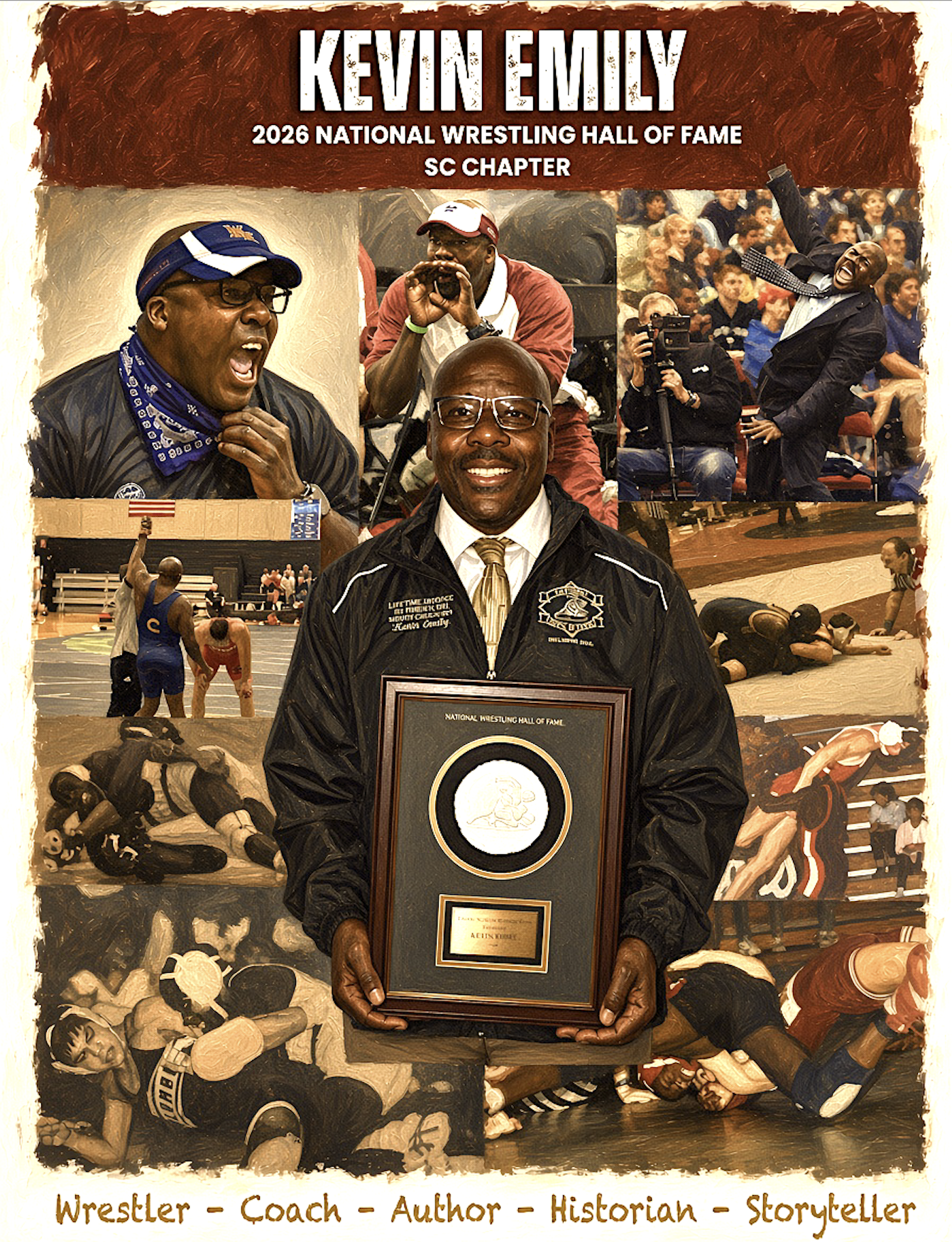
Wrestler. Coach. Author. Historian. Storyteller.

Some wrestling stories are measured in championships, medals and records. Others are measured by something harder to quantify—the ability to overcome failure, inspire others and leave the sport better than you found it.
Kevin Emily’s story is one of those.
In 2026, that lifetime of service was formally recognized when Emily received the National Wrestling Hall of Fame Lifetime Service to Wrestling Award from the South Carolina Chapter.
For more than three decades, Emily has immersed himself in wrestling—as a competitor, coach, clinician, mentor, author and historian.
His journey began with an intimidating introduction to wrestling in Waterloo, Iowa, and eventually took him from a 0–19 high school freshman season to becoming a Division I starter at the University of Tennessee at Chattanooga. Along the way, he became a successful high school coach, founded the Mighty Warriors Wrestling Academy, worked alongside some of the sport’s most accomplished figures and authored three books dedicated to preserving important stories from wrestling history.
Now, his work on Giant Killer: The Carlton Haselrig Story may take him into an entirely new arena—the possibility of bringing the story from the printed page to the big screen.
Yet the numbers and accomplishments only tell part of the story.
At the center of Emily’s journey is a philosophy forged through adversity and carried throughout his life:
Never give up. And always give back.
FROM 0–19 TO 19–0
Emily was first introduced to wrestling as a seventh-grader at Edison Intermediate School in Waterloo, Iowa. He remembers seeing wrestlers walking from the locker room to practice and being particularly struck by one wrestler who looked, in his words, “mean and menacing.” That wrestler was Victor Allen, the son of the late National Wrestling Hall of Fame referee Mike Allen.
Emily decided he wasn’t quite ready.
A year later, he stepped onto the mat as an eighth-grader—and was hooked.
His early high school career, however, offered little indication of the wrestler he would eventually become. Competing at 105 pounds as a freshman at Waterloo Central High School, Emily finished 0–19.
He wasn’t simply losing matches. He was learning what it meant to struggle, endure and return to the mat after another defeat.
By his sophomore year, he had improved to 10–12. Before his junior season, his parents moved to Georgia, where Emily placed third in the state at 112 pounds. But Waterloo Central was nearing the end of its existence as a high school, and Emily desperately wanted to return to Iowa and graduate alongside the friends with whom he had grown up.
He asked his parents if he could move back and live with a friend.
They agreed.
The decision changed everything.
As a senior, Emily went 19–0 before suffering his first loss, ultimately finishing 22–3 and earning a place in the Iowa state tournament while climbing to No. 4 in the state rankings.
The transformation was remarkable.
0–19 as a freshman. 22–3 as a senior.
He never became the state champion he had hoped to be. But he left high school with something that would prove far more valuable: confidence in his ability to overcome adversity.
Wrestling had taught him that failure did not have to be permanent.
That lesson would become the foundation of his life.

BECOMING A DIVISION I WRESTLER
Emily continued his wrestling career at Meramec Community College in St. Louis. During his freshman year, however, tragedy struck when his brother died by suicide during the Christmas holiday. With his parents still living in Georgia, they did not want Emily attending college so far from home.
He ultimately walked on at the University of Tennessee at Chattanooga.
At Chattanooga, Emily became a Division I starter, wrestling at 142 pounds during his junior season. He started throughout much of the year before losing a wrestle-off shortly before the Southern Conference Tournament to teammate Guy Harris, who would go on to become an NCAA All-American, finishing eighth nationally.
Emily’s senior season brought another significant accomplishment. He placed third in the Southern Conference while helping Chattanooga win its ninth consecutive Southern Conference championship.
Although he did not qualify for the NCAA Championships, Emily took enormous pride in what he had accomplished.
He had become something few wrestlers ever can claim:
A Division I starter.
More importantly, his competitive career gave him firsthand knowledge of the demands of high-level wrestling—the discipline, sacrifice and mental toughness required to compete at that level. Those experiences would later become essential elements of his coaching philosophy.

A COACHING CAREER BUILT ON EXPERIENCE
Emily’s transition from competitor to coach was a natural progression. Over more than three decades, he has coached at the youth and high school levels while simultaneously building the Mighty Warriors Wrestling Academy, which he established in 1999.
His high school head-coaching career has taken him from Red Bank High School in Chattanooga to White Knoll, North Charleston, Waterloo West and Midland Valley, before returning to White Knoll. In total, he spent 19 years as a high school head coach.
At Red Bank, Emily coached a state champion, six state placers, two NHSCA All-Americans and an NHSCA National Champion. At White Knoll, his teams produced four state champions, two state runners-up and five state placers. He was named Region Coach of the Year in 2009 and guided the program to a 4A Traditional State Runner-up finish and a region championship in 2011.
His tenure at Waterloo West produced two state qualifiers and a USA/Cliff Keen All-American. At Midland Valley, Emily helped establish the wrestling program and coached the first state place winner in Aiken County history. He was also selected to coach in the South Carolina North/South All-Star Match.
When he returned to White Knoll for a second stint, Emily coached five state placers and became the first wrestling coach in school history to reach 100 victories.
But perhaps the most important part of Emily’s coaching legacy has developed away from the traditional high school setting.
Through the Mighty Warriors Wrestling Academy, Emily has coached youth state placers and champions in Tennessee, Iowa and South Carolina, along with Tulsa Nationals, Adidas Nationals and NHSCA All-Americans and national champions.
The academy has allowed him to work with wrestlers from different schools while focusing on what he values most:
Developing young people.
THE INFLUENCE OF JERRY SPRINGER
Much of Emily’s coaching philosophy can be traced directly to his own high school coach, Jerry Springer.
Springer, a state champion at Waterloo West, was an intense coach who demanded tremendous effort from his wrestlers. Emily remembers him as someone who believed in his athletes, encouraged them and would “go to war” for them.
Emily patterned his own coaching style after Springer, although with one humorous modification—he left out the chair throwing.
The intensity remained.
So did the belief in his athletes.
For Emily, coaching has never been solely about wins and losses. He teaches wrestlers to establish daily, weekly, monthly, practice and tournament goals. Wanting to become a state champion is fine, he tells his athletes, but a goal without a plan is simply a wish.
His message is simple:
Give it your all.
That philosophy comes directly from his own journey. The wrestler who once went 0–19 understands better than most that improvement doesn’t happen overnight.
It happens one practice, one goal and one challenge at a time.
A LIFETIME OF LEARNING FROM THE SPORT’S BEST
Emily has also continued to develop as a clinician, working with some of the most accomplished names in American wrestling.
His experiences have included working alongside Olympic and World champions such as Kevin Jackson and Zeke Jones, Olympic medalists Jamill Kelly and Nate Carr, and accomplished NCAA champions and All-Americans including David Carr and Greg Jones.
Those relationships have reinforced an important part of Emily’s philosophy:
Even experienced coaches remain students of the sport.
He continues to learn. He continues to teach. And he continues to share what he has learned with the next generation.

FROM COACH TO AUTHOR
Eventually, Emily found another way to give back.
Writing.
His transition into authorship began during Black History Month, when he found himself thinking about the accomplishments of African-American wrestlers and wondering whether there was a consolidated source that told their stories in sufficient depth.
He conducted research and discovered that while historical information existed, much of it focused primarily on accomplishments.
Emily believed there was more to the story.
He wanted to know the people behind the records—their struggles, their influences, their families and the events that shaped their lives.
After discussing the idea with his lifelong mentor, Nate Carr, Emily received the encouragement he needed. He began conducting interviews and speaking with wrestlers, relatives and others who had been part of their journeys.

The result was his first book, Pathfinder, Vol. 1: The Journey of the African American Wrestler, published in April 2017.
The book became a factual tribute to African-American wrestlers and coaches who influenced the history of high school, collegiate and amateur wrestling. Among those featured were Harold Henson, Simon Roberts, Carlton Haselrig, Jamill Kelly, Nate Carr, Kevin Jackson, Lee Kemp, Marcus LeVesseur, and Joey Davis.
Emily’s goal was not simply to document what these wrestlers accomplished.
He wanted readers to understand what they went through to accomplish it.
That philosophy continued with Pathfinder, Vol. 2: The Journey Continues, published in January 2018. The second volume expanded the scope of the project, examining the experiences of wrestlers such as Greg Jones, Jordan Burroughs, Tab Thacker, Jamill Kelly and J’den Cox.
Together, the two books became a historical record of achievement, adversity and perseverance.
For Emily, however, they represented something more personal: his contribution to the sport.
He wasn’t simply putting his name on book covers. He was preserving stories that might otherwise disappear, recognizing athletes whose accomplishments deserved to be remembered and creating a historical record for future generations.
GIANT KILLER: THE STORY OF CARLTON HASELRIG
Emily’s third book took his storytelling to an entirely different level.
Published in March 2019, Giant Killer: The Carlton Haselrig Story chronicles the extraordinary life of one of the most remarkable athletes in American wrestling history.
Haselrig accomplished something no other wrestler has accomplished, winning six NCAA championships—three in Division II and three in Division I—along with seven All-American honors.
His athletic story did not end with wrestling.
Despite never playing college football, Haselrig was selected by the Pittsburgh Steelers in the 12th round of the NFL Draft. He eventually became a Pro Bowl selection.
But the greatest significance of Haselrig’s story was not found in the championship records or NFL statistics.
It was found in the human being behind them.
Haselrig experienced a devastating fall from athletic prominence, followed by personal struggles that tested every aspect of his life. Ultimately, however, his story became one of redemption and the fight to reclaim a meaningful life.
Emily became involved with the project in 2018 after Haselrig’s widow, Michelle, approached him about writing Carlton’s life story. The family had previously been approached by others interested in telling the story, but they had never found the right fit.
They believed Emily understood Carlton, understood wrestling and, perhaps most importantly, understood the importance of telling the complete story.
Emily embraced the challenge.
His goal was never simply to write about six NCAA championships.
He wanted readers to understand Carlton Haselrig the person.
The same philosophy that defined Pathfinder was present again:
Tell the story behind the statistics.
Now, that story may be moving beyond the printed page.
Emily is currently exploring the possibility of having Giant Killer: The Carlton Haselrig Story adapted into a feature film, with Beverly Hills award-winning screenwriter Andrew Koponen working on the screenplay.
Koponen sees enormous cinematic potential in Haselrig’s remarkable life and believes the story deserves to reach an audience far beyond the wrestling community.
“I’m incredibly excited to partner with Kevin Emily in bringing Carlton Haselrig’s remarkable story to the silver screen. Kevin did an outstanding job capturing Carlton’s journey in The Giant Killer, and from the moment I became involved, I could see the enormous cinematic potential in this story. Carlton wasn’t just a great wrestler, he was a once-in-a-generation athlete who accomplished something we may never see again, winning six NCAA wrestling championships before going on to become a Pro Bowl player in the NFL. But what makes his story truly compelling is the man behind those accomplishments: the triumphs, the struggles, the setbacks, and the fight to keep moving forward. Kevin and I both believe Carlton’s life deserves to reach a much larger audience, and I’m honored to have the opportunity to help bring The Giant Killer to the screen.”
—Andrew Koponen, Beverly Hills Award-Winning Screenwriter
For Emily, the possibility represents the fulfillment of a vision that began when Michelle Haselrig first contacted him.
Get Carlton’s story to Hollywood.
If that vision becomes reality, the life of a wrestler from Johnstown, Pennsylvania, who became a six-time NCAA champion and NFL Pro Bowler could reach audiences who may never have heard his name.
More importantly, they could discover the man behind the accomplishments—the triumphs, struggles, setbacks and resilience that made Carlton Haselrig’s story worth telling.
A HISTORIAN OF THE HUMAN STORY
Perhaps the most distinctive aspect of Emily’s work is that he is not simply documenting wrestling statistics.
He is documenting people.
He wants to know what motivated them, what obstacles they faced, who influenced them and what happened after the championships were won.
Records can eventually be broken. Championships can eventually fade from memory. Statistics can eventually become footnotes.
Stories endure.
Emily understands that.
That is why his books are more than collections of wrestling accomplishments. They preserve the human experience behind those accomplishments.
In that respect, his work as an author is a natural extension of his work as a coach.
A coach helps develop the next generation.
A historian makes sure previous generations are not forgotten.
Emily has found a way to do both.
KING OF THE MAT: THE NEXT CHAPTER
Emily’s writing journey is far from finished.
He is currently working on his fourth book, King of the Mat: Some of High School’s Most Legendary Coaches. The interviews have already been completed, and he estimates that the project is approximately a year from completion.
The subject is particularly appropriate for Emily.
His own life was profoundly influenced by a coach. Jerry Springer helped shape the wrestler, and wrestling helped shape the man.
Now Emily is turning his attention toward the coaches who have shaped generations of wrestlers.
In many ways, King of the Mat represents the natural evolution of his writing career.
First, he documented wrestlers.
Then, he documented the extraordinary life of Carlton Haselrig.
Now, he is preserving the stories of the coaches who have dedicated their lives to developing young athletes.
LIFE BEYOND THE MAT
Away from wrestling, Emily finds balance through woodworking. He works with epoxy to create decorative wall pieces and furniture, giving him an opportunity to exercise a different kind of creativity.
He also enjoys spending time near the water, whether relaxing at the beach or sitting beside a river.
After decades spent in the intensity of wrestling, those moments provide an opportunity to step away from the demands of coaching, writing and competition.
For Emily, bodies of water are soothing and relaxing. They offer a break from the hustle and bustle of life.
It is another side of a man whose professional life has been defined by intensity, competition and service.
A LEGACY STILL BEING WRITTEN
There is a remarkable symmetry to Kevin Emily’s wrestling journey.
The young wrestler who went 0–19 became a Division I starter.
The competitor who learned how to overcome losing became a coach who spent decades teaching others how to overcome adversity.
The coach became a clinician.
The clinician became an author.
The author became a historian.
And the historian became a storyteller determined to make sure the people who shaped wrestling would not be forgotten.
Now another chapter is unfolding.
Emily is exploring the possibility of seeing Giant Killer: The Carlton Haselrig Story adapted for the big screen while continuing work on King of the Mat, extending his mission of preserving the people and stories that have shaped the sport.
Through it all, the thread connecting every chapter remains the same:
Never give up.
But perhaps an equally important lesson has emerged along the way:
Give back.
Emily has given back through coaching and mentoring, through clinics and the Mighty Warriors Wrestling Academy, through his books and research, and through the stories he has preserved for generations of wrestlers who may never have the opportunity to meet the people whose paths they follow.
And perhaps the best measure of his legacy comes from Emily himself:
“When people read Pathfinder, Volumes 1 and 2, I want them to remember Kevin Emily as a guy who gave back—to the sport, to its people, and to the world.”
That is ultimately what makes Emily’s story bigger than wrestling.
It is a story about what happens when a person refuses to let adversity define him—and then chooses to use what he has learned to help others.
From 0–19 to a life of impact.
Wrestler. Coach. Clinician. Author. Historian. Storyteller.
And perhaps, one day, the storyteller behind a story that reaches the big screen.
Kevin Emily’s story is still being written.
And fittingly, much of his life’s work has been devoted to making sure the stories of others are never forgotten.

Photos courtesy of Kevin Emily.
Follow me on X @Coach_Al_1984 | on Instagram @tier_one_idaho | on Facebook @TIER1 WRESTLING
Leave a Reply