
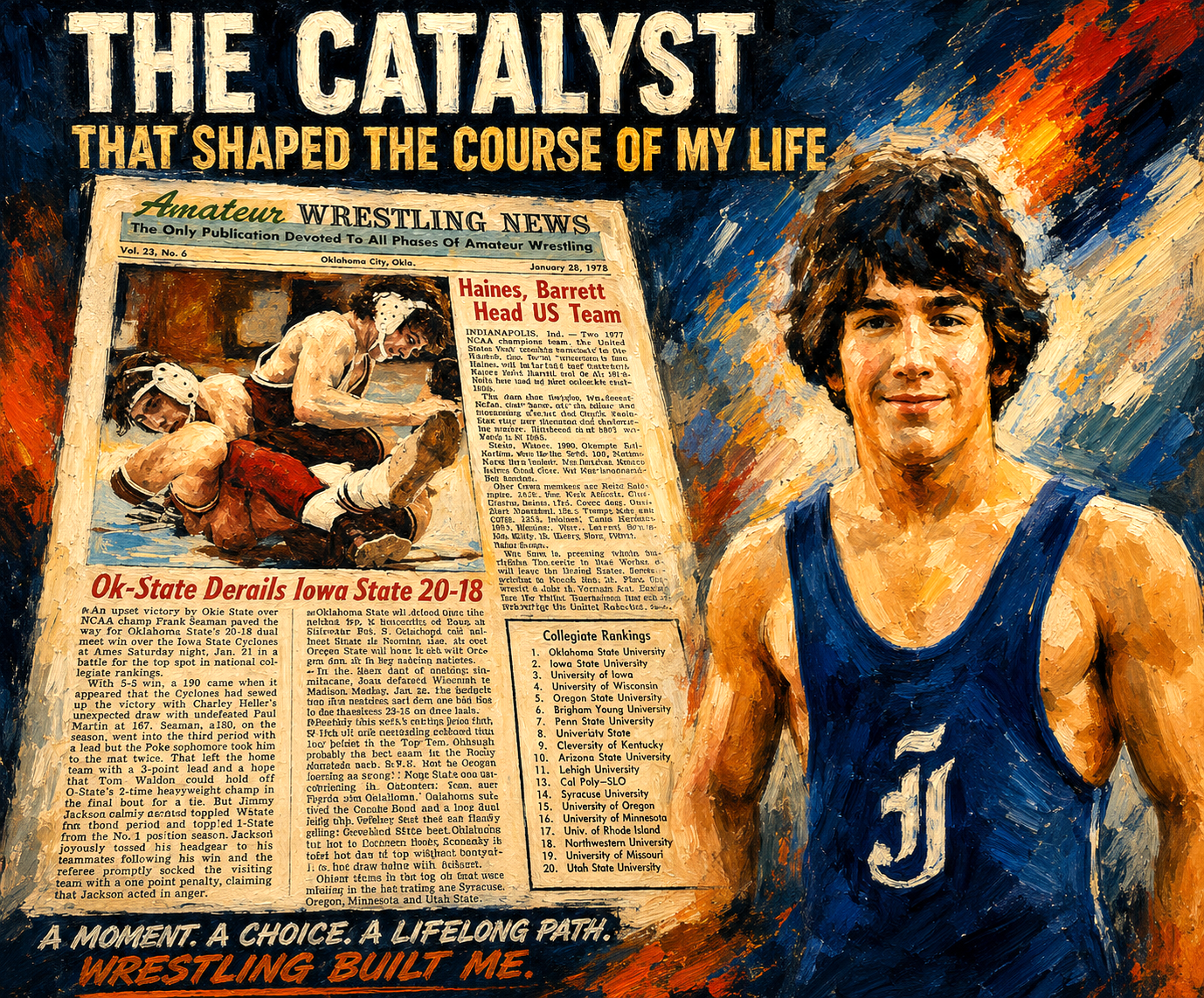

Few experiences have shaped my life more profoundly than the sport of wrestling. Looking back today, it is almost impossible to believe where that journey has taken me. If someone had told me in the late 1970s that I would one day become a nationally recognized wrestling writer, promoter, historian, and podcaster—working alongside many of the sport’s greatest coaches, athletes, and organizations—I would have dismissed the idea as pure fantasy. Yet that is exactly what happened.
Ironically, my lifelong passion for wrestling didn’t begin inside a gymnasium or at a wrestling tournament. It started in one of the most unlikely places imaginable—a dentist’s waiting room.
I was about 11 or 12 years old, sitting in the office of my family dentist, Dr. Sue, waiting for my annual checkup. Like most waiting rooms of that era, the coffee table was covered with magazines intended to occupy restless children. I flipped through several familiar copies of Highlights magazine, spending time on the iconic “Hidden Pictures” puzzles, games, crafts, and other activities that had entertained generations of young readers.
Then something different caught my eye.
Buried beneath the stack of magazines was a copy of Amateur Wrestling News. At first glance, I assumed it was another publication devoted to professional wrestling. As a devoted fan of Big Time Wrestling—the precursor to today’s WWE—I expected to find stories about colorful superstars like Hulk Hogan, “Rowdy” Roddy Piper, André the Giant, and the larger-than-life personalities that dominated television every weekend.
Instead, I discovered an entirely different world.
Its pages were filled with photographs of collegiate champions, Olympic hopefuls, NCAA and Midlands tournament results, and stories celebrating athletes whose names were unfamiliar to me but whose accomplishments immediately captured my imagination. The magazine introduced me to wrestling as a legitimate athletic pursuit built on discipline, sacrifice, perseverance, and relentless competition—not scripted entertainment.
I was fascinated.
That curiosity sparked something inside me that would soon lead me beyond the pages of a magazine and onto the wrestling mat myself. Not long after that discovery, I entered the wrestling circle as a middle school student, and it was there that my appreciation for the sport transformed into something much deeper. I quickly fell in love with wrestling—the intensity of the competition, the physical and mental challenges, the camaraderie among teammates, and the life lessons that came from stepping onto the mat. Wrestling was unlike any other sport I had experienced. It demanded accountability, resilience, and commitment, while rewarding those willing to embrace the struggle.
Those early experiences as a young wrestler became the foundation for everything that followed. The lessons I learned in middle school wrestling would stay with me throughout my life and eventually shape my path as a coach, promoter, historian, writer, and advocate for the sport.
Before leaving the dentist’s office that day, I asked my mother if she would purchase a subscription to Amateur Wrestling News. She agreed, and that simple decision changed the course of my life in ways neither of us could have imagined.
Each new issue opened another door into the sport. I eagerly studied tournament results, learned the names of the nation’s elite wrestlers and coaches, and developed a growing appreciation for the traditions and history that make amateur wrestling one of the world’s oldest and most demanding sports. My curiosity soon evolved into a lifelong passion that has now spanned decades.
What I couldn’t possibly have known as that young boy flipping through a magazine in a dentist’s waiting room was that the publication inspiring me would someday become one of the outlets for my own work. Years later, I would have the privilege of writing for Amateur Wrestling News, along with several other respected national wrestling publications [i.e., WIN, Wrestling USA], while dedicating my career to promoting the sport at every level—from local youth tournaments and high school championships to collegiate competition, international events, and the Olympic movement.
Sometimes life’s greatest journeys begin with the smallest moments. Mine began with a forgotten magazine lying on a waiting room table, but it truly came alive when I stepped onto the wrestling mat as a middle school athlete. That first experience inside the wrestling circle ignited a passion that would continue for a lifetime, ultimately leading me to tell the stories of the athletes, coaches, and communities that make wrestling one of the greatest sports in the world.
I Never Saw It Coming: The Unexpected Journey That Changed My Life in Wrestling
My journey into the wrestling promotional and writing world began somewhat unexpectedly in the early 1990s, during a time when I was serving as an assistant wrestling coach at my alma mater, Livermore High School, in the Bay Area. While coaching had allowed me to remain connected to the sport I loved, I had no idea that one opportunity would open the door to a completely new chapter of my wrestling life.
That opportunity came through the annual Monterey Clinic of Champions, one of California wrestling’s most prestigious coaching and training events. Our Livermore coaching staff attended the clinic, which brought together some of the greatest minds and ambassadors in the sport, including Olympic champions and legends such as Dan Gable, John Azevedo, and Zeke Jones, among many others. The clinic was more than just a weekend of technical instruction; it was a gathering place for coaches, athletes, and wrestling advocates who shared a passion for growing the sport throughout California and beyond.
It was at the Monterey Clinic where my high school coach and mentor, Steve Page, introduced me to Bill Grant, the longtime director of the clinic and the founder of the California Wrestler Newsletter—later known as The California Wrestler (TCW). During our conversation, Bill and I discussed the state of wrestling in California, the tremendous talent throughout the state, and the importance of telling the stories of the athletes, coaches, and programs that helped shape the sport. Recognizing my passion for wrestling history, storytelling, and promotion, Bill extended an invitation for me to join his staff at TCW.
That conversation became a defining moment in my wrestling journey. What began as an opportunity to contribute to a wrestling publication quickly evolved into a lifelong commitment to documenting, promoting, and preserving the sport I loved. Looking back, that introduction was the beginning of a path I never could have predicted—a journey that would eventually lead to decades of writing, historical preservation, event promotion, podcasting, and working alongside many of the most respected figures in wrestling.
I am forever grateful for the opportunity that Bill provided me. The rest, as they say, is history.
Beyond the Podium: Preserving the People, Programs, and Traditions That Built California Wrestling
From the very beginning of my writing career, I set out to tell the stories that too often went untold. While many wrestling publications understandably focused on championship results and national headlines, I was drawn to the deeper foundations of the sport—its history, traditions, personalities, and the countless individuals whose contributions shaped wrestling long before they ever stood atop a podium. Through more than 60 published articles, two decades of annual CIF State Wrestling Championship previews, and my book History of Livermore High School Wrestling (1963–2020)—co-edited with my brother Aaron—I sought to preserve the people, programs, and defining moments that helped shape California wrestling. Over time, my work evolved beyond journalism, becoming an effort to document and preserve the rich heritage of one of America’s premier wrestling states.
A recurring theme throughout my writing has been the preservation of wrestling history before it disappears. Whether chronicling the origins of the California State Wrestling Championships, documenting the remarkable legacies of Fresno City College, Santa Ana College, Sierra College, and California’s community college wrestling system, or highlighting the traditions of Livermore and Granada High Schools, I have consistently emphasized that today’s achievements are built upon the sacrifices, vision, and perseverance of those who came before us. I wanted my articles to serve not only as news stories but also as historical records—ensuring that influential coaches, pioneering programs, and landmark moments would remain part of wrestling’s collective memory for future generations.
Just as important to me has been telling the human side of wrestling. Through in-depth feature stories and question-and-answer interviews, I introduced readers to accomplished athletes, coaches, officials, and wrestling ambassadors whose journeys reflected the values that make this sport unique: perseverance, discipline, humility, sacrifice, and service. My profiles of individuals such as James Medeiros, Joe Iacono, Andrew Koponen, Jonovan Smith, Frank Jasper [aka Shute from Vision Quest], Jace Luchau, Perez Perez, and many others demonstrated that wrestling’s greatest victories are often measured long after an athlete leaves the mat. These stories illustrated how wrestling develops leaders, educators, physicians, entrepreneurs, coaches, and mentors whose impact extends far beyond championships and medals.
Another hallmark of my writing has been providing historical context rather than simply reporting results. My annual CIF State Championship weight-by-weight previews, tournament analyses, and national event coverage offered readers historical perspective, statistical comparisons, and insight into how California’s best athletes compared with the nation’s elite. Whether examining prestigious events such as the Walsh Ironman, Reno Tournament of Champions, Beast of the East, NHSCA Nationals, or the California State Championships, I wanted readers to understand not only who won, but why those performances mattered within the broader history of the sport.
I also devoted considerable attention to wrestling’s continued growth and evolution. I explored the expansion of youth wrestling, the advancement of coaching education through events such as the Monterey Clinic of Champions, the emergence of new collegiate opportunities, and the continued strengthening of California’s developmental pipeline. Rather than viewing wrestling as a series of isolated competitions, I saw it as an interconnected community where youth clubs, high schools, colleges, coaches, officials, families, volunteers, and supporters all played vital roles in sustaining the sport for future generations.
Perhaps the most consistent thread throughout my work has been my unwavering belief that every successful wrestling community is built upon people who rarely seek recognition. Whether profiling Hall of Fame coaches, documenting championship programs, celebrating family traditions, or preserving decades of wrestling history, I have always tried to shine a spotlight on those whose quiet dedication elevated the sport without expecting applause. My writing has reflected a deep appreciation for wrestling’s culture and history, reinforcing my belief that while championships define seasons, it is the people, relationships, traditions, and shared experiences that truly define wrestling.
Looking back, my work from 1999 through 2020 represents far more than a collection of published articles. It is a historical archive spanning more than two decades of California wrestling—one that celebrates the individuals, institutions, and enduring values that have made the Golden State one of the nation’s premier wrestling landscapes. If my writing has accomplished anything, I hope it has demonstrated that journalism can be more than reporting scores and results. It can preserve history, honor those who built the sport, and inspire future generations to appreciate wrestling’s remarkable heritage while continuing to shape its future.
Chapter Two: A Second Life in Wrestling — Preserving History, Celebrating Champions, and Building the Future
When I entered retirement in 2020 after a 30-year career at Lawrence Livermore National Laboratory [LLNL], I quickly discovered that retirement was not an ending—it was the beginning of the most productive and fulfilling chapter of my wrestling journey. The sport that had shaped my life since I first stepped onto the wrestling mat in middle school continued to provide purpose, inspiration, and a platform to give back.
The second chapter of my life became a mission: to preserve wrestling history, recognize the people who built the sport, and tell the stories of athletes, coaches, programs, and communities whose contributions deserved to be remembered. Through my writing, research, podcasting, and historical projects, I transitioned from competitor and coach to storyteller, historian, and advocate for the sport I love.
Since 2021, I have authored more than 325 published wrestling articles covering Idaho, California, national, and international wrestling. My work has appeared through Simple Man Wrestling, Idaho Sports, Idaho Elite Report, Wrestling USA Magazine, Amateur Wrestling News, Wrestling Insider Newsmagazine (WIN), and the National Wrestling Hall of Fame, while also producing podcasts, historical publications, and original research projects.

Building Idaho Wrestling’s Story: The Birth of TIER ONE and Hidden Gems
One of the defining achievements of this second chapter has been documenting the rise of Idaho wrestling. After moving to Idaho, I recognized that the Gem State was producing talented wrestlers whose stories were often overlooked on the national stage. That realization led to the creation of two signature series:
TIER ONE of Idaho Prep Wrestling
This series was designed to spotlight Idaho’s elite athletes—the wrestlers whose dedication, accomplishments, and potential placed them among the best in the state and nation.
Through profiles on athletes such as:
- Jadon Skellenger
- Ivan Ivanov
- Nathan Gugelman II
- Mack Mauger
- Aden Attao
- Brock Armstrong
- Jake Mescher
- Dylan Dottaviano
- Brand’n Edstrom
- Olivia Bezdicek
- Roxy Sheen
the series highlighted not only championships and rankings, but the character, discipline, family support, and personal journeys behind each athlete.

Hidden Gems of Idaho Prep Wrestling
Perhaps the most rewarding project of this chapter has been uncovering the stories of wrestlers who may not always receive national recognition but represent the heart and foundation of the sport.
The Hidden Gems series became a celebration of:
- Small-town wrestlers
- Underrated programs
- Coaches building culture
- Families supporting young athletes
- Wrestlers overcoming adversity
These stories reinforced a belief I have carried throughout my writing career:
Every wrestler has a story, and every story deserves to be told.
Documenting Idaho’s Rise on the National Stage
A major focus of my retirement writing has been chronicling Idaho wrestling’s transformation from a developing wrestling state into a nationally respected pipeline.
Through hundreds of articles, I have documented:
- Idaho’s emergence at Fargo Nationals
- National championship performances
- NCAA Division I, II, III, NAIA, and NJCAA success
- Idaho’s growing college recruiting pipeline
- The rise of women’s wrestling
- The expansion of youth and high school opportunities
Major stories included:
- “Team Idaho Makes History at the U.S. Marine Corps Junior Nationals (Fargo)”
- “From Underdog to National Powerhouse: Team Idaho’s Remarkable Rise”
- “Idaho Has Earned a Women’s Collegiate Program: The Data No Longer Supports Waiting”
- “Idaho Is Coming: The Youth Movement Is Real”
- “Idaho Wrestling’s National Surge Continues as the 2026 Class Raises the Standard”
My research-driven articles combined statistics, historical perspective, and storytelling to show that Idaho wrestling’s growth was not accidental—it was the result of vision, commitment, and years of work by coaches, athletes, parents, and supporters.
Preserving California Wrestling History
Although I relocated to Idaho, California wrestling remained a significant part of my identity. The second chapter of my writing career allowed me to return to my roots and preserve the history of the state that shaped me as a wrestler, coach, and writer.
Some of my most extensive historical projects focused on:
- The evolution of CIF State Wrestling
- California’s championship traditions
- College wrestling programs
- Legendary coaches and athletes
- The state’s unmatched talent pipeline
Major historical works included:
- “More Than a Half-Century of Excellence: The Evolution of CIF State Wrestling Through Top Five Team Finishes (1973-2026)”
- “The Golden State Machine: Wrestling’s Relentless Pipeline (2000-2009)”
- “The Foundation Decade: How the 1970s Shaped California Wrestling Greatness”
- “The Toughest Decade: Inside 1990s California Wrestling”
- “California’s Golden Class of 1996”
- “California NAIA Wrestling History (1965-2026)”
- “California NCAA Division II Wrestling: A Legacy of Dynasties, Champions, and Perfection”
These projects allowed me to document generations of wrestlers and programs that helped establish California as one of the greatest wrestling states in America.
Honoring the People Who Built Wrestling
A central theme of my retirement writing has been recognizing the individuals whose contributions often extend beyond championships.
Some of the most meaningful profiles included:
- Bill Grant: The Visionary Who Helped Define California Wrestling Identity
- Bobby Douglas: An Architect of American Wrestling
- Dwayne Buth: Building Champions, Changing Lives
- Lynn Dyche: 75 Years of Wrestling Leadership
- Rich Goodwin: A Life Rebuilt Through Wrestling, Discipline, and Service
- Bennie LaFever: Building Lives Beyond Wrestling
- Steve Siroy: The Golden Effect of a Lifelong Coaching Figure
- Zack Papachristos: From Near Death to Legend
These stories reflected what I believe is the true foundation of wrestling—not only medals and championships, but mentorship, sacrifice, and the impact people have on others.

Becoming a Wrestling Historian and Author
The second chapter of my life also allowed me to become a published wrestling historian.
Major publications included:
History of Chabot College Wrestling Program (1962-2025)
Published in 2025, this project preserved the story of my alma mater’s wrestling tradition, including the coaches, athletes, championships, and legacy of one of California’s historic junior college programs.
PAPACHRISTOS – From Near Death to Legend
Published in 2023, this project allowed me to help tell the inspirational life story of my mentor Zack Papachristos.
History of Livermore High School Wrestling (1963-2020)
A preservation project documenting the program that played such an important role in my own wrestling journey.
A special “THANK YOU” to my brother, Aaron, the co-author of this book. Without his thurough research and in depth knowledge of our program, this book would not have been possible.

Expanding the Conversation Through Podcasting
Writing was only one part of this new chapter. Through the Simple Man Wrestling Podcast and Idaho Sports’ Mat Chat/Hidden Gems/TIER ONE Series, I was able to sit down with some of the most influential voices in wrestling.
Guests included:
- Coaches
- NCAA champions
- Hall of Fame members
- Officials
- Administrators
- Current athletes
Conversations explored:
- The future of wrestling
- Growth opportunities
- Coaching philosophy
- Athlete development
- Preserving wrestling traditions
The podcast became another powerful avenue for capturing and preserving the voices, stories, and personalities shaping the sport of wrestling. More recently, I have expanded my writing journey through Simple Man Wrestling, an experience that has become both deeply rewarding and personally meaningful.
What makes Simple Man truly special is the camaraderie among our staff. Our collective passion is rooted in a simple but powerful mission: to give back to the sport that has given so much to each of us—teaching us discipline, resilience, character, and providing a course in life that extends far beyond the wrestling mat.
That shared commitment has helped transform Simple Man Wrestling into one of the most widely viewed wrestling platforms in the country, with our reach now extending to nearly 70 countries around the world.What began as a passion for telling wrestling stories has evolved into a global platform connecting athletes, coaches, fans, and wrestling communities across generations and borders.
It is an honor and a privilege to be part of this remarkable team alongside Founder Brian Battisto; Podcaster and Broadcaster Brian Navarro; Wrestling Commentator Oren Dramen; Podcaster Carlo Franciotti; Wrestling Journalist Pablo DiMaria; and Wrestling Journalist Aaron LaFarge.
Together, we share something far more important than a platform—we share a deep appreciation for wrestling and a commitment to preserving, promoting, and giving back to the sport that has given so much to all of us.
A Legacy Project Still Being Written
The second chapter of my life has been defined by one simple purpose:
To give back to the sport that gave me so much.
From writing about national champions to highlighting unknown wrestlers, from preserving forgotten histories to analyzing the future of the sport, my goal has remained consistent:
Celebrate the past. Recognize the present. Help build the future of wrestling.
When I look back at this chapter, I do not measure it by the number of articles written or podcasts recorded. I measure it by the people whose stories were finally told, the histories that were preserved, and the young wrestlers who realized their journey mattered.
The wrestling circle I entered as a middle school athlete has continued to expand throughout my life—and in retirement, I have found my greatest role yet: being the storyteller who keeps that circle alive.
Follow me on X @Coach_Al_1984 | on Instagram @tier_one_idaho | on Facebook @TIER1 WRESTLING
Leave a Reply