
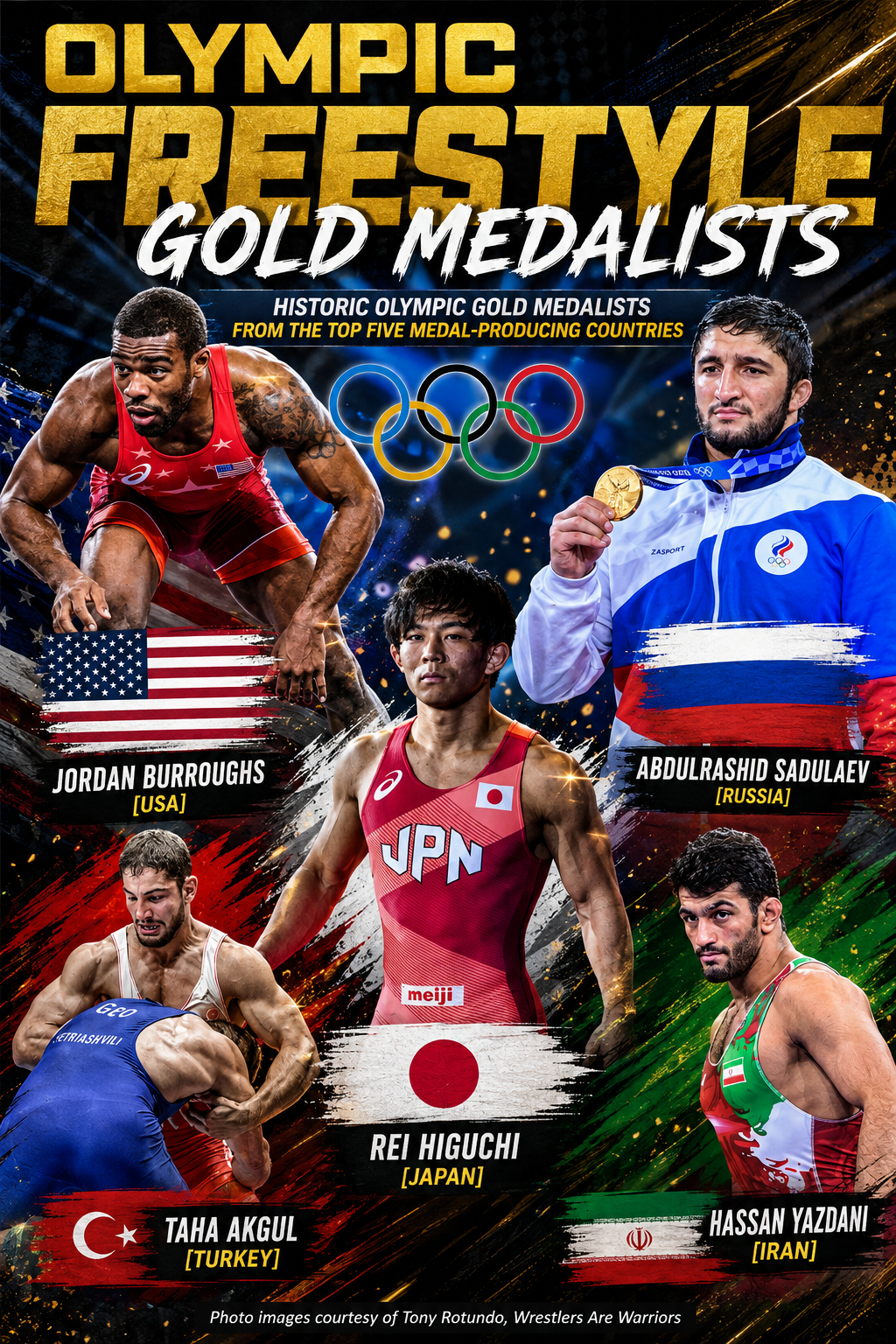
INTRODUCTION: From American Foundations to Global Wrestling Powerhouse

Olympic freestyle wrestling has experienced one of the most dramatic competitive transformations in the history of the Olympic Games. What began at the 1904 St. Louis Olympics as a small competition featuring only 44 wrestlers representing five nations has evolved into one of the most globally competitive and technically sophisticated sports on the Olympic program.
Over more than 120 years of Olympic competition, freestyle wrestling has expanded from a predominantly North American and European discipline into a truly worldwide sport. Twenty-eight nations have captured Olympic gold medals, while more than 40 countries have earned Olympic podium finishes. The historical medal record reveals not only the success of traditional powers such as the United States, Soviet Union, Japan, Iran, and Turkey, but also the evolution of wrestling systems, coaching philosophies, and national development programs that have reshaped international competition.
The history of Olympic freestyle wrestling can be divided into three major eras: the early American foundation, the Soviet transformation of international wrestling, and the modern global era created by the emergence of multiple elite wrestling nations.
UNITED STATES: The Historical Foundation of Olympic Freestyle Wrestling
The United States remains the most successful nation in Olympic freestyle wrestling history, establishing the statistical and historical foundation upon which the sport developed.
American wrestlers have earned 115 Olympic medals, including:
- 50 gold medals
- 36 silver medals
- 29 bronze medals
dating back to the inaugural 1904 Olympic competition.
The United States immediately established dominance in St. Louis, where American wrestlers captured the majority of available medals in a tournament featuring athletes from the United States, Germany, Norway, Canada, and Switzerland.
Unlike nations whose success has been concentrated in specific eras, American wrestling has demonstrated remarkable longevity across multiple generations. The United States has produced Olympic champions from the early pioneers of the sport to modern legends including Bruce Baumgartner, John Smith, Jordan Burroughs, and Kyle Snyder.
The foundation of American success has been built upon a unique wrestling structure combining:
- extensive high school participation
- collegiate wrestling development
- NCAA competition
- Olympic clubs
- international freestyle programs
The American model differs from many international systems because athletes often develop through a large grassroots participation base before transitioning into elite freestyle competition.
OLYMPIC GREATS FROM USA: Dan Gable, John Peterson, Ben Peterson, Dave Schultz, Mark Schultz, Randy Lewis John Smith, Bruce Baumgartner, Brandon Slay, Kevin Jackson, Kendall Cross, Kenny Monday, Henry Cejedo, Tom Brands, Kurt Angle, Cael Sanderson, Jordan Burroughs, Kyle Snyder, David Taylor, and Gable Stevenson among many others.
THE SOVIET UNION: The Most Influential Force in Modern Wrestling History
While the United States established Olympic freestyle wrestling’s historical foundation, the arrival of the Soviet Union at the 1952 Helsinki Olympics transformed the competitive landscape forever.
During only ten Olympic Games between 1952 and 1988, the Soviet Union became the dominant force in international wrestling, earning:
- 28 gold medals
- 15 silver medals
- 14 bronze medals
- 57 total Olympic medals
The achievement becomes even more impressive considering Olympic rules allowed only one wrestler per weight class, forcing the Soviet system to select from an extraordinary depth of talent.
The Soviet wrestling model emphasized:
- centralized athlete development
- scientific training methods
- technical specialization
- elite coaching systems
- extensive international competition
The Soviet Union was not simply a Russian program. It represented the combined wrestling strength of 15 Soviet republics:
Russia, Ukraine, Belarus, Georgia, Armenia, Azerbaijan, Kazakhstan, Uzbekistan, Kyrgyzstan, Tajikistan, Turkmenistan, Moldova, Estonia, Latvia, and Lithuania.
Each region contributed unique wrestling traditions. The Caucasus region, particularly Georgia, Armenia, and Azerbaijan, became internationally recognized for producing technically gifted wrestlers, while Russia provided unmatched depth through its enormous wrestling infrastructure.
The Soviet system raised the global standard of wrestling. Nations competing against the USSR were forced to modernize their own training systems, coaching methods, and athlete development programs.
OLYMPIC GREATS FROM SOVIET UNION: Alexandr Medved, Levan Tediashvili, Ivan Yarygin, Sergei Beloglazov, Arsen Fadsaev, and Makharbek Khadartsev.
The Post-Soviet Era: One Power Becomes Many — Russia and the Former Soviet Republics Reshape Olympic Freestyle Wrestling (1996–2024)
The dissolution of the Soviet Union on December 26, 1991, marked one of the most significant turning points in the history of Olympic freestyle wrestling. Beginning with the 1996 Atlanta Olympic Games, former Soviet republics entered international competition under their own national flags, transforming what had once been a single dominant wrestling superpower into a collection of elite programs capable of challenging for Olympic supremacy. Rather than diminishing Soviet influence, independence expanded it, as the coaching expertise, scientific training methods, technical philosophies, regional development centers, and deeply established wrestling cultures created during the Soviet era continued to thrive across multiple nations. From the 1996 Atlanta Olympics through the 2024 Paris Olympics, Russia remained the leading successor to the Soviet wrestling tradition, capturing 27 Olympic freestyle wrestling medals, including 18 gold, 4 silver, and 5 bronze medals. Russia’s sustained excellence reflected the continuation of a world-class system built on elite athlete identification, disciplined training structures, advanced preparation methods, and generations of technical knowledge passed from Soviet coaches to a new era of Russian champions. However, Russia was only one part of a much larger post-Soviet wrestling legacy. Collectively, the former Soviet republics outside of Russia produced 41 additional Olympic freestyle wrestling medals during this period, including 9 gold, 18 silver, and 14 bronze medals, demonstrating that the Soviet wrestling model had evolved into a network of internationally successful programs. Georgia became one of the strongest successors to this tradition, earning 13 Olympic medals (3 gold, 4 silver, and 6 bronze), while Azerbaijan also captured 13 medals (3 gold, 3 silver, and 7 bronze) and established itself as a consistent global contender. Ukraine followed with 9 medals (1 gold, 3 silver, and 5 bronze), while Uzbekistan emerged as a rapidly growing power with 7 medals (2 gold, 1 silver, and 4 bronze). Additional contributions came from Kazakhstan with 4 medals (2 silver and 2 bronze), Belarus with 4 medals (3 silver and 1 bronze), Armenia with 1 silver medal, Tajikistan with 1 silver medal, and Kyrgyzstan with 1 bronze medal. Combined, Russia and the former Soviet republics produced an extraordinary 68 Olympic freestyle wrestling medals from 1996 through 2024, including 27 gold, 22 silver, and 19 bronze medals. The emergence of multiple championship-level nations from the former Soviet system fundamentally increased the depth and difficulty of Olympic competition. The wrestling world no longer faced one Soviet team occupying the global stage; instead, it faced numerous nations whose athletes shared similar technical foundations, coaching philosophies, and competitive traditions. The breakup of the Soviet Union effectively transformed one dominant wrestling empire into a powerful federation of independent wrestling nations, making Olympic freestyle wrestling significantly more competitive and ensuring that the legacy of Soviet excellence continued to influence the sport for more than three decades after its collapse.
RUSSIA: The Continuation of a Wrestling Dynasty
Following the Soviet collapse, Russia inherited much of the Soviet wrestling structure and remained one of the world’s strongest freestyle programs.
Russian athletes have earned:
- 19 Olympic gold medals
- 4 silver medals
- 5 bronze medals
Russian success has been driven by:
- legendary coaching traditions
- powerful regional wrestling centers
- extensive youth development
- generations of elite competitors
Regions such as Dagestan, Chechnya, and North Ossetia have become internationally recognized as some of the greatest wrestling-producing areas in the world.
The Russian program represents continuity between Soviet wrestling excellence and modern international competition.
OLYMPIC GREATS FROM RUSSIA: Buvaisar Saitiev, Adam Saitiev, and Abdulrashid Sadulaev among many others.
Japan, Iran, and Turkey: Historic Global Powers
Behind the United States and Soviet Union, Japan, Iran, and Turkey represent three of wrestling’s most consistent international powers.
JAPAN
Japan ranks among the most successful freestyle nations with:
- 20 Olympic gold medals
- 13 silver medals
- 11 bronze medals
- 44 total medals
Japanese wrestling has been defined by technical precision, speed, discipline, and systematic athlete preparation.
OLYMPIC GREATS FROM JAPAN: Shochachi Ishii, Yojiro Uetake, and Rei Higuchi among many others.
IRAN
Iran has become one of the world’s most respected wrestling nations, earning:
- 7 Olympic gold medals
- 17 silver medals
- 18 bronze medals
- 42 total medals
While Iran has fewer Olympic championships than some traditional powers, its consistency demonstrates the country’s deep wrestling culture.
Wrestling is one of Iran’s most important sports, producing generations of Olympic and world champions.
OLYMPIC GREATS FROM IRAN: Gholamreza Takhti, Rasoul Khadem, Alireza Dabir, Komeil Ghasemi, and Hassan Yazdani.
TURKEY
Turkey has also played a significant role in Olympic freestyle history:
- 18 Olympic gold medals
- 13 silver medals
- 11 bronze medals
- 42 total medals
Turkey’s success reflects generations of wrestling tradition, cultural importance, and strong domestic competition.
OLYMPIC GREATS FROM TURKEY: Yasar Dogu, Mustafa Dagistandi, and Taha Akgul among many others.
THE MODERN ERA: The Globalization of Olympic Wrestling
The modern Olympic wrestling landscape is no longer controlled by only two or three nations.
Today’s elite competition includes:
- United States
- Russia
- Iran
- Japan
- Turkey
- Georgia
- Azerbaijan
- Kazakhstan
- Uzbekistan
- India
- Cuba
The expansion of wrestling excellence demonstrates that successful programs are now built through a combination of tradition, coaching quality, athlete development, and international opportunity.

LEGENDARY CHAMPIONS: The Greatest Individual Performers in Olympic Freestyle Wrestling History
Throughout Olympic freestyle wrestling history, a select group of athletes have transcended their era through extraordinary dominance, technical mastery, and sustained excellence on the world stage. These legendary champions represent the sport’s highest standard of achievement, combining Olympic success with World Championship supremacy and remarkable longevity. Aleksandr Medved built one of wrestling’s greatest legacies, winning three consecutive Olympic gold medals (1964, 1968, and 1972) across multiple weight classes—from light heavyweight to super heavyweight—while capturing 10 global titles. Buvaisar Saitiev is widely regarded as one of the greatest freestyle wrestlers of all time, dominating the 74 kg division with Olympic gold medals in 1996, 2004, and 2008, along with six World Championship titles that highlighted his technical brilliance and consistency. Makharbek Khadartsev ruled the light-heavyweight division for more than a decade, winning Olympic gold medals in 1988 and 1992, adding a silver in 1996, and becoming one of the Soviet system’s most accomplished wrestlers. Bruce Baumgartner became America’s most decorated Olympic freestyle wrestler, earning four Olympic medals—gold in 1984 and 1992, silver in 1988, and bronze in 1996—while defining excellence in the super heavyweight division.
The modern era has produced its own dominant champions, led by Abdulrashid Sadulaev, “The Russian Tank,” who captured consecutive Olympic gold medals in 2016 (86 kg) and 2021 (97 kg), won multiple World Championship titles, and established himself among the greatest wrestlers of his generation. John Smith became a symbol of American wrestling excellence by winning Olympic gold medals in 1988 and 1992 while completing an unprecedented six-year streak of Olympic and World titles. Sergei Beloglazov won Olympic gold medals in 1980 and 1988 and likely lost another opportunity for Olympic glory because of the Soviet-led boycott of the 1984 Games. Arsen Fadzayev compiled one of the sport’s most dominant careers, winning Olympic gold medals in 1988 and 1992 while going years without a significant international defeat.
Representing the next generation of American excellence, Jordan Burroughs won Olympic gold at the 2012 London Games and followed it with six World Championship titles, becoming one of the defining figures of modern freestyle wrestling. Collectively, these champions reflect the evolution of Olympic freestyle wrestling—from Soviet dominance during the Cold War to Russia’s continued influence and the rise of global powers such as the United States. Their careers embody exceptional athleticism, technical innovation, mental toughness, and longevity, securing their places among the greatest figures in Olympic wrestling history.

COMPETING UNDER A NEW FLAG: The Changing Face of Olympic Representation
One of the defining trends of modern Olympic wrestling has been the increasing number of athletes competing internationally under a country different from their birthplace.
Athletes change representation for several reasons:
- access to stronger training environments
- citizenship opportunities
- family heritage
- improved qualification pathways
- financial and institutional support
Examples include:
Frank Chamizo, born in Cuba, who represented Italy and became an Olympic medalist.
Myles Amine, born in the United States, who earned an Olympic bronze medal representing San Marino through family citizenship.
Sebastian Rivera, a New Jersey native, who represented Puerto Rico at the 2024 Paris Olympics.
Other examples include wrestlers from Russia’s powerful Dagestan region representing different nations, including Olympic champions and medalists competing for Bulgaria, Greece, and Bahrain.
This trend demonstrates that modern Olympic wrestling has become increasingly international, where talent, opportunity, heritage, and national identity intersect.
CONCLUSION: 120 Years of Evolution and Global Excellence
The statistical history of Olympic freestyle wrestling from 1904 through 2024 reflects the remarkable transformation of one of the Olympic Games’ oldest and most celebrated combat sports. The United States established the foundation of Olympic freestyle wrestling during its formative years, while the Soviet Union revolutionized international competition through a systematic approach to athlete development, technical innovation, and elite training. Following the dissolution of the Soviet Union, that legacy expanded across numerous independent nations, creating an increasingly competitive global landscape. Today, Olympic freestyle wrestling stands as one of the most internationally diverse and technically demanding sports in the Olympic movement.
What began as a competition among just five nations at the 1904 St. Louis Olympic Games has evolved into a worldwide showcase of technical mastery, cultural tradition, athletic excellence, and international rivalry. Generations of wrestlers from every continent have elevated the sport through exceptional performances, inspiring future champions and demonstrating the universal appeal of wrestling.
While this article highlights many of the sport’s most influential countries, historic trends, legendary champions, and statistical milestones, it is not intended to serve as an exhaustive record of every great Olympic champion or medalist. Countless extraordinary athletes have made lasting contributions to Olympic freestyle wrestling through their perseverance, sportsmanship, and competitive achievements. Every Olympic medalist has earned a place among the world’s elite, and every Olympic champion has secured a permanent legacy in wrestling history. Their accomplishments—regardless of whether they are specifically featured in this analysis—deserve the highest respect and admiration for reaching the pinnacle of one of the world’s most challenging and prestigious sports.
Ultimately, the evolution of Olympic freestyle wrestling is far more than a story of medals and championship counts. It is the story of how nations, coaching systems, competitive philosophies, and generations of remarkable athletes transformed a modest Olympic event into one of the world’s premier combat sports traditions. Its rich history continues to evolve with each Olympic cycle, ensuring that future champions will add new chapters to a legacy built on excellence, resilience, and the enduring pursuit of greatness.
HISTORY OF THE OLYMPIC FREESTYLE
1904 – 2024
GOLD MEDALS BY COUNTRY [First Olympic medal | Last Olympic medal]
- United States [USA]: 50 [1904 – 2020]
- Soviet Union: 28 [1952 – 1988]
- Japan: 20 [1952-2024]
- Russia: 19 [1996 – 2016]
- Turkey: 18 [1948 – 2016]
- Bulgaria: 8 [1956-2024]
- Finland: 8 [1920 – 1948]
- Sweden: 8 [1920 – 1952]
- Iran: 7 [1956-2016]
- South Korea: 4 [1976 – 1992]
- Switzerland: 4 [1920 – 1928]
- Azerbaijan: 3 [2000-2012]
- Georgia: 3 [2008-2024]
- Great Britain: 3 [1908]
- Hungary: 3 [1936-1948]
- North Korea: 3 [1992-1996]
- ROC [Russian Olympic Committee]: 3 [2020]
- Unified Team: 3 [1992]
- Estonia: 2 [1928-1936]
- Norway: 2 [1904]
- Uzbekistan: 2 [2004]
- Bahrain: 1 [2024]
- Canada: 1 [2000]
- Cuba: 1 [1992]
- Germany: 1 [1960]
- Romania: 1 [1988]
- Ukraine: 1 [2004]
- Yugoslavia: 1 [1984]
Total countries listed: 28
SILVER MEDALS BY COUNTRY [First Olympic medal | Last Olympic medal]
- United States [USA]: 36 [1904 – 2024]
- Iran: 17 [1952 – 2024]
- Soviet Union: 15 [1952 – 1988]
- Bulgaria: 16 [1956 – 2000]
- Japan: 13 [1952 – 2024]
- Turkey: 13 [1948 – 2016]
- Sweden: 10 [1920 – 1972]
- South Korea: 9 [1964 – 2004]
- Finland: 7 [1920 – 1932]
- Canada: 5 [ 1928 – 1996]
- Russia: 4 [1996 – 2016]
- Azerbaijan: 4 [1996 – 2020]
- Switzerland: 4 [1920 – 1948]
- Georgia: 4 [2008 – 2024]
- Hungary: 4 [1932 – 1980]
- Germany: 4 [1904 – 1992]
- Great Britain: 4 [1908]
- Mongolia: 4 [1968 – 1980]
- Belgium: 3 [1924 – 1956]
- Belarus: 3 [1996 – 2020]
- Ukraine: 3 [2000 – 2012]
- Kazakhstan: 2 [2000 – 2004]
- Uzbekistan: 2 [2000 – 2004]
- East Germany: 2 [1976 – 1980]
- India: 2 [2012 – 2020]
- Unified Team: 2 [1992]
- France: 2 [1928 – 1968]
- North Korea: 2 [1980]
- Armenia: 1 [1996]
- Australia: 1 [1948]
- Cuba: 1 [2000]
- Poland: 1 [1980]
- Puerto Rico: 1 [2012]
- Syria: 1 [1984]
- Slovakia: 1 [2008]
- Tajikistan: 1 [2008]
- Estonia: 1 [1936]
- Yugoslavia: 1 [1988]
- Norway: 1 [1908]
- West Germany: 1 [1984]
- Czechoslovakia: 1 [1936]
TOTAL COUNTRIES LISTED: 41
BRONZE MEDALS BY COUNTRY [First Olympic medal | Last Olympic medal]
- United States [USA]: 29 [1904 – 2024]
- Iran: 18 [1952 – 2024]
- Soviet Union: 14 [1956 – 1988]
- Japan: 11 [1924 – 2012]
- Turkey: 11 [1936 – 2024]
- Bulgaria: 11 [1960 – 2008]
- Finland: 10 [1924 – 1984]
- Great Britain: 10 [1908 – 1984]
- Cuba: 8 [1992 – 2020]
- Hungary: 8 [1932 – 2012]
- Sweden: 8 [1920 – 1960]
- Azerbaijan: 7 [2008 – 2024]
- Germany: 7 [1936 – 1996]
- Georgia: 6 [1996 – 2016]
- Romania: 6 [1972 – 2016]
- South Korea: 6 [1976 – 1988]
- Switzerland: 6 [1904 – 1948]
- Russia: 5 [2004 – 2012]
- Kazakhstan: 5 [1996 – 2012]
- India: 5 [1952 – 2024]
- Mongolia: 4 [1968 – 1980]
- North Korea: 4 [1972 – 2012]
- Uzbekistan: 4 [2016 – 2024]
- Ukraine: 3 [1996 – 2008]
- France: 3 [1928 – 1948]
- Greece 3 [1980 – 2024]
- Poland: 3 [1960 – 1980]
- West Germany: 3 [1968 – 1976]
- Albania: 2 [2024]
- Australia: 2 [1932 – 1948]
- Czechoslovakia: 2 [1980]
- Italy: 2 [2016 – 2020]
- ROC: 2 [2020]
- Yugoslavia: 2 [[1980 – 1984]
- Austria: 1 [1932]
- Belarus: 1 [2016]
- Canada: 1 [1984]
- East Germany: 1 [1988]
- Kyrgyzstan: 1 [2008]
- Macedonia: 1 [2000]
- North Korea: 1 [2012]
- Pakistan: 1 [1960]
- Puerto Rico: 1 [2024]
- San Marino: 1 [2020]
TOTAL COUNTRIES LISTED: 44
TOP 5 COUNTRIES [OVERALL MEDAL COUNT]
1 – UNITED STATES: 50 [GOLD] | 36 [SILVER] ] 29 [BRONZE] | TOTAL: 115
2 – SOVIET UNION: 28 [GOLD] | 15 [SILVER] | 14 [BRONZE] | TOTAL: 57
3 – JAPAN: 20 [GOLD] | 13 [SILVER] | 11 [BRONZE] | TOTAL: 44
4 – IRAN: 7 [GOLD] | 17 [SILVER] | 18 [BRONZE]: TOTAL: 42
5 – TURKEY: 18 [GOLD] | 13 [SILVER] | 11 [BRONZE] | TOTAL: 42
Photo images courtesy of National Wrestling HOF inductee Tony Rotundo, Wrestlers Are Warriors.
Follow me on X @Coach_Al_1984 | on Instagram @tier_one_idaho | on Facebook @TIER1 WRESTLING
Leave a Reply