
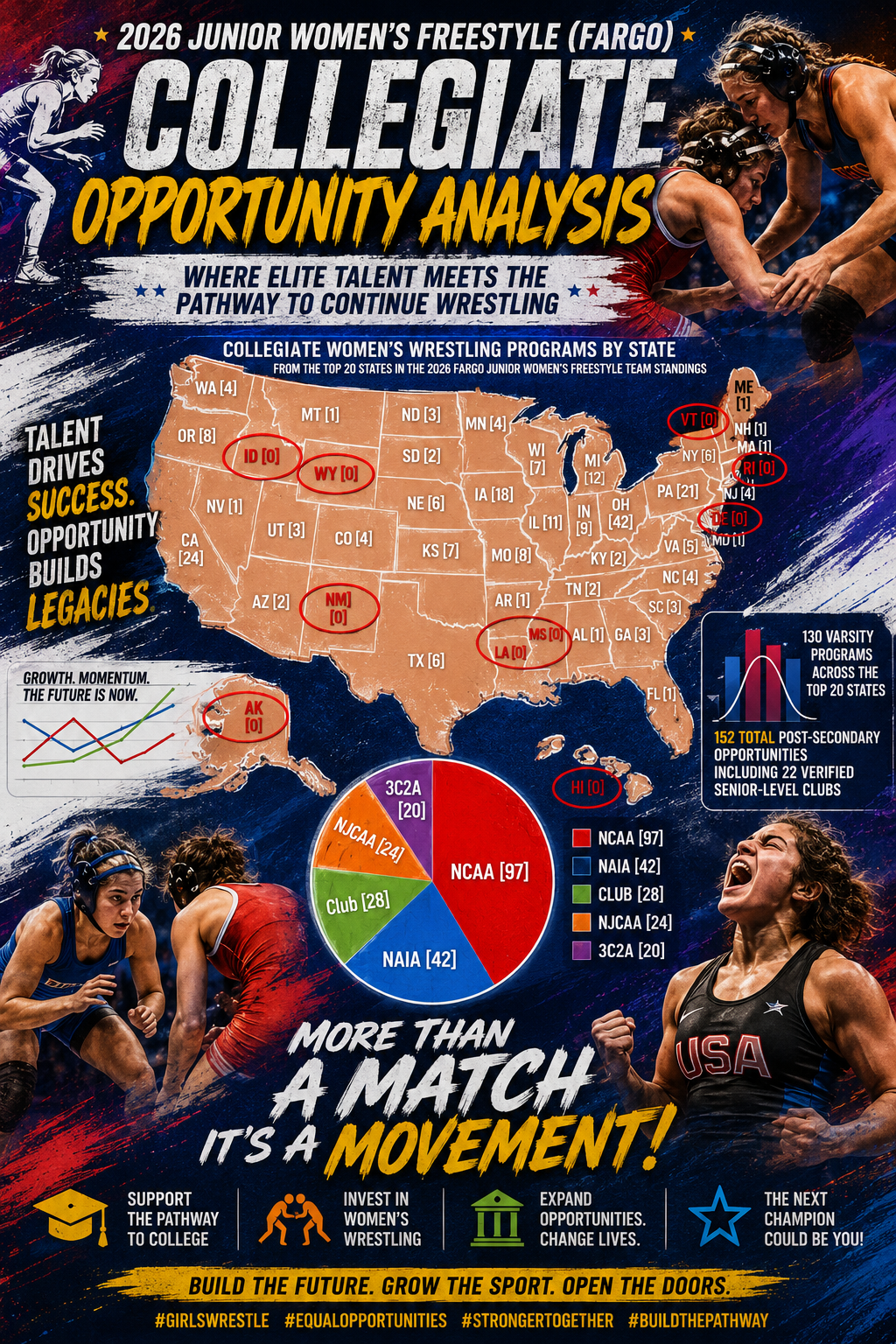

Success at the U.S. Marine Corps Junior Nationals (Fargo) has long served as one of the nation’s premier benchmarks for identifying elite high school wrestling talent. Yet beyond determining which states produce the country’s top female wrestlers, the tournament also provides a revealing measure of how effectively states support the transition from high school success to collegiate opportunity.
The final team standings at the 2026 U.S. Marine Corps Junior Nationals Junior Women’s Freestyle Division reveal far more than which states currently produce the nation’s best female wrestlers. They also expose a growing divide between elite athlete production and collegiate accessibility. While many traditional wrestling powers have invested heavily in women’s collegiate programs, several emerging wrestling states continue to produce nationally ranked competitors despite offering few—or, in some cases, no—in-state opportunities beyond high school.
The following analysis compares the top 20 team finishers in the 2026 Junior Women’s Freestyle Division with the current availability of women’s collegiate wrestling programs in each state. More than a comparison of tournament standings, the data provides insight into the relationship between elite high school performance, long-term investment in women’s wrestling, and the strength of each state’s developmental pipeline.
It identifies which states have successfully aligned high school success with collegiate opportunity—and which states continue to develop championship-caliber athletes despite limited pathways after graduation.
Methodology: All 50 states were reviewed using current national collegiate wrestling directories and verified for the 2026 season. Varsity totals include NCAA Division I, II, and III programs, NAIA programs, NJCAA programs, and California’s 3C2A community college programs where applicable. Developing programs and non-varsity clubs are excluded from varsity totals, while verified senior women’s wrestling clubs are identified separately as additional opportunities.
The National Picture: Elite Talent Is Growing Faster Than Opportunity
Among the top 20 states in the 2026 Fargo Junior Girls Freestyle team standings, there is a striking contrast between national-level success and collegiate accessibility.
Collectively, these states account for 126 varsity women’s collegiate wrestling programs across the NCAA, NAIA, NJCAA, and California’s 3C2A system, along with 22 verified senior-level women’s wrestling clubs, creating a combined total of 148 post-secondary opportunities.
However, those opportunities are distributed far from evenly.
The data reveals that some states have created complete developmental pipelines where athletes can progress from youth wrestling to high school success and eventually into collegiate competition. Others have demonstrated that elite talent can emerge without a significant collegiate infrastructure—but the absence of those opportunities creates challenges in retaining athletes and sustaining long-term growth.
The central question emerging from the 2026 Fargo results is:
Are the states producing America’s best female wrestlers also providing the opportunities necessary for those athletes to continue their careers?
The answer varies dramatically by state.
Pennsylvania: The Complete Pipeline
Pennsylvania represents the strongest overall model of aligning elite athlete development with collegiate opportunity.
The Keystone State captured the 2026 Fargo Junior Girls Freestyle team championship, demonstrating one of the nation’s strongest high school talent pools. However, Pennsylvania’s success extends far beyond Fargo results. The state also provides one of the most complete women’s wrestling pathways in the country.
Pennsylvania currently offers 21 total post-secondary opportunities, including:
- 13 NCAA programs
- 1 NJCAA program
- 7 verified senior women’s wrestling clubs
The state’s investment at every level of the sport mirrors its continued success in producing elite athletes. Wrestlers developed through Pennsylvania’s youth and high school systems have multiple opportunities to continue competing without leaving the state.
Pennsylvania represents the ideal developmental model: strong participation, national-level success, and a robust collegiate infrastructure capable of retaining talent.
California: The Nation’s Deepest Opportunity Pool
California provides the largest overall number of collegiate opportunities among all states analyzed, with 24 total pathways.
The state’s advantage comes primarily from its unprecedented 20 California Community College (3C2A) women’s wrestling programs, creating the deepest junior college pipeline in the nation.
California’s collegiate structure demonstrates both opportunity and complexity. While the state possesses unmatched depth, the majority of those opportunities exist at the junior college level. California currently has only three four-year opportunities through NCAA and NAIA programs combined.
As a result, many athletes use community college wrestling as a developmental bridge before advancing to four-year programs.
Nevertheless, California’s 3C2A system remains one of the most significant contributors to women’s wrestling growth nationally. No other state provides a comparable opportunity for athletes to continue competing immediately after high school.
California illustrates an important distinction: a state can possess the nation’s deepest wrestling infrastructure while still facing challenges transitioning athletes into four-year collegiate programs.
Iowa: The National Model Per Capita
Iowa continues to demonstrate that population size alone does not determine wrestling opportunity.
Despite ranking only 32nd nationally in population, with approximately 3.3 million residents, Iowa finished ninth at the 2026 Fargo Junior Girls Freestyle Championships while supporting 18 varsity collegiate programs.
Those opportunities include:
- 9 NCAA programs
- 4 NAIA programs
- 5 NJCAA programs
When adjusted for population, Iowa becomes one of the strongest women’s wrestling environments in America, providing approximately one collegiate opportunity for every 183,000 residents.
The state’s success demonstrates the importance of intentional investment. Iowa does not simply produce talented wrestlers—it has created a system where those athletes have multiple pathways to continue their careers.
Among all states analyzed, Iowa may represent the strongest example of how a smaller population state can build a nationally competitive women’s wrestling ecosystem.
When Fargo Success Does Not Equal Collegiate Opportunity
One of the most significant findings from the analysis is that Fargo success does not automatically translate into collegiate accessibility.
Several states that finished among the nation’s top-performing teams continue to have limited opportunities for female wrestlers after high school.
Indiana: National Success, Limited Pathway
Indiana produced one of the strongest performances at the 2026 Fargo Junior Girls Freestyle Championships, finishing third nationally.
However, despite its elite high school results, Indiana currently provides only four collegiate opportunities.
The state demonstrates the growing national trend: athlete development is advancing faster than collegiate expansion.
Indiana has proven it can produce nationally competitive wrestlers. The next challenge is creating enough opportunities to retain those athletes.
Texas: A Growing State With a Significant Infrastructure Gap
Texas represents one of the clearest examples of the imbalance between participation and collegiate opportunity.
The second-most populous state in America, with more than 31 million residents, finished fourth nationally at Fargo.
Yet Texas currently provides only six total collegiate pathways for female wrestlers.
Considering the state’s rapidly expanding girls wrestling participation, its population size, and its continued success at national events, Texas represents one of the largest opportunity gaps in the country.
The state has the athletes. The next step is developing the collegiate infrastructure necessary to support them.
Arizona: Elite Results With Limited Options
Arizona presents another compelling example.
The state tied for sixth nationally at Fargo, proving it has developed a highly competitive girls wrestling pipeline.
However, Arizona currently offers only two collegiate opportunities.
The state has demonstrated that elite wrestlers can emerge without a large collegiate system, but maintaining long-term success becomes more difficult when athletes must leave home to continue competing.
New Jersey: Wrestling Tradition Meets Modern Opportunity Challenges
New Jersey has long been recognized as one of America’s premier wrestling states.
The state finished 10th nationally at Fargo, continuing its tradition of producing elite competitors.
However, New Jersey currently offers only four collegiate opportunities for women’s wrestling.
Despite its wrestling history and strong athlete base, the state faces the same challenge confronting many established wrestling communities: ensuring that high school success leads to sustainable collegiate opportunities.
Idaho: The Emerging Model—and the Largest Opportunity Gap
Among all states analyzed, Idaho may represent the most significant contrast between elite performance and collegiate opportunity.
The Gem State finished 15th nationally at the 2026 Fargo Junior Girls Freestyle Championships, continuing its emergence as one of the fastest-growing girls wrestling states in America.
Idaho has demonstrated that it can produce nationally competitive female wrestlers, Fargo All-Americans, and championship-level athletes.
However, Idaho currently offers:
- 0 NCAA women’s wrestling programs
- 0 NAIA women’s wrestling programs
- 0 NJCAA women’s wrestling programs
- 0 verified senior women’s wrestling clubs
Despite its rapid growth and national success, Idaho remains without an in-state collegiate pathway.
Idaho represents the central challenge facing women’s wrestling nationwide: talent development is expanding faster than opportunity.
The state has already proven it can create elite wrestlers. The next question is whether collegiate opportunities will eventually develop to retain that talent.
The Remaining Top 20 States: Strong Performances, Uneven Pathways
While Pennsylvania, California, Iowa, Indiana, Texas, Arizona, New Jersey, and Idaho provide some of the most compelling examples of the relationship between Fargo success and collegiate opportunity, the remaining states in the Top 20 standings further illustrate the uneven development of women’s wrestling infrastructure nationwide.
Several states have successfully built a connection between high school achievement and collegiate opportunity, while others continue producing elite athletes despite limited pathways.
Illinois: A Strong Balance Between Success and Opportunity
Illinois represents one of the more balanced models among the nation’s wrestling states.
The state finished 13th at the 2026 Fargo Junior Girls Freestyle Championships while providing 11 total post-secondary opportunities, including:
- 10 varsity collegiate programs
- 1 verified senior women’s wrestling club
Illinois demonstrates that strong high school performance and collegiate accessibility can develop together. The state has built enough infrastructure to provide multiple options for athletes while continuing to grow its presence on the national stage.
Although Illinois does not match Pennsylvania, California, or Iowa in overall opportunity depth, it represents a healthy and sustainable wrestling ecosystem.
Michigan: A Growing Women’s Wrestling Pipeline
Michigan finished among the nation’s Top 20 states while supporting 12 total opportunities for female wrestlers.
The state’s combination of high school participation, competitive success, and collegiate availability places it among the stronger wrestling environments nationally.
Michigan reflects the broader expansion of women’s wrestling in the Midwest, where many states with traditional wrestling cultures have increasingly invested in creating opportunities for female athletes.
Missouri and Ohio: Traditional Wrestling States Building Women’s Pathways
Missouri and Ohio continue to demonstrate the advantage of established wrestling cultures transitioning into women’s wrestling.
Both states have historically produced elite wrestlers, and that foundation has helped accelerate women’s wrestling growth.
Missouri
- Fargo Top 20 finish
- 8 total opportunities
Ohio
- Fargo Top 20 finish
- 8 total opportunities
These states illustrate the importance of existing wrestling infrastructure. Communities with strong youth programs, coaching networks, and wrestling traditions have been able to adapt quickly as women’s wrestling has expanded.
Wisconsin and Kansas: Smaller States Creating Strong Environments
Wisconsin and Kansas provide additional examples of smaller population states creating meaningful opportunities.
Wisconsin
- Fargo Top 20 finish
- 7 total opportunities
Kansas
- Fargo Top 20 finish
- 7 total opportunities
Neither state possesses the population size of Texas, California, or Florida, yet both have created collegiate pathways that support continued athlete development.
Their success reinforces one of the major findings of this analysis:
Population alone does not determine opportunity. Investment and commitment do.
States Producing Elite Talent With Limited College Options
Several states in the Top 20 continue to demonstrate that elite wrestling success can occur even when collegiate infrastructure remains limited.
These states have successfully developed nationally competitive athletes but face challenges retaining those athletes after high school.
Hawaii: National Success Without a Collegiate Destination
Hawaii’s performance at Fargo represents one of the most remarkable stories in the tournament.
Despite finishing 12th nationally, Hawaii currently offers:
- 0 NCAA programs
- 0 NAIA programs
- 0 NJCAA programs
- 0 verified senior clubs
The state has demonstrated that geography does not prevent the development of elite wrestlers.
However, the absence of collegiate opportunities creates a significant challenge. Athletes who wish to continue wrestling must leave the state, often separating them from their families, communities, and local wrestling systems.
Hawaii is proof that talent exists everywhere. The challenge is creating pathways everywhere.
Florida: A Large State With a Major Opportunity Gap
Florida represents one of the largest discrepancies between population and collegiate opportunity.
As the nation’s third-most populous state, Florida possesses:
- A rapidly growing girls wrestling population
- A large youth sports market
- Increasing high school participation
Yet after finishing 16th nationally at Fargo, the state currently provides only:
- 0 varsity collegiate programs
- 1 verified senior women’s wrestling club
Florida’s situation mirrors Texas: athlete development has accelerated, but collegiate expansion has not kept pace.
Washington, Colorado, Minnesota, and New Jersey: Competitive States Seeking Greater Depth
Several other Top 20 states have developed nationally competitive athletes but provide more limited collegiate options.
These include:
- Washington
- Colorado
- Minnesota
- New Jersey
Each state has strong wrestling traditions and growing girls wrestling participation. However, compared with states such as Pennsylvania, Iowa, and California, their collegiate pathways remain relatively limited.
Their future success will depend on whether collegiate opportunities expand at the same pace as athlete development.
Population Does Not Equal Opportunity
One of the most significant conclusions from this analysis is that population size has little correlation with collegiate opportunity.
Large states do not automatically provide the strongest pathways.
California, with approximately 39.4 million residents, has created the nation’s largest overall opportunity pool through its community college system.
Texas, with approximately 31.7 million residents, has significantly fewer opportunities despite a comparable population base.
Florida, with more than 23 million residents, remains one of the most underserved states.
Meanwhile:
- Iowa (~3.3 million residents)
- Kansas (~3 million residents)
- Nebraska (~2 million residents)
- North Dakota (~800,000 residents)
have created highly effective opportunity systems relative to their population.
The data demonstrates that women’s wrestling opportunity is not simply a function of population.
It is a reflection of institutional commitment.
States Finishing 21–50: Opportunity Varies Dramatically
Among states finishing 21st through 50th in the 2026 Fargo Junior Girls Freestyle team standings, the same national trend continues: some smaller states have created impressive collegiate pathways, while several larger states remain underserved.
Nebraska: The National Per Capita Success Story
Nebraska arguably provides one of the strongest population-adjusted women’s wrestling environments in the country.
With approximately 2 million residents, Nebraska offers:
- 6 varsity collegiate programs
This equates to roughly one collegiate opportunity for every 333,000 residents, placing Nebraska among the national leaders in access relative to population.
Nebraska demonstrates that smaller states can build nationally competitive environments when investment aligns with athlete development.
Oregon: Strong Infrastructure Among Emerging States
Oregon leads the 21–50 group with:
- 8 total opportunities
- 6 varsity programs
- 2 verified senior clubs
The state’s investment provides one of the strongest pathways among emerging wrestling states and positions Oregon as a model for developing programs outside traditional wrestling hotbeds.
Oklahoma, West Virginia, North Dakota, and South Dakota: Small States With Strong Access
Several smaller states provide impressive opportunity relative to population.
Oklahoma
- Approximately 4 million residents
- 5 total opportunities
West Virginia
- Approximately 1.7 million residents
- 3 NCAA programs
North Dakota
- Less than 800,000 residents
- 3 programs
South Dakota
- Approximately 935,000 residents
- 2 programs
These states demonstrate that smaller populations can support meaningful collegiate pathways when institutions prioritize women’s wrestling.
States With Significant Opportunity Deficits
Several states continue to produce wrestlers or show growing participation but currently provide minimal pathways.
States with no varsity women’s wrestling programs or verified clubs include:
- Alaska
- Wyoming
- Louisiana
- New Mexico
- Delaware
- Rhode Island
- Vermont
- Mississippi
Other states with extremely limited opportunities include:
- Nevada – one verified club
- Montana – one collegiate opportunity
- Arkansas – one collegiate opportunity
- Maine – one collegiate opportunity
- New Hampshire – one collegiate opportunity
- Connecticut – one collegiate opportunity
- Alabama – one collegiate opportunity
These states represent future growth opportunities for collegiate expansion.
The Future of Women’s Wrestling: From Talent Development to Talent Retention
The 2026 Fargo Junior Girls Freestyle Championships provide undeniable evidence that women’s wrestling has become a truly national sport.
Elite athletes are no longer concentrated in a handful of traditional wrestling states. National-caliber wrestlers are emerging from every region of the country.
However, the data also reveals a critical challenge:
The growth of female wrestling talent is currently outpacing the growth of collegiate opportunity.
Pennsylvania demonstrates what a complete pipeline can look like.
California demonstrates the power of broad developmental access.
Iowa demonstrates how intentional investment can create national success despite a smaller population.
Idaho, Hawaii, Arizona, and Florida demonstrate the consequences when elite talent develops without a collegiate destination.
The next phase of women’s wrestling growth will not be measured only by how many athletes compete at Fargo or how many champions are crowned.
It will be measured by whether those athletes have opportunities to continue.
Final Conclusion: The Next Frontier Is Opportunity
The 2026 Fargo Junior Girls Freestyle results demonstrate that elite female wrestling talent is expanding nationwide. The question facing the sport is no longer whether talented athletes exist.
They do.
The question is whether the infrastructure exists to support them.
States that successfully align youth development, high school success, and collegiate opportunity will become the future leaders of women’s wrestling. Those that produce elite athletes without corresponding collegiate pathways risk becoming developmental systems that export their best competitors elsewhere.
The next stage of women’s wrestling growth will require universities, athletic departments, and state leaders to recognize what Fargo has already proven:
Championship-level talent exists everywhere. The opportunity to continue competing should too.
2026 JUNIOR WOMEN’S FREESTYLE [FARGO]
The following table highlights the top 50 state team finishers in the Junior Women’s Freestyle Division at the U.S. Marine Corps Junior Nationals (Fargo), along with the number of women’s collegiate wrestling programs currently available in each state. This comparison provides valuable insight into the relationship between high school-level success, state wrestling development, and opportunities for female athletes to continue their careers at the collegiate level.
NOTE: All 50 states checked against national program directories and current-season corrections. Developing programs and clubs are not included in varsity totals.
1 – PENNSYLVANIA [PA]
- STATE POPULATION: 13,000,000 [Ranked #5]
- NCAA [DI, DII, DIII]: 13 PROGRAMS
- NAIA: 0 PROGRAMS
- NJCAA: 1 PROGRAMS
- TOTAL: 14 PROGRAMS
- VERIFIED CLUBS: 7
- OVERALL OPPORTUNITIES: 21
2 – MICHIGAN [MI]
- STATE POPULATION: 10,200,000 [Ranked #10]
- NCAA [DI, DII, DIII]: 6 PROGRAMS
- NAIA: 2 PROGRAMS
- NJCAA: 1 PROGRAMS
- TOTAL: 9 PROGRAMS
- VERIFIED CLUBS: 3
- OVERALL OPPORTUNITIES: 12
3 – INDIANA [IN]
- STATE POPULATION: 7,000,000 [Ranked #17]
- NCAA [DI, DII, DIII]: 2 PROGRAMS
- NAIA: 1 PROGRAMS
- NJCAA: 1 PROGRAMS
- TOTAL: 4 PROGRAMS
- VERIFIED CLUBS: 0
- OVERALL OPPORTUNITIES: 4
4 – TEXAS [TX]
- STATE POPULATION: 31,700,000 [Ranked #2]
- NCAA [DI, DII, DIII]: 2 PROGRAMS
- NAIA: 3 PROGRAMS
- NJCAA: 0 PROGRAMS
- TOTAL: 5 PROGRAMS
- VERIFIED CLUBS: 1
- OVERALL OPPORTUNITIES: 6
5 – CALIFORNIA [CA]
- STATE POPULATION: 39,400,000 [Ranked #1]
- NCAA [DI, DII, DIII]: 2 PROGRAMS
- NAIA: 1 PROGRAM
- NJCAA: 0
- 3C2A [CA JUCO]: 20 PROGRAMS
- TOTAL: 23 PROGRAMS
- VERIFIED CLUBS: 1
- OVERALL OPPORTUNITIES: 24
5T – ARIZONA [AZ]
- STATE POPULATION: 7,700,000 [Ranked #14]
- NCAA [DI, DII, DIII]: 0 PROGRAMS
- NAIA: 1 PROGRAM
- NJCAA: 0 PROGRAMS
- TOTAL: 1 PROGRAM
- VERIFIED CLUBS: 1
- OVERALL OPPORTUNITIES: 2
7T – OHIO [OH]
- STATE POPULATION: 11,900,000 [Ranked #6]
- NCAA [DI, DII, DIII]: 6 PROGRAMS
- NAIA: 1 PROGRAM
- NJCAA: 0 PROGRAMS
- TOTAL: 7 PROGRAMS
- VERIFIED CLUBS: 1
- OVERALL OPPORTUNITIES: 8
7T – WISCONSIN [WI]
- STATE POPULATION: 6,000,000 [Ranked #21]
- NCAA [DI, DII, DIII]: 6 PROGRAMS
- NAIA: 0 PROGRAMS
- NJCAA: 0 PROGRAMS
- TOTAL: 6 PROGRAMS
- VERIFIED CLUBS: 1
- OVERALL OPPORTUNITIES: 7
9 – IOWA [IA]
- STATE POPULATION: 3,300,000 [Ranked #32]
- NCAA [DI, DII, DIII]: 9 PROGRAMS
- NAIA: 4 PROGRAMS
- NJCAA: 5 PROGRAMS
- TOTAL: 18 PROGRAMS
- VERIFIED CLUBS: 0
- OVERALL OPPORTUNITIES: 18
10 – NEW JERSEY [NJ]
- STATE POPULATION: 9,600,000 [Ranked #11]
- NCAA [DI, DII, DIII]: 3 PROGRAMS
- NAIA: 0 PROGRAMS
- NJCAA: 0 PROGRAMS
- TOTAL: 3 PROGRAMS
- VERIFIED CLUBS: 1
- OVERALL OPPORTUNITIES: 4
11 – COLORADO [CO]
- STATE POPULATION: 6,000,000 [Ranked #20]
- NCAA [DI, DII, DIII]: 2 PROGRAMS
- NAIA: 0 PROGRAMS
- NJCAA: 1 PROGRAM
- TOTAL: 3 PROGRAMS
- VERIFIED CLUBS: 1
- OVERALL OPPORTUNITIES: 4
12 – HAWAII [HI]
- STATE POPULATION: 1,500,000 [Ranked #40]
- NCAA [DI, DII, DIII]: 0
- NAIA: 0
- NJCAA: 0
- TOTAL: 0
- VERIFIED CLUBS: 0
- OVERALL OPPORTUNITIES: 0
13 – ILLINOIS [IL]
- STATE POPULATION: 12,700,000 [Ranked #6]
- NCAA [DI, DII, DIII]: 9 PROGRAMS
- NAIA: 0 PROGRAMS
- NJCAA: 1 PROGRAM
- TOTAL: 10 PROGRAMS
- VERIFIED CLUBS: 1
- OVERALL OPPORTUNITIES: 11
14 – UTAH [UT]
- STATE POPULATION: 3,600,000 [Ranked #30]
- NCAA [DI, DII, DIII]: 0 PROGRAMS
- NAIA: 0 PROGRAMS
- NJCAA: 1 PROGRAM
- TOTAL: 1 PROGRAM
- VERIFIED CLUBS: 2
- OVERALL OPPORTUNITIES: 3
15 – IDAHO [ID]
- STATE POPULATION: 2,000,000 [Ranked #37]
- NCAA [DI, DII, DIII]: 0
- NAIA: 0
- NJCAA: 0
- TOTAL: 0
- VERIFIED CLUBS: 0
- OVERALL OPPORTUNITIES: 0
16 – FLORIDA [FL]
- STATE POPULATION: 23,500,000 [Ranked #3]
- NCAA [DI, DII, DIII]: 0 PROGRAMS
- NAIA: 0 PROGRAMS
- NJCAA: 0 PROGRAMS
- TOTAL: 0 PROGRAMS
- VERIFIED CLUBS: 1
- OVERALL OPPORTUNITIES: 1
17 – MINNESOTA [MN]
- STATE POPULATION: 5,800,000 [Ranked #22]
- NCAA [DI, DII, DIII]: 1 PROGRAM
- NAIA: 0 PROGRAMS
- NJCAA: 3 PROGRAMS
- TOTAL: 4 PROGRAMS
- VERIFIED CLUBS: 0
- OVERALL OPPORTUNITIES: 4
18 – KANSAS [KS]
- STATE POPULATION: 3,000,000 [Ranked #34]
- NCAA [DI, DII, DIII]: 1 PROGRAM
- NAIA: 5 PROGRAMS
- NJCAA: 1 PROGRAM
- TOTAL: 7 PROGRAMS
- VERIFIED CLUBS: 0
- OVERALL OPPORTUNITIES: 7
19 – WASHINGTON [WA]
- STATE POPULATION: 8,100,000 [Ranked #13]
- NCAA [DI, DII, DIII]: 0 PROGRAMS
- NAIA: 1 PROGRAM
- NJCAA: 2 PROGRAMS
- TOTAL: 3 PROGRAMS
- VERIFIED CLUBS: 1
- OVERALL OPPORTUNITIES: 4
20 – MISSOURI [MO]
- STATE POPULATION: 6,300,000 [Ranked #19]
- NCAA [DI, DII, DIII]: 3 PROGRAMS
- NAIA: 5 PROGRAMS
- NJCAA: 0 PROGRAMS
- TOTAL: 8 PROGRAMS
- VERIFIED CLUBS: 0
- OVERALL OPPORTUNITIES: 8
THE NEXT 30 STATES
21 – OKLAHOMA [OK]
- STATE POPULATION: 4,000,000 [Ranked #28 ]
- NCAA [DI, DII, DIII]: 0
- NAIA: 1
- NJCAA: 3
- TOTAL: 4
- VERIFIED CLUBS: 1
- OVERALL OPPORTUNITIES: 5
22 – OREGON [OR]
- STATE POPULATION: 4,200,000 [Ranked #27 ]
- NCAA [DI, DII, DIII]: 2
- NAIA: 2
- NJCAA: 2
- TOTAL: 6
- VERIFIED CLUBS: 2
- OVERALL OPPORTUNITIES: 8
23 – NORTH CAROLINA [NC]
- STATE POPULATION: 10,832,000 [Ranked #9]
- NCAA [DI, DII, DIII]: 2
- NAIA: 2
- NJCAA: 0
- TOTAL: 4
- VERIFIED CLUBS: 0
- OVERALL OPPORTUNITIES: 4
24 – VIRGINIA [VA]
- STATE POPULATION: 8,7000,000 [Ranked #12]
- NCAA [DI, DII, DIII]: 4
- NAIA: 0
- NJCAA: 0
- TOTAL: 4
- VERIFIED CLUBS: 1
- OVERALL OPPORTUNITIES: 5
25 – TENNESSEE [TN]
- STATE POPULATION: 7,100,000 [Ranked #15]
- NCAA [DI, DII, DIII]: 2
- NAIA: 0
- NJCAA: 0
- TOTAL: 2
- VERIFIED CLUBS: 0
- OVERALL OPPORTUNITIES: 2
26 – NEBRASKA [NE]
- STATE POPULATION: 2,000,000 [Ranked #37]
- NCAA [DI, DII, DIII]: 1
- NAIA: 4
- NJCAA: 1
- TOTAL: 6
- VERIFIED CLUBS: 0
- OVERALL OPPORTUNITIES: 6
27 – KENTUCKY [KY]
- STATE POPULATION: 4,512,000 [Ranked #26]
- NCAA [DI, DII, DIII]: 0
- NAIA: 2
- NJCAA: 0
- TOTAL: 2
- VERIFIED CLUBS: 0
- OVERALL OPPORTUNITIES: 2
28 – SOUTH CAROLINA [SC]
- STATE POPULATION: 5,282,000 [Ranked #23]
- NCAA [DI, DII, DIII]: 3
- NAIA: 0
- NJCAA: 0
- TOTAL: 3
- VERIFIED CLUBS: 0
- OVERALL OPPORTUNITIES: 3
29 – ALASKA [AK]
- STATE POPULATION: 737,000 [Ranked #48]
- NCAA [DI, DII, DIII]: 0
- NAIA: 0
- NJCAA: 0
- TOTAL: 0
- VERIFIED CLUBS: 0
- OVERALL OPPORTUNITIES: 0
30 – GEORGIA [GA]
- STATE POPULATION: 11,037,000 [Ranked #8]
- NCAA [DI, DII, DIII]: 1
- NAIA: 2
- NJCAA: 0
- TOTAL: 3
- VERIFIED CLUBS: 0
- OVERALL OPPORTUNITIES: 3
31 – WYOMING [WY]
- STATE POPULATION: 588,000 [Ranked #50]
- NCAA [DI, DII, DIII]: 0
- NAIA: 0
- NJCAA: 0
- TOTAL: 0
- VERIFIED CLUBS: 0
- OVERALL OPPORTUNITIES: 0
32 – NEVADA [NV]
- STATE POPULATION: 3,200,000 [Ranked #32]
- NCAA [DI, DII, DIII]: 0
- NAIA: 0
- NJCAA: 0
- TOTAL: 0
- VERIFIED CLUBS: 1
- OVERALL OPPORTUNITIES: 1
33 – LOUISIANA [LA]
- STATE POPULATION: 4,590,000 [Ranked #25]
- NCAA [DI, DII, DIII]: 0
- NAIA: 0
- NJCAA: 0
- TOTAL: 0
- VERIFIED CLUBS: 0
- OVERALL OPPORTUNITIES: 0
34 – MARYLAND [MD]
- STATE POPULATION: 6,200,000 [Ranked #19]
- NCAA [DI, DII, DIII]: 2
- NAIA: 0
- NJCAA: 0
- TOTAL: 2
- VERIFIED CLUBS: 0
- OVERALL OPPORTUNITIES: 2
35 – NEW YORK [NY]
- STATE POPULATION: 20,000,000 [Ranked #4]
- NCAA [DI, DII, DIII]: 5
- NAIA: 0
- NJCAA: 1
- TOTAL: 6
- VERIFIED CLUBS: 0
- OVERALL OPPORTUNITIES: 6
36 – NEW MEXICO [NM]
- STATE POPULATION: 2,100,000 [Ranked #36]
- NCAA [DI, DII, DIII]: 0
- NAIA: 0
- NJCAA: 0
- TOTAL: 0
- VERIFIED CLUBS: 0
- OVERALL OPPORTUNITIES: 0
37 – MONTANA [MT]
- STATE POPULATION: 1,144,000 [Ranked #43]
- NCAA [DI, DII, DIII]: 0
- NAIA: 1
- NJCAA: 0
- TOTAL: 1
- VERIFIED CLUBS: 0
- OVERALL OPPORTUNITIES: 1
38 – ARKANSAS [AR]
- STATE POPULATION: 3,100,000 [Ranked #33]
- NCAA [DI, DII, DIII]: 0
- NAIA: 1
- NJCAA: 0
- TOTAL: 1
- VERIFIED CLUBS: 0
- OVERALL OPPORTUNITIES: 1
39 – NORTH DAKOTA [ND]
- STATE POPULATION: 799,000 [Ranked #47]
- NCAA [DI, DII, DIII]: 1
- NAIA: 2
- NJCAA: 0
- TOTAL: 3
- VERIFIED CLUBS: 0
- OVERALL OPPORTUNITIES: 3
40 – SOUTH DAKOTA [SD]
- STATE POPULATION: 935,000 [Ranked #46]
- NCAA [DI, DII, DIII]: 1
- NAIA: 1
- NJCAA: –
- TOTAL: 2
- VERIFIED CLUBS: 0
- OVERALL OPPORTUNITIES: 2
41 – DELAWARE [DE]
- STATE POPULATION: 1,059,000 [Ranked #45]
- NCAA [DI, DII, DIII]: 0
- NAIA: 0
- NJCAA: 0
- TOTAL: 0
- VERIFIED CLUBS: 0
- OVERALL OPPORTUNITIES: 0
42 – MAINE [ME]
- STATE POPULATION: 1,414,000 [Ranked #42]
- NCAA [DI, DII, DIII]: 1
- NAIA: 0
- NJCAA: 0
- TOTAL: 1
- VERIFIED CLUBS: 0
- OVERALL OPPORTUNITIES: 1
43 – NEW HAMPSHIRE [NH]
- STATE POPULATION: 1,400,000 [Ranked #41]
- NCAA [DI, DII, DIII]: 1
- NAIA: 0
- NJCAA: 0
- TOTAL: 1
- VERIFIED CLUBS: 0
- OVERALL OPPORTUNITIES: 1
44 – RHODE ISLAND [RI]
- STATE POPULATION: 1,114,000 [Ranked #44]
- NCAA [DI, DII, DIII]: 0
- NAIA: 0
- NJCAA: 0
- TOTAL: 0
- VERIFIED CLUBS: 0
- OVERALL OPPORTUNITIES: 0
45 – VERMONT [VT]
- STATE POPULATION: 644,000 [Ranked #49]
- NCAA [DI, DII, DIII]: 0
- NAIA: 0
- NJCAA: 0
- TOTAL: 0
- VERIFIED CLUBS: 0
- OVERALL OPPORTUNITIES: 0
46 – CONNECTICUT [CT]
- STATE POPULATION: 3,600,000 [Ranked #29]
- NCAA [DI, DII, DIII]: 1
- NAIA: 0
- NJCAA: 0
- TOTAL: 1
- VERIFIED CLUBS: 0
- OVERALL OPPORTUNITIES: 1
47 – MASSACHUSETTS [MA]
- STATE POPULATION: 7,000,000 [Ranked #16]
- NCAA [DI, DII, DIII]: 1
- NAIA: 0
- NJCAA: 0
- TOTAL: 1
- VERIFIED CLUBS: 1
- OVERALL OPPORTUNITIES: 2
48 – MISSISSIPPI [MS]
- STATE POPULATION: 2,900,000 [Ranked #35]
- NCAA [DI, DII, DIII]: 0
- NAIA: 0
- NJCAA: 0
- TOTAL: 0
- VERIFIED CLUBS: 0
- OVERALL OPPORTUNITIES: 0
49 – ALABAMA [AL]
- STATE POPULATION: 5,074,000 [Ranked #24]
- NCAA [DI, DII, DIII]: 1
- NAIA: 0
- NJCAA: 0
- TOTAL: 1
- VERIFIED CLUBS: 0
- OVERALL OPPORTUNITIES: 1
50 – WEST VIRGINIA [WV]
- STATE POPULATION: 1,700,000 [Ranked #39]
- NCAA [DI, DII, DIII]: 3
- NAIA: 0
- NJCAA: 0
- TOTAL: 3
- VERIFIED CLUBS: 0
- OVERALL OPPORTUNITIES: 3
Leave a Reply