
By Al Fontes, NWHOF Writer
On the brink of elimination, the 1996 Roadrunners delivered a stunning third-place finish at the NCAA Championships—saving their team and redefining what California wrestling could be.
In 1996, the wrestling room at CSU Bakersfield wasn’t just preparing for a season—it was bracing for an ending. The program had been marked for elimination, its future hanging by a thread. Instead of fading quietly, the Roadrunners chose a different path.
They fought back.
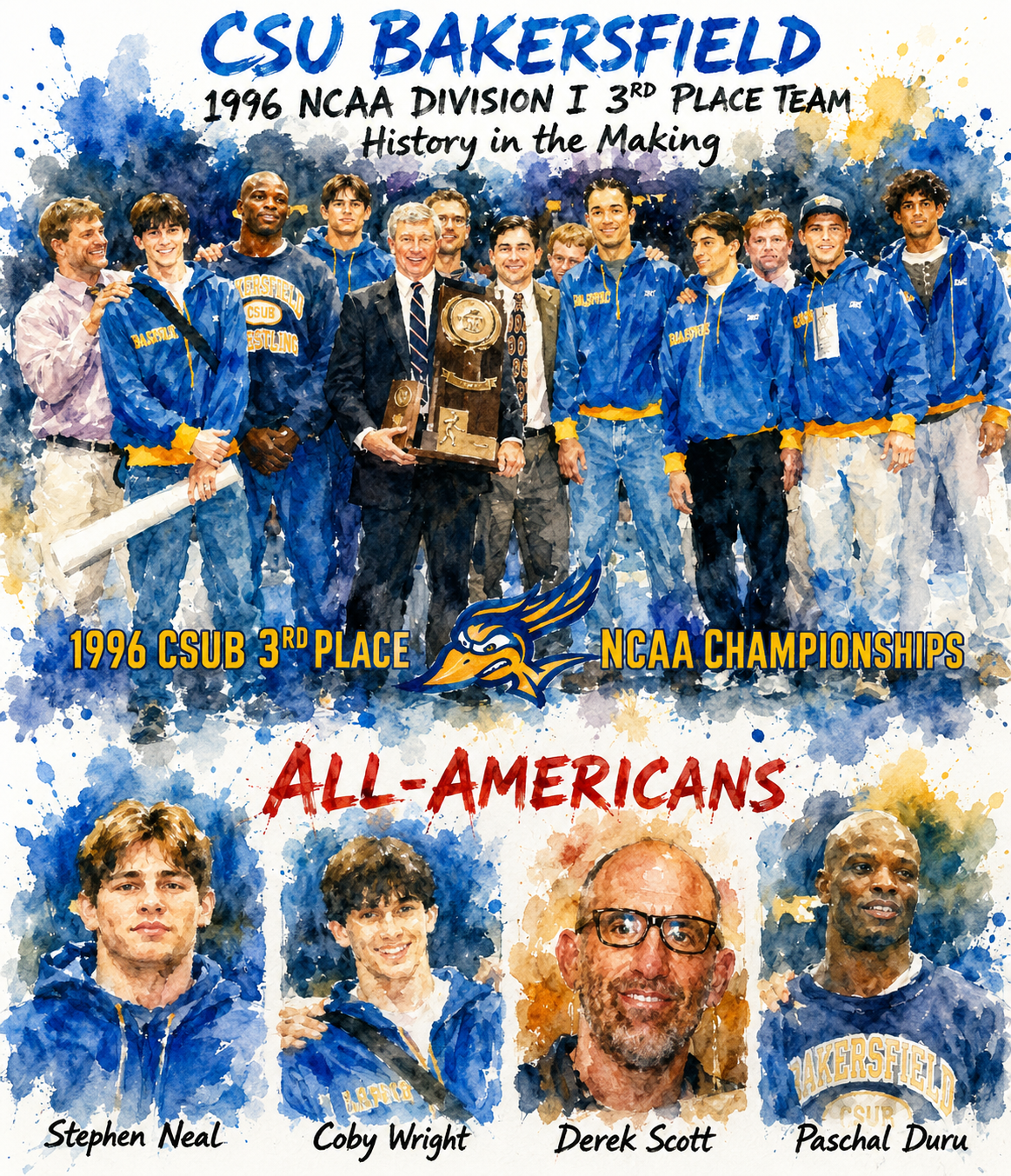
By March, that fight carried them to the podium at the NCAA Division I Wrestling Championships, where CSU Bakersfield stunned the sport with a third-place finish—the highest ever by a California program. Nearly three decades later, the run still stands alone.
Ahead of this year’s NCAA Championships, I spoke with two-time All-American and assistant coach Rich Bailey to revisit the season that didn’t just make history—it saved a program.
To understand how it happened, you have to go back.
In the early 1970s, Hall of Fame coach Joe Seay built CSU Bakersfield wrestling from the ground up. What began as a modest program quickly grew into a national force, producing NCAA champions, All-Americans and Olympians like Joe Gonzales and John Azevedo. By the mid-1980s, seven Division II national titles had established Bakersfield as one of the sport’s premier programs.
When T.J. Kerr took over in 1985, he didn’t just build a program—he built a strong contender. Bakersfield surged into national relevance, churning out All-Americans, capturing a Division II title, and proving it could hang at the highest level. When the Roadrunners jumped to Division I, they didn’t flinch—producing standouts like Bailey and NCAA champion Paul Keysaw. The blueprint wasn’t just solid—it was built to win.
Then came 1996 — and everything changed.
The announcement hit hard: The university planned to cut the wrestling program.
For most teams, that would have signaled the end. For Bakersfield, it became a turning point.
From the first practice, the mission shifted. This wasn’t just about winning anymore — it was about survival. Every takedown, every scramble and every second on the clock carried weight far beyond the scoreboard.
The Roadrunners responded with urgency. They stormed through the Pac-10 season, sending seven finalists, crowning four champions and qualifying nine wrestlers for the NCAA Championships.
At the NCAA Championships, that belief turned into one of the most remarkable team performances in the sport’s history.
CSU Bakersfield didn’t win a single individual title. They didn’t need to.
Instead, they built their finish through depth and consistency:
- Paschal Duru (190 pounds, No. 3 seed) powered his way to the finals, finishing runner-up.
- Coby Wright (126 pounds, No. 7 seed) placed fourth.
- Derek Scott (177 pounds, No. 8 seed) finished sixth.
- Stephen Neal (heavyweight, No. 10 seed) rebounded from an early loss with six straight wins in the consolation bracket to place fourth.
The difference, however, came from the rest of the lineup.
Mike Mendoza (134 pounds) won a match. Jason Ramstetter (142) went 3-2 and reached the blood round. Tony DeSouza (150) added a win. Mickey Ritter (158) won two matches. Jonny McCreary (167) contributed another victory.
Those results produced crucial advancement points — often called “hidden points” in wrestling — that proved decisive in a tightly contested team race.
By the final session, CSU Bakersfield had done the unthinkable.
The Roadrunners finished with 66 points, edging Penn State by one point and finishing five ahead of Nebraska to secure third place behind Iowa and Iowa State.
Bailey still remembers the moment vividly.
“The NCAA tournament process, from beginning to end, was truly surreal,” he said. “By the second day, we had nine wrestlers still competing. Securing a third-place finish alongside Iowa was extraordinary. That achievement played a pivotal role in preserving the program. Had we not accomplished this feat, the program would have been discontinued.”
Behind the scenes, the coaching staff made it all work.
Head coach T.J. Kerr, assistant Darryl Pope and Bailey formed a tightly aligned group that balanced structure, toughness and technical precision. Kerr managed scheduling and program direction. Pope instilled a relentless, physical style. Bailey focused on technique and athlete development.
“We had outstanding chemistry,” Pope said. “Coach Kerr handled program logistics and exposure to top competition. I contributed a tough, tenacious style. Rich Bailey added the technical expertise and teaching ability.”
Together, they turned uncertainty into purpose — and pressure into performance.
What Bakersfield accomplished extended beyond a single season.
The Roadrunners became just the fourth western program to finish in the top three at the Division I level, joining Oregon State (1969, ’70, ’95), Arizona State (1988, ’89, ’90) and Wyoming (1960). More importantly, they demonstrated that programs outside traditional power regions could compete at the highest level.
Thirty years later, the 1996 Roadrunners remain a defining chapter in California wrestling history. Their third-place finish has never been matched by another program from the state.
But their legacy isn’t measured only in points or placement.
It’s measured in what they refused to accept.
They wrestled knowing their program might disappear. They wrestled with urgency, belief and resolve.
They wrestled for survival.
And in doing so, they didn’t just save a program — they built a legacy that still endures.
Photo images: CSU Bakersfield Wrestling.
Follow me on X @Coach_Al_1984 | on Instagram @tier_one_idaho


Leave a Reply