
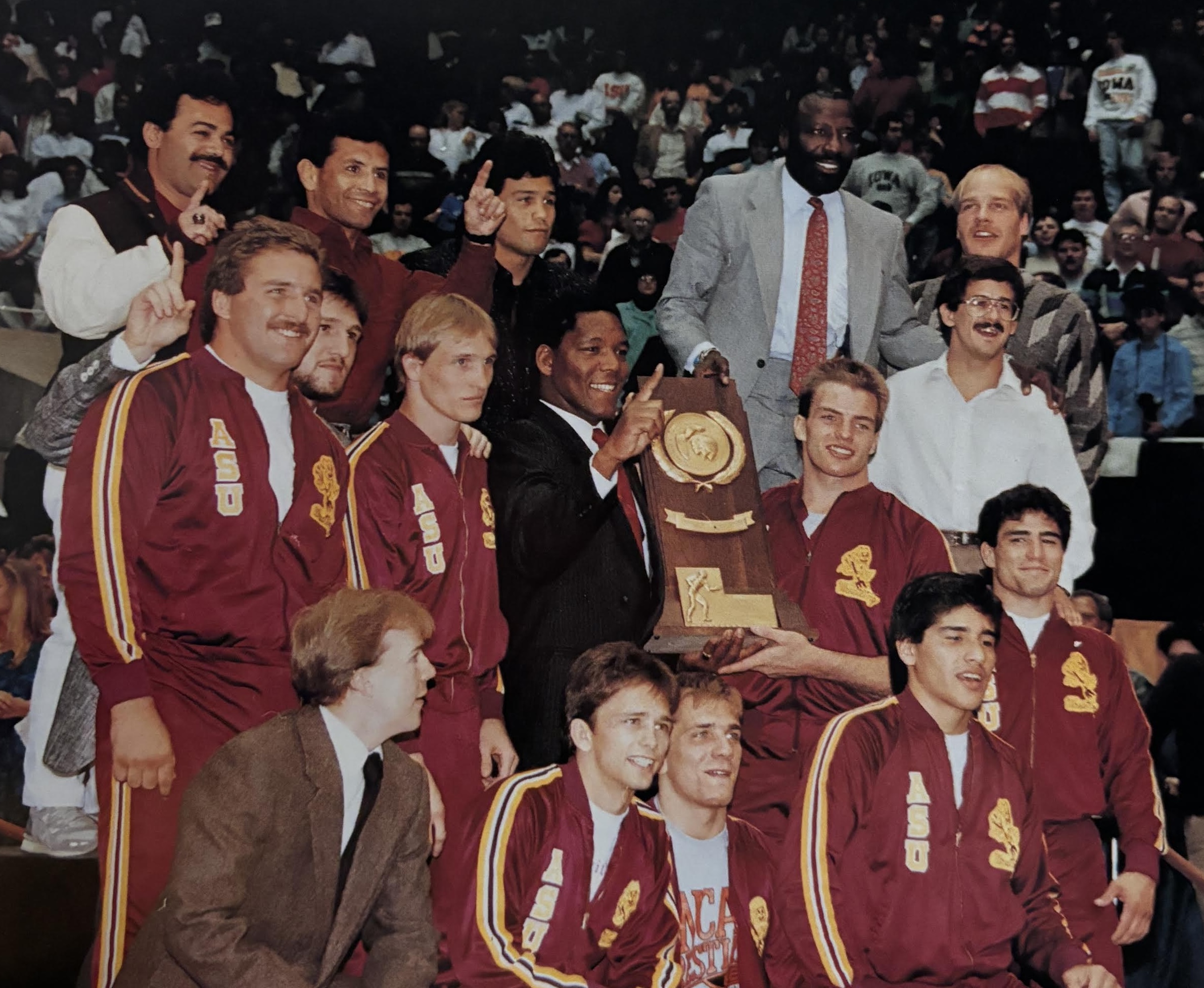
How many coaches west of the Rockies built a national championship program? One—Robert Edward Douglas (aka Coach Bobby Douglas).
Titles only scratch the surface. Coach Douglas didn’t just win—he set a standard that others would spend decades chasing. From Arizona State through Iowa State, his wrestlers carried his system forward, shaping champions and leading programs at the pinnacle of Division I wrestling. Names like Cael and Cody Sanderson, Zeke Jones, Tommy Ortiz, and Shawn Charles, along with Matt Azevedo, Joe Heskett, and Chris Bono, reflect generations of champions molded by his system.
When the wrestling world mourned his passing, it didn’t just lose a coach—it lost an ARCHITECT, a force who shaped the sport from college mats to the world stage. Across 31 seasons at UC Santa Barbara, Arizona State, and Iowa State, Coach Douglas built programs defined by excellence, integrity, and vision, all while being an integral part of shaping Team USA.
From Blaine to the World Stage
Born on March 26, 1942, in Bellaire, Ohio, Coach Douglas was raised in nearby Blaine amid grinding poverty and relentless racial prejudice. His heritage traces to the Nuba tribes of Sudan, where wrestling is more than a sport—it is a proving ground of honor, where respect, rank, and destiny are seized with every fall. In that lineage, combat wasn’t chaos—it was purpose.
Life hurled unyielding trials his way, but on the mat, he found refuge—a place where struggle forged mastery and every bout drove him closer to greatness.
At Bridgeport High School, under coach George Kovalick, his raw talent was shaped and ambition sharpened. Two Ohio state titles and a third-place finish as a junior announced the arrival of a force few could reckon with.

At West Liberty State, he flipped the script—winning an NAIA title as a freshman and surging, unseeded, to the NCAA Division I finals. Then came a new challenge: transferring to Oklahoma State, where NCAA rules forced him to sit out a year. What might have stalled another wrestler only sharpened Coach Douglas. He used the pause as fuel, earning a spot on the 1964 Olympic team and finishing fourth at featherweight. Returning to competition, he captured the Big Eight title—but a season-ending injury robbed him of a 1965 national run.
He returned stronger: a silver medal at the 1966 World Championships, a second World Team appearance, and matches that would etch his name into wrestling history. Before Dan Gable became the embodiment of dominance, Coach Douglas met him head-on—and broke through. An 11–1 win at the 1968 Olympic Trials. Another at the 1970 World Team Trials where he went on to earn a Bronze medal at the World Championships in Edmonton. These weren’t just victories—they were proving grounds. Coach Douglas didn’t just challenge Gable; he tested him in ways few others could—and sharpened the edge that would define a legend.
Coach Douglas also made history as the first Black American to medal twice on the world stage and as captain of the 1968 U.S. Olympic freestyle wrestling team in Mexico City. His competitive career announced him as a force. But it was his coaching career that declared him a revolution.

Breaking Barriers and Building Powerhouses
Coach Douglas didn’t just enter coaching—he kicked the door in. In 1973, he became the first Black head coach of a major university wrestling program at UC Santa Barbara. A year later, he turned Arizona State into a Western powerhouse.
The results were undeniable: nine conference titles, eight Coach of the Year honors, three NCAA champions, and 59 All-Americans—highlighted by the 1988 national title and back-to-back runner-up finishes. A record still unmatched west of the Rockies.
Beyond trophies, Coach Douglas left an indelible mark on the psyche of every wrestler.
“From the moment he recruited us, Coach Douglas talked about winning a national team title. When the defining moment arrived, we came together and made it happen,” said Mike Davies, a two-time All-American and captain of ASU’s championship team.
His presence wasn’t just instructional—it was electric, demanding every athlete chase their absolute ceiling.
From 1992 to 2006, at Iowa State, Coach Douglas didn’t just coach—he transformed the Cyclones into a national powerhouse, producing 10 NCAA champions, 52 All-Americans, and 31 conference titles. His vision extended beyond wins; by strategically recruiting the older Sanderson brothers—he paved the way for the youngest, Cael, who would achieve a perfect 159–0 collegiate record, four NCAA titles, and a legacy shaped by Coach Douglas’s guidance.
Decades earlier, Coach Douglas had already left his mark on Lee Kemp, a three-time NCAA and World Freestyle champion, whose historic career—culminating as the first American to win three World Freestyle Championships and a 1980 Olympic favorite denied by the boycott—was built on the technical mastery, discipline, and quiet confidence Coach Douglas instilled. Across generations, his influence forged champions who redefined the sport.
Behind the intensity and relentless drive was a foundation few saw. Coach Douglas married Jackie (Davidson) Douglas, whom he met in Stop 32 near Wheeling, West Virginia. They wed in 1966, and Jackie became a steady anchor through every chapter of his rise, supporting one of wrestling’s most driven figures. Coach Douglas often credited her and his high school coach as the forces that kept him grounded while his influence spread nationwide. Together, they raised a son, Robert “Bobby” Douglas Jr., extending a legacy beyond the mat.
Resilience, Vision, and Legacy
Coach Douglas’s story isn’t about wins—it’s about will. Poverty and prejudice didn’t stop him; they sharpened him. Every obstacle became fuel. Every setback, an opening. And he didn’t just coach wrestling—he engineered its blueprint.
Through six instructional books, including Takedown I, Douglas didn’t just share knowledge—he built a system wrestlers could follow long after the whistle.
That impact wasn’t theoretical—it showed on the mat.
“Bobby was ahead of his time. Long before technique was widely documented, he was publishing detailed systems athletes could study and take straight to competition,” said Joe Gonzales, NCAA champion and 1984 Olympian.
Over three decades, he cultivated a coaching tree whose branches now span Division I wrestling.
His influence flows through three forces: Gable—the catalyst. Kemp—the evolution. Sanderson—the proof.
Three forces. One lineage. And at the center—Coach Douglas, the visionary.
Blueprint of Champions
Coach Douglas’s influence went beyond wins and titles. He instilled discipline, meticulous preparation, and quiet confidence—traits that still resonate across American wrestling.
“Bobby Douglas was the key reason I became the Olympic coach in 2008…He believed I deserved it,” said Lee Kemp.
His athletes—from the Sanderson brothers to Jones, Charles, Ortiz, and countless others—carried his philosophy forward. Their successes on the mat and in leading programs today reflect Coach Douglas’s enduring technical mastery and strategic vision.
Across eras, across generations, Coach Bobby Douglas’s influence is unmistakable. From collegiate championships to global stages, from mentoring the next Sanderson to being an integral part of shaping Team USA, his fingerprints are everywhere. The mat was his canvas, and he painted a legacy of resilience, vision, and excellence.
The Architect’s Enduring Legacy
Coach Bobby Douglas didn’t just produce champions—he engineered the blueprint for modern American wrestling.
Champions fade. Eras pass. His system endures.
Forged in adversity and driven by purpose, he turned vision into a standard others still chase. West of the Rockies, he stands alone. Everywhere else, his influence stands beside every contender.
From Blaine to the world stage, he wasn’t just a coach—he was the architect of excellence.
Others built champions.
Coach Bobby Douglas built the system that built them.

A TRIBUTE TO BOBBY DOUGLAS – ARCHITECT OF EXCELLENCE
SHAWN CHARLES
4X NCAA Division I ALL-AMERICAN [ASU]
“It’s taken me some time to process the recent passing of my former head coach and mentor Bobby Douglas. I’m sending my deepest condolences to Jackie and Bobbo Douglas. Coach Douglas was truly a “Sifu.” If you’re not familiar with the term, it’s a Cantonese word used to describe a teacher of martial arts who often occupies both the roles of coach and paternal figure in the lives of their students. His wrestling knowledge was unparalleled. His legacy of producing outstanding wrestlers and coaches is unmatched. Effort and a willingness to learn were paramount to Coach Douglas. If you were willing to put in the effort and learn, he would teach you. You wanted him to coach you. That was his gift. That’s why he was a great coach. Because of this, he made champions out of and influenced the lives of students of all backgrounds.”
“Coach Douglas recruited a young wrestler who had only started wrestling in high school and had found some moderate success in Arizona, had never competed in the Cadet or Junior Nationals, had never wrestled freestyle, and had never wrestled a match outside of Arizona. Coach Douglas gave that wrestler a chance to wrestle for him, trained him, and poured his knowledge into him. That wrestler went on to become the first four-time NCAA All-American at ASU. In me, Coach Douglas saw a diamond in the rough and committed to giving me the skills and opportunities required to make my potential a reality.”
“I’m grateful to have had the chance to coach alongside Sifu Bobby Douglas and see him develop greatness in others. His legacy and impact on the sport and the lives of his students have and will continue to influence wrestlers far into the future.”
MIKE DAVIES
2X NCAA DIVISION I ALL-AMERICAN [ASU] | TEAM CAPTAIN
“Coach Douglas was a very cool guy—but to us, he was much more than that. We looked up to him…We idolized him. He was a father figure. He gave us the freedom to find our own path, whether in wrestling or in life, yet he always had a pulse on what we were doing. Coach allowed us to walk through the door of failure, but he was always there on the other side—ready to catch us if we needed it.
“Coach Douglas lived by a relentless work ethic and an unshakable moral compass. He followed the rules to the letter and never wavered. Wrestling may be an individual sport, but Coach Douglas made it a team sport. He constantly emphasized we—the team—because he believed our greatest strength was what we accomplished together.
“From the moment he recruited us, Coach Douglas talked about winning a national team title. When the defining moment arrived, we came together and made it happen—even after losing our three-time All-American John Ginther to injury for the remainder of the season. Meanwhile, coaches from other top-ranked programs were casting doubt on what we could accomplish. But we entered the tournament with belief, reinforced our will on the mat, and refused to be denied. Coach Douglas gave us the vision—and in the end, we shared the moment: NCAA Champions.
“Coach Douglas always reminded us that we were students first and athletes second. More importantly, he was a man of wisdom who helped guide us in life. He gave us the freedom to grow, the discipline to succeed, and the values to carry long after wrestling ended. For that, I will always be grateful.”
TOM ORTIZ
3X NCAA DIVISION I ALL-AMERICAN [ASU] | ARIZONA ST. HEAD COACH | IOWA ST. ASSISTANT COACH
“Coach Bobby Douglas was always honest and forthright—he told you exactly what he thought. We lost one of the greatest tacticians in wrestling history. His approach to teaching technique was second to none—innovative and highly effective. He impacted wrestlers from all walks of life, both male and female. In fact, he was among the first to support women’s wrestling in the United States, a true trailblazer in the movement.”
RAY MILLER
4X NCAA DIVISION I ALL-AMERICAN [ASU]
“The first time I met Coach Douglas was at the Pittsburgh Classic my senior year of high school. But it wasn’t the first time I’d heard of him. By then, Bobby Douglas was already a legend to me.
Growing up in a small town in Oklahoma, most of our coaches were dads with little wrestling background, and we lacked technique. It wasn’t like today—kids don’t realize how much access they have now. My dad got ahold of Coach Douglas’s book, Wrestling: The Making of a Champion—The Takedown. It was a game changer. The techniques were broken down with photos and descriptions, even shot in front of a grid wall so you could see depth and level changes. In a way, Bobby Douglas had been coaching me from the start.
My senior year, we trained in Edmond with another team, and one guy said he wanted to wrestle at Arizona State under Douglas. That stuck with me. At the Pittsburgh Classic, ASU had just won the 1988 national title. I saw Coach Douglas in the lobby—my first time seeing him in person. I introduced myself, congratulated him, and told him I’d grown up studying his book. We talked briefly, but I remember he seemed preoccupied. Later I learned that was just who he was—always thinking ahead, always working to improve something, whether it was the sport or the lives of his wrestlers. He treated them like his own kids. I ended with, “Great to meet you, Coach,” and shook his hand.
Later that day, we had a workout with a Pennsylvania team. Afterward, I went back to my hotel room, and I can still remember it clearly—the phone rang. When I answered, I heard, “Ray Miller, how would you like to become a Sun Devil?” I said, “I’d certainly consider it, Coach.”
I took a visit to ASU and knew it was where I belonged. It felt like Coach Douglas would take care of me. My parents felt the same, which says a lot since I’d never been outside Oklahoma and was very close to them. It felt less like being recruited and more like being adopted. He cared about more than wrestling—he stayed on us about grades and made sure we had tutors if needed.
Freshman year is the toughest transition—from high school to college wrestling, it’s a huge jump. It’s easy to get discouraged when you go from winning all the time to taking daily beatings. Coach Douglas would call and remind me this was part of the process—that I’d be okay, that I’d be a champion someday. That encouragement carried me through.
Make no mistake, he was tough on us—but in the right way. He knew how to push us, how to harden us into competitors, and how to lift us back up when we fell. He struck that balance perfectly. He was the kind of leader you wanted to follow—a great coach, a great man, and a true mentor.”
MARCO SANCHEZ
2X NCAA DIVISION I ALL-AMERICAN [ASU] | 1996 OLYMPIAN [GR]
“Coach Bobby Douglas was a technician on a mission to develop wrestling talent not just on the mat, but off the mat as well. He expected us to graduate on time and go out and make a positive impact on the world. He was one of the GOATs in that regard and many other ways as an example of overcoming obstacles that would have destroyed a lesser man – Rest in Peace and Power Coach.”
GT TAYLOR
2X NCAA DIVISION I ALL-AMERICAN [ASU]
“Before I considered coming to Arizona State University to wrestle, I had not really known much of Bobby Douglas. After being under his guidance, I came to know the coach that was Bobby Douglas. Later in life, after becoming a coach myself, I grew to understand the man Bobby Douglas. And now I find myself striving to uphold the ideals of Bobby Douglas. He was one of the greatest contributors to the sport of wrestling this world will ever know. He will be missed.”
MIKE ANDERSON
2X NCAA DIVISION I ALL-AMERICAN [ASU]
“Coach Douglas has a long list of accomplishments, but I want to share what I learned from him as my Coach at ASU. He taught me discipline and how to push myself physically and mentally to a place I never dreamed of. His coaching systems developed me from a young man to being an All-American which wasn’t a goal, it was a standard. He would say we (ASU) will be the best conditioned team in the country and he was right. I know I won many matches not based solely on talent, but on conditioning and outworking my opponents. Coach Douglas was selfless and brought world class athletes in our wrestling room to help us develop our techniques. Names like Matt Ghaffari, Melvin Douglas, and countless others regularly worked out with us all in the pursuit of becoming a champion. Coach Douglas was the gold standard of wrestling and will always be remembered that way.”
LEE KEMP
FIRST 3X WORLD CHAMPION [FS] | 3X NCAA DIV. I CHAMPION [WISCONSIN] | 1980 OLYMPIAN [FS] | 2008 OLYMPIC COACH
“Bobby Douglas was the key reason I became the Olympic coach in 2008. Bobby felt it was important that I be granted that opportunity…He believed I deserved it.”
CAEL SANDERSON
2004 OLYMPIC GOLD [FS] | 4X NCAA CHAMPION [159-0] | HEAD COACH [Penn State]
“Coach Douglas was a true legend and pioneer of our sport. Everyone who was blessed to know him, work with him, or be coached by him loved him. He taught us to be self-sufficient, to work extremely hard, and to do things the right way. He taught technique that was years ahead of the game, and he ran his program with honor and integrity. I am extremely grateful to have known him, to have learned from him, and to have been coached by him. A lot of how I run our program comes from things I learned from him. His legacy will live on through all the people and programs he influenced.”
KEVIN JACKSON
1992 OLYMPIC GOLD [FS] | 2X WORLD CHAMPION [FS] | 4X NCAA ALL-AMERICAN
“Bobby was more than a mentor, more than a hero. He was a real man. A man’s man. Humbled but powerful. He was always the smartest, most intelligent guy in the room, the most technical, most tactical coach in the world. He was always that guy. Without Bobby, I would not have achieved the success I did internationally, and I would not be the coach I am today. The things that he shared—his impact on our sport cannot be expressed in words but in the lives of many! Bobby was simply the best. Let’s continue to celebrate a man who has had his fingerprints all over America’s wrestling success – Rest in Love Coach!”
JOE GONZALES
NCAA DIV. I CHAMPION [CS BAKERSFIELD] | OLYMPIAN ’84 [FS] | 3X WORLD CUP CHAMPION | ASSIST. COACH [ASU]
“Bobby was ahead of his time…Long before technique was widely documented, he was publishing detailed systems that athletes could study, absorb, and take straight to the mat. Much of what I relied on came from those pages—and it showed. His approach elevated my performance and reshaped how I competed. I later had the privilege of standing beside him at Arizona State, part of the 1988 national championship team—still unmatched. Whether in the college room, with the Sunkist Kids, or on the international stage, Bobby was always in my corner. He brought unmatched energy, demanded more from everyone around him, and inspired us to reach levels we didn’t know we had.
Bobby didn’t just coach champions—he ignited them. And he will be deeply missed.”
TIM VANNI
2X OLYMPIAN | 5X SENIOR U.S. NATIONAL CHAMPION | ASST. COACH 1987-’92 [ASU]
“When I first arrived at the Sunkist Kids Wrestling Club, I didn’t know Bobby personally, but I had devoured all his technique books. He was someone you wanted to emulate and learn from—a trusted guide on what athletes strive to achieve. His impact on wrestling was profound; Bobby transcended the sport. Beyond that, he was a kind and genuine person, deeply committed to the people in his life.”
CLIFF LAUGHLIN
COACH OLYMPIC FESTIVAL ’90 [West] | 1996 OLYMPIC COACHING STAFF | NWHOF [ID CHAPTER]
“I had the privilege of rooming with Bobby for a week at the 1990 U.S. Olympic Festival. In that short time, he mentored me, generously sharing his wisdom on coaching athletes at the elite level. Bobby was not only a great coach—he was a true teacher.”
DAVE “DOC” BENNETT
NATIONAL DEVELOPMENT COACH – USA WRESTLING| NWHOF [Lifetime Service | Order of Merit]
“I first met Bobby Douglas in 1962 at the NAIA National Championships while cutting weight together. Years later, he and Joe Seay introduced me to Art Martori, founder and longtime leader of the Sunkist Kids Wrestling Club, for scouting and technical video work. Over the years, Bobby and I built a strong relationship. He was a true innovator—together we transformed his technique training books into instructional videotapes and traveled extensively with the national team. Bobby’s impact on the sport was immense, and he always emphasized living a useful, productive life, especially beyond wrestling.”

BOBBY DOUGLAS’S WRESTLING AND COACHING ACCOLADES
WRESTLING ACCOLADES [High School | Collegiate | International]
- World Championships – Silver – 1966 Toledo [63 kg] | Bronze – 1970 Edmonton [68 kg].
- Pioneer Status: Douglas was the first Black American to wrestle in the Olympics [1964, 1968], the first to captain a U.S. Olympic team [1968].
- Five-time National Champion [Senior level].
- West Liberty State: Won NAIA National Championship at 130 pounds and was the 1963 NCAA Division I runner-up, unseeded.
- Oklahoma State: Captured the Big Eight Conference title in 1965 at 147 pounds.
- Career Record: He concluded his collegiate wrestling career with a record of 72-2.
- Two-time Ohio State Champion – 112 lb.| 127 lb., 1959, ’61 [Bridgeport High School].
- Accumulated a career record of 303–17–7 [.953] from his high school days through his World Championship competition.
HALL OF FAME HONORS | AWARDS
- National Wrestling Hall of Fame – Distinguished Member, 1987
- West Liberty College Hall of Fame, 1983
- NAIA Hall of Fame, 1985
- Arizona State Hall of Fame, 1999
- NWCA National Coach of the Year, 2000
- Arizona Wrestling Hall of Fame, 2004
- Iowa (Glen Brand) Wrestling Hall of Fame
- Ohio Hall of Fame
- Iowa State Athletic Hall of Fame
- 12-time Coach of the Year
- Two-time USA Wrestling Freestyle Coach of the Year [1992 | 2004]
COLLEGIATE COACHING ACCOMPLISHMENTS
- Served as a head coach at UC Santa Barbara [1973, one season, first black head coach].
- Arizona State [1974–1992]: Led the Sun Devils to the 1988 NCAA National Championship, making history as the first program from the West to win the title.
- Eight-time conference coach of the year at ASU.
- Iowa State [1993–2006]: Achieved 198 wins in Ames, guiding the Cyclones to three NCAA runner-up. finishes [1996, 2000, 2002] and nine top-six national finishes.
- Finished coaching career dual record of 427-168-9.
- Conference titles – 68 individual champions.
- Bobby Douglas was a legendary figure in collegiate wrestling, recognized as a pioneering athlete and one of only four coaches in history to surpass 400 career dual victories. Over 31 seasons, he coached 13 NCAA individual champions and 110 All-Americans. Notably, Douglas mentored Cael Sanderson at Iowa State during his historic undefeated 159-0 collegiate career.
- Legendary coach who guided numerous World and Olympic wrestlers, serving as an assistant or head coach for 10 plus USA World |Olympic teams, including the 1992 Olympic head coach. He coached elite talent like Olympic champion Cael Sanderson, 3x World Champion Lee Kemp, and World Champion and Olympic silver medalist Zeke Jones.
- Head Coach of the 1992 U.S. Olympic team [6 medalists | 4 gold].
OTHER NOTABLE ACCOMPLISHMENTS
- Earned a bachelor’s degree from Oklahoma State in 1967 and master’s degree from Arizona State in 1981 – Admitted to the doctoral program.
- Author and Mentor: He authored several influential books on wrestling technique: Takedown I, Takedown II, Pinning and Olympic Technique, Take It To The Mat, Wrestling Skills and Drills, and The Last Takedown
- Legacy award named in his honor by the Black Wrestling Association [BWA].
- Gold Certified Coach – USA Wrestling.
COACHING TENURE AT ARIZONA STATE AND IOWA STATE
IOWA STATE [ISU]
TOP 10 NCAA FINISHES, 1993 – 2006 [11 total | 3 runner-up finishes]
- 10th Place – 2005 [3 All-Americans]
- 6th Place – 2004 [1 Champion | 5 All-Americans]
- 2nd Place – 2002 [3 Champions | 5 All-Americans]
- 6th Place – 2001 [1 Champion | 2 All-Americans]
- 2nd Place – 2000 [1 Champion | 5 All-Americans]
- 4th Place – 1999 [1 Champion | 4 All-Americans]
- 6th Place – 1998 [2 All-Americans]
- 4th Place – 1997 [1 Champion | 4 All-Americans]
- 2nd Place – 1996 [1 Champion | 5 All-Americans) ]
- 10th Place – 1994 [3 All-Americans]
- 6th Place – 1993 [7 All-Americans]
ARIZONA STATE [ASU]
TOP 10 NCAA FINISHES, 1974 – 1992 [9 total | 1 team title | 2 runner-up finishes]
- 6th Place – 1992 [4 All-Americans]
- 2nd Place – 1990 [1 Champion | 8 All-American]
- 2nd Place – 1989 [5 All-Americans]
- NCAA Div. I CHAMPIONS – 1988 [7 All-Americans]
- 9th Place – 1987 [3 All-Americans]
- 8th Place – 1986 [3 All-Americans]
- 6th Place – 1985 [1 Champion | 5 All-Americans]
- 5th Place – 1980 [4 All-Americans]
- 8th Place – 1979 [5 All-Americans]
4x NATIONAL CHAMPION
184|197 – Cael Sanderson – Iowa State [1st, 1st, 1st, 1st], 1999-’02 [4x OW]
2x NATIONAL CHAMPION
158|167 – Dan St. John – Arizona State, 1989-’90
1x NATIONAL CHAMPIONS
141 – Nate Gallick – Iowa State, 2006
133 – Zach Roberson – Iowa State, 2004
141 – Aaron Holker – Iowa State, 2002
165 – Joe Heskett – Iowa State, 2002
177 – Barry Weldon – Iowa State, 1997
150 – Chris Bono – Iowa State, 1996
150 – Eddie Urbano – Arizona State, 1985
4x ALL-AMERICANS
165 – Joe Heskett – Iowa State [3rd, 2nd, 2nd, 1st], 1999-’02
184|197 – Cael Sanderson – Iowa State [1st, 1st, 1st, 1st], 1999-’02 [4x OW]
126 – Dwight Hinson – Iowa State [3rd, 2nd, 4th, 3rd], 1995-‘98
126 – Shawn Charles – Arizona State [5th, 7th, 2nd], 1990-’93*
158 – Ray Miller – Arizona State [5th, 4th, 2nd, 1st], 1990-’93
*First ASU wrestler to earn four All-American honors.
3x ALL-AMERICANS
141 – Nate Gallick – Iowa State [5th, 2nd, 1st], 2004-’06
133 – Zach Roberson – Iowa State [7th, 4th, 1st], 2002-’04
150 – Chris Bono – Iowa State [5th, 1st, 2nd], 1995-’97
142|150 – Tom Ortiz – Arizona State [4th, 7th, 6th], 1988-‘90
118 – Zeke Jones – Arizona State [6th, 4th, 2nd], 1988-’90
158|167 – Dan St. John – Arizona State [3rd, 1st, 1st], 1988-’90
177|190 – John Ginther – Arizona State [8th, 8th, 5th], 1986-‘89
275 – Rod Severn – Arizona State [7th, 6th, 5th], 1985-‘88
150|158 – Roy Oliver – Arizona State [5th, 5th, 8th], 1976-’79
2x ALL-AMERICANS
157|165 – Travis Paulson – Iowa State [6th, 6th], 2004-’06
285 – Scott Coleman – Iowa State [8th, 7th], 2004-’05
141 – Aaron Holker – Iowa State [1st, 7th], 2002-’03
133 – Cody Sanderson – Iowa State [2nd, 2nd], 1999-‘00
197 – Zach Thompson – Iowa State [8th, 2nd], 1999-’00
275 – Trent Hynek – Iowa State [2nd, 3rd], 1998, ’00
167|177 – Barry Weldon – Iowa State [5th, 1st], 1996-’97
118 – Eric Akin – Iowa State [4th, 2nd], 1993-’94
190 – Dan Troupe – Iowa State [6th, 6th], 1993-’94
275 – Mike Anderson – Arizona State [7th, 4th], 1991-’92
177|167 – G.T. Taylor – Arizona State [7th, 7th], 1990-’91
142|150 – Junior Saunders – Arizona State [2nd, 3rd], 1989-’90
190 – Mike Davies – Arizona State [3rd, 2nd], 1987-’88
150 – Eddie Urbano – Arizona State [3rd, 1st], 1984-’85
150 – Jackson Kistler – Arizona State [5th, 7th], 1981-‘82
190|HWT – Dan Severn – Arizona State [2nd, 4th], 1980-’81
177 – Dave Severn – Arizona State [5th, 2nd], 1979-’80
142 – Bill Cripps – Arizona State [7th, 3rd], 1979-’80
IOWA STATE ALL-AMERICANS, 1993 – 2006
[10 Individual Champions | 51 All-Americans]
141 – Nate Gallick – NATIONAL CHAMPION, 2006
157 – Trent Paulson – 4th Place, 2006
165 – Travis Paulson – 6th Place, 2006
141 – Nate Gallick – 2nd Place, 2005
141 – Trent Paulson – 4th Place, 2005
285 – Scott Coleman – 7th Place, 2005
133 – Zach Roberson – NATIONAL CHAMPION, 2004
141 – Nate Gallick – 5th Place, 2004
157 – Travis Paulson – 6th Place, 2004
184 – Kurt Backes – 7th Place, 2004
285 – Scott Coleman – 8th Place, 2004
133 – Zach Roberson – 4th Place, 2003
141 – Aaron Holker – 7th Place, 2003
133 – Zach Roberson – 7th Place, 2002
141 – Aaron Holker – NATIONAL CHAMPION, 2002
149 – Bill Maldonado – 6th Place, 2002
165 – Joe Heskett – NATIONAL CHAMPION, 2002
197 – Cael Sanderson – NATIONAL CHAMPION, 2002 [OW]
165 – Joe Heskett – 2nd Place, 2001
184 – Cael Sanderson – NATIONAL CHAMPION, 2001 [OW]
133 – Cody Sanderson – 2nd Place, 2000
165 – Joe Heskett – 2nd Place, 2000
184 – Cael Sanderson – NATIONAL CHAMPION, 2000 [OW]
197 – Zach Thompson – 2nd Place, 2000
285 – Trent Hynek – 3rd Place, 2000
133 – Cody Sanderson – 2nd Place, 1999
165 – Joe Heskett – 3rd Place, 1999
184 – Cael Sanderson – NATIONAL CHAMPION, 1999 [OW]
197 – Zach Thompson – 8th Place, 1999
126 – Dwight Hinson – 3rd Place, 1998
275 – Trent Hynek – 2nd Place, 1998
126 – Dwight Hinson – 4th Place, 1997
150 – Chris Bono – 2nd Place, 1997
167 – Bart Horton – 7th Place, 1997
177 – Barry Weldon – NATIONAL CHAMPION, 1997
118 – Jason Nurre – 2nd Place, 1996
126 – Dwight Hinson – 2nd Place, 1996
142 – Derek Mountsier – 4th Place, 1996
150 – Chris Bono – NATIONAL CHAMPION, 1996
167 – Barry Weldon – 5th Place, 1996
126 – Dwight Hinson – 3rd Place, 1995
150 – Chris Bono – 5th Place, 1995
118 – Eric Akin – 2nd Place, 1994
126 – Derek Mountsier – 8th Place, 1994
190 – Dan Troupe – 6th Place, 1994
118 – Eric Akin – 4th Place, 1993
142 – Jody Wilson – 7th Place, 1993
158 – Earl Harrison – 8th Place, 1993
177 – Matt Johnson – 4th Place, 1993
190 – Dan Troupe – 6th Place, 1993
275 – Toddy Kinney – 6th Place, 1993
ARIZONA STATE ALL-AMERICANS, 1976 – 1992
[3 Individual Champions | 59 All-Americans]
126 – Shawn Charles – 2nd Place, 1992
134 – Marco Sanchez – 3rd Place, 1992
158 – Ray Miller – 2nd Place, 1992
275 – Mike Anderson – 4th Place, 1992
126 – Shawn Charles – 7th Place, 1991
158 – Ray Miller – 4th Place, 1991
167 – G.T. Taylor – 7th Place, 1991
275 – Mike Anderson – 7th Place, 1991
118 – Zeke Jones – 2nd Place, 1990
126 – Shawn Charles – 5th Place, 1990
134 – Wayne McMinn – 6th Place, 1990
142 – Thom Ortiz – 6th Place, 1990
150 – Junior Saunders – 3rd Place, 1990
158 – Ray Miller – 5th Place, 1990
167 – Dan St. John – NATIONAL CHAMPION, 1990
177 – G.T. Taylor – 7th Place, 1990
118 – Zeke Jones – 4th Place, 1989
142 – Junior Saunders – 2nd Place, 1989
150 – Tom Ortiz – 7th Place, 1989
158 – Dan St. John – NCAA CHAMPION, 1989
190 – John Ginther – 5th Place, 1989
118 – Zeke Jones – 6th Place, 1988
126 – Chip Park – 3rd Place, 1988
142 – Tom Ortiz – 4th Place, 1988
158 – Dan St. John – 3rd Place, 1988
167 – Jim Gressley – 3rd Place, 1988
190 – Mike Davies – 2nd Place, 1988
275 – Rod Severn – 5th Place, 1988
177 – John Ginther – 8th Place, 1987
190 – Mike Davies – 3rd Place, 1987
275 – Rod Severn – 6th Place, 1987
150 – Adam Cohen – 2nd Place, 1986
177 – John Ginther – 8th Place, 1986
HWT – Rocco Liace – 7th Place, 1986
126 – Gary Bairos – 8th Place, 1985
150 – Eddie Urbano – NCAA CHAMPION, 1985
158 – Tom Draheim – 5th Place, 1985
177 – Tom Kolopus – 6th Place, 1985
HWT – Rod Severn – 7th Place, 1985
150 – Eddie Urbano – 3rd Place, 1984
126 – Gary Bohay – 2nd Place, 1983
158 – Jackson Kistler – 7th Place, 1982
150 – Jackson Kistler – 5th Place, 1981
HWT – Dan Severn – 4th Place, 1981
126 – Eddie Ortiz – 4th Place, 1980
142 – Bill Cripps – 3rd Place, 1980
177 – Dave Severn – 2nd Place, 1980
190 – Dan Severn – 2nd Place, 1980
118 – Randy Hoffman – 7th Place, 1979
134 – Joe Romero – 4th Place, 1979
142 – Bill Cripps – 7th Place, 1979
158 – Roye Oliver – 8th Place, 1979
177 – Dave Severn – 5th Place, 1979
150 – Tim Jefferies – 5th Place, 1978
177 – Don Shuler – 4th Place, 1978
118 – Bill Rosado – 5th Place, 1977
125 – Ricky Reed – 4th Place, 1977
150 – Roye Oliver – 5th Place, 1977
150 – Roye Oliver – 5th Place, 1976
Photos courtesy of the National Wrestling Hall of Fame.

I extend my deepest gratitude to the wrestlers, alumni, coaches, and colleagues of Coach Bobby Douglas who generously shared their stories, reflections, and memories. Your contributions provided invaluable insight and were essential in bringing this article to life.
Shortly after his retirement, I had the rare privilege of meeting Coach Douglas at the Monterey Clinic of Champions. Following an extraordinary 31-year coaching career, his depth of knowledge, keen insight, and profound understanding of the sport were immediately evident. Coach Douglas is more than a coach—he is a visionary and a true architect of American wrestling. His influence is enduring, his wisdom timeless, and his legacy will continue to shape and inspire generations of wrestlers for years to come.


Leave a Reply