
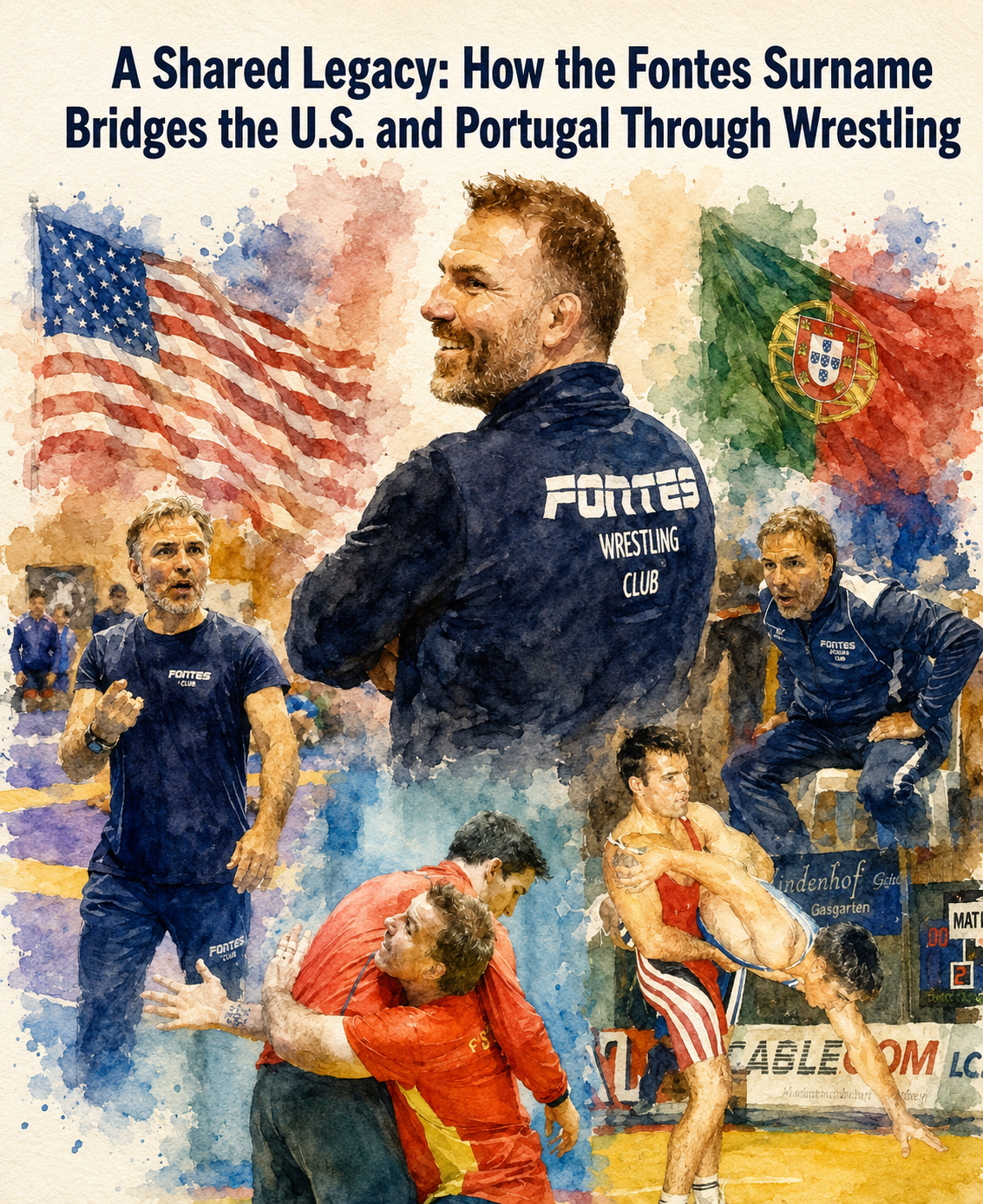

Wrestling has been a fundamental part of my life since the late 1970s. The sport’s rigorous discipline instilled unparalleled dedication and passion from the start. Its continuous challenges forge a unique universal bond among those I trained and competed with, a connection unlike any other athletic pursuit. This mutual respect is wrestling’s enduring hallmark, an aspect that has, over time, transcended geopolitical borders and cultural backgrounds to consolidate a single, global wrestling community.
A seemingly random conversation with my friend Pablo DiMaria about our Portuguese heritage led to a remarkable discovery. As we pondered whether Portugal had any Olympic or world medalists in wrestling, a lighthearted joke by Pablo—that a distant relative of mine might be the head coach—turned out to be almost true. My subsequent research confirmed that the National Technical Director of the Portuguese National Wrestling Federation is actually Luís Fontes. After reaching out via social media, I was able to connect with Luís by phone. We bonded over the uncanny coincidence of our shared surname and our mutual journeys in the sport, confirming a strong, shared passion for wrestling.
Making such timely connections is a testament to the dramatic advancement of global connectivity. Digital globalization, fueled by social media and mobile devices, enables instant, vast-distance communication, a change unimaginable a century ago. In my nearly fifty years in wrestling, information was once scarce and limited to print or rare televised NCAA events. By 2025, technology has revolutionized access, offering a comprehensive look at the entire sport world-wide with a single click.
Despite a promising wrestling career—including a top-six finish at the 1993 Espoir World Championships for Portugal and wins over several senior internationally ranked opponents—Luis’s Olympic dreams (Barcelona ’92, Atlanta ’96, Sydney ’00) were dashed by three separate accidents. Undeterred, his story is one of immense resilience; he transitioned his focus to coaching and mentoring, choosing to support the community that once supported him.
Luís, who holds a master’s degree in sports science and physical education teaching (Human Kinetics) from Universidade Técnica de Lisboa, has been a driving force in promoting Portuguese wrestling. He was appointed the women’s national coach in 2003 and has since been instrumental in efforts to improve the national Olympic wrestling legacy. Although Portugal’s Olympic wrestling history dates back to 1912 with athletes such as António Pereira and Joaquim Vital, the country has yet to earn a world or Olympic medal. Hugo Passos was the last wrestler to represent Portugal at the Olympics in 2004.
Coinciding with United World Wrestling (UWW) President Nenad Lalović’s drive to foster global growth (through technology adoption, youth participation increases, traditional style preservation, women’s wrestling advocacy, and international expansion), a 2018 initiative saw the Portuguese National Wrestling Federation join the Olympic Solidarity Development of National Sports System (DNSS) program. As a matter of course, Luis was named to the leadership position for this parallel effort.
As the National Technical Director of the Portuguese National Wrestling Federation since 2018, Luís has been dedicated to cultivating a new wave of talent nationwide, spanning freestyle, Greco, and women’s wrestling. His efforts extend to his Fontes Wrestling Club, established in 2023. According to Luís, the club’s achievements feature several victories in the Portuguese Cup and Super Cup, in addition to a second-place finish at the national team championships. He emphasized the comprehensive approach the club provides: “Having a club allows me to oversee the development of wrestlers from the grassroots level to high-performance levels, not only from a physical, technical, or tactical standpoint, but also from the perspective of European, World, and Olympic goals, making them believe that it’s possible!”
In addition to his coaching roles, Luís has also held a key position as UWW’s Regional Development Officer for Europe (2014-’17). In the latter role, he provided coaching training across Georgia, Bosnia and Herzegovina, Spain, Portugal, Bangladesh, Guinea-Bissau, and the Dominican Republic. He further implemented programs like “More Than Medals Europe” in Sweden and “More Than Medals World” in Borjomi, Georgia as well as conduct various national federation workshops.
Luís’ strategic efforts and dedication have clearly raised Portugal’s international athletic competitiveness, as demonstrated by the results in the European Championships (specifically Greco and women’s styles). This momentum makes the emergence of a future Olympic or world medalist appear very likely.
Outside the sport of wrestling, Luís leads a full life: he is married (wife Sara) with two daughters (Frederica, 8 and Francisca, 14) and resides in Costa de Caparica, Portugal just outside the capital of Lisbon. He also has a passion for surfing and has ridden waves at many beaches around the world, which include Venezuela, Brazil, Spain, and Italy. My new connection with Luís has been an honor, revealing how closely our paths mirror one another. Our shared surname and family backgrounds, along with a deep passion for wrestling forged from personal setbacks, show that a love for the sport can transcend continental divides. The extraordinary coincidence of our acquaintance continues to amaze me. Moving forward, I wish Luís the best in the future years to come and look forward to the day when a wrestler from Portugal first steps on the medal stand at the Olympics or World Championships. Boa sorte, meu amigo!
Photos courtesy of Luis Fontes.
Leave a Reply